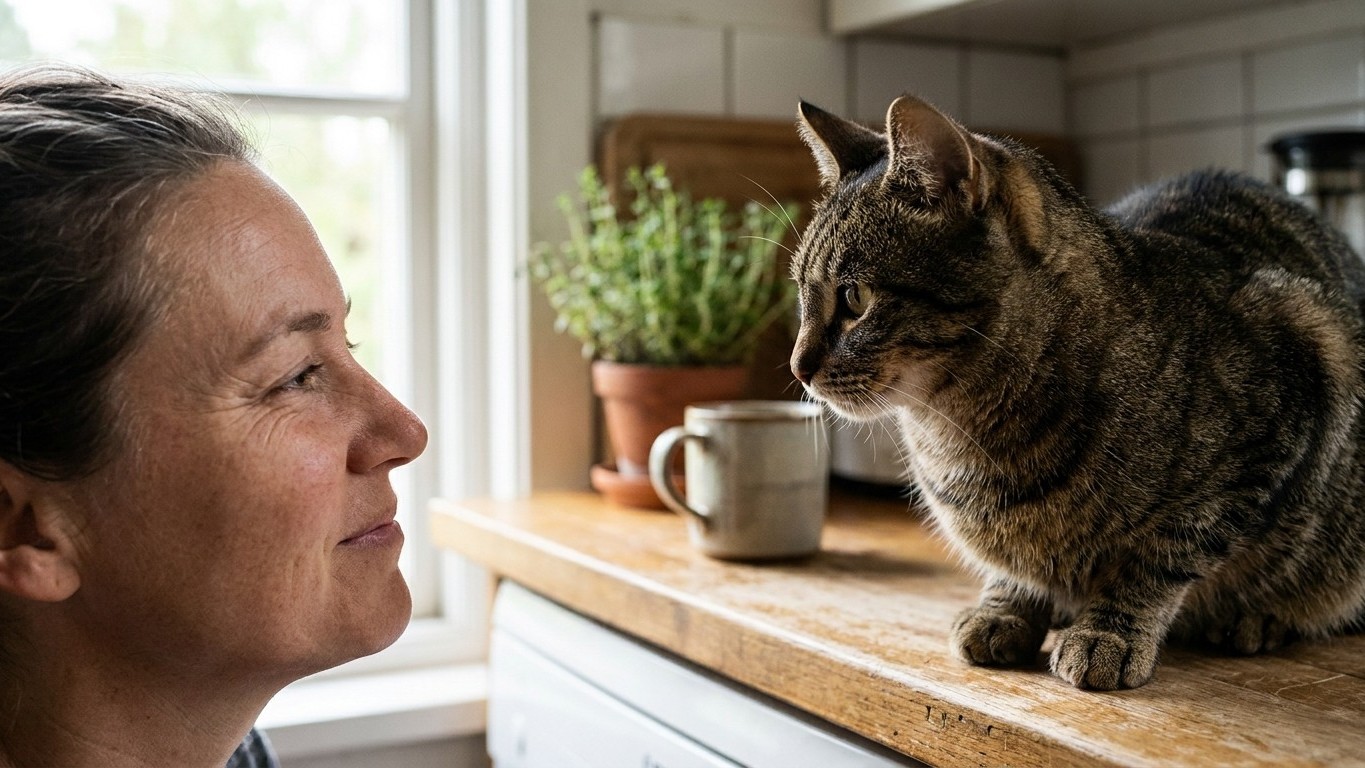
A slow blink did what years of meowing back never managed: it made my cat actually look at me like she understood something. When the behaviourist told me to stop trying to “speak cat” through sound and start speaking through my face instead, I felt faintly ridiculous. Then I tried it. My cat, Willow, who usually treats my meows with the same enthusiasm she reserves for the vacuum cleaner, blinked back. Slowly. Deliberately. It was the first proper conversation we’d ever had.
Here’s what I didn’t know: cats don’t meow at each other. Adult cats typically don’t meow to other cats; instead, they use their body language, like a twitch of the tail or a flattening of the ears, to communicate with other cats. Meowing is something they reserve almost entirely for us. In effect, I’d spent years replying to my cat in a language she’d invented specifically to manipulate humans, and my clumsy imitation simply didn’t compute as anything meaningful to her.
Key takeaways
- Adult cats don’t meow to communicate with each other—only with humans, and your attempts to speak their language might actually be meaningless noise to them
- A single slow blink from a stranger cat proved more effective than years of meowing, changing everything about how one owner understood her pet
- Researchers at the University of Sussex discovered slow-blinking isn’t folklore—it’s a replicable signal that even unfamiliar cats respond to by blinking back
Why your meow means nothing to your cat
Norwegian animal behaviour researcher Bjarne Braastad has studied this extensively, and his explanation is refreshingly blunt. Cat meows towards humans are largely leftover kitten vocalisations that adult cats have learned still get results with us specifically. When cats meow at humans, they’re using what were originally kitten sounds, and animals that live with humans tend to use their baby behaviour towards humans because they find that it works, but they don’t use the same behaviour towards other adult animals of their own species. Willow was never trying to have a chat with me in feline. She was doing what worked on the woman who feeds her, and my meow-backs were just noise that happened to occur near her.
The uncomfortable truth is that a cat can learn to tune us out entirely. If your cat meows spontaneously but does not reply to your sounds, they no longer see the point, because the cat has learned that your meowing is gibberish and does not result in a positive outcome for them. That stung a little. All those years of “conversation” and Willow had quietly concluded I was talking rubbish. Some breeds make this easier or harder to notice, mind you: some cats are quiet by nature due to their breed, with Siamese cats especially chatty, while others prefer to be quieter, speaking when spoken to, and sometimes not even then.
The slow blink: the signal that actually lands
This is where the behaviourist’s advice made sense, and where the real science gets rather lovely. A 2020 study from the University of Sussex, published in the journal Scientific Reports, tested whether narrowing your eyes and blinking slowly at a cat, essentially the feline equivalent of a warm smile, actually registers as friendly. Researchers ran two experiments: owners slow-blinked at 21 cats from 14 different households, sitting about a metre away and slow-blinking when the cat was looking at them. The results were clear. Cats are more likely to slow-blink at their humans after their humans have slow-blinked at them, compared to the no-interaction condition.
What surprised even the researchers was the second experiment, where complete strangers tried the same trick. They found that cats were more likely to blink back. Also, more likely to approach the human’s hand after the human blinked. Psychologist Karen McComb, who led the research, put it simply: “As someone who has both studied animal behaviour and is a cat owner, it’s great to be able to show that cats and humans can communicate in this way. It’s something that many cat owners had already suspected, so it’s exciting to have found evidence for it.” It’s not folklore, then. It’s a genuine, replicable signal, and it works on cats you’ve never met, not just your own.
Try it properly: soften your gaze as though you’re about to smile, narrow your eyes gently, then close them for a beat or two before opening again. No staring contests, no sudden movements. Willow now does this back at me across the kitchen most mornings, and it’s become far more reliable than any meow ever was.
Reading the rest of the conversation
Meowing isn’t entirely worthless, to be fair. It just carries less information than we assume. Certified cat Behaviourist Stephen Quandt notes that “repetitive meowing usually indicates that your cat wants something and they’re tasking you with providing it,” whether that’s food, play, or fuss. The pitch matters too: high-pitched meows tend to signal warmth, while a longer, insistent tone is closer to a demand. And if you ever hear a rolling, almost purring trill, take it as a compliment. “Trilling, which sounds like slightly high-pitched rolling Rs, is often done by mother cats towards their young. With humans, it’s a sign of affection,” Quandt explains.
None of this replaces watching the whole cat. Tail position, ear angle, whether she’s presenting her flank or her face, these tell you far more than any sound she makes. If your cat suddenly stops vocalising altogether after being a chatty sort her whole life, that’s worth a trip to the vet rather than a shrug, since it can occasionally point to pain, a respiratory issue, or a problem with the larynx rather than a simple change in mood.
The oddest part of this whole discovery is that the slow blink apparently works on lions and other big cats too, at least according to keepers who’ve tried it at a safe distance through enclosure glass. Whether that counts as bravery or madness, I’ll let you decide. Either way, next time your cat gazes at you from across the room, try softening your eyes and blinking slowly before you say a word. It might be the first time she actually understands you.
Sources : welovecatz.hu | medium.com