
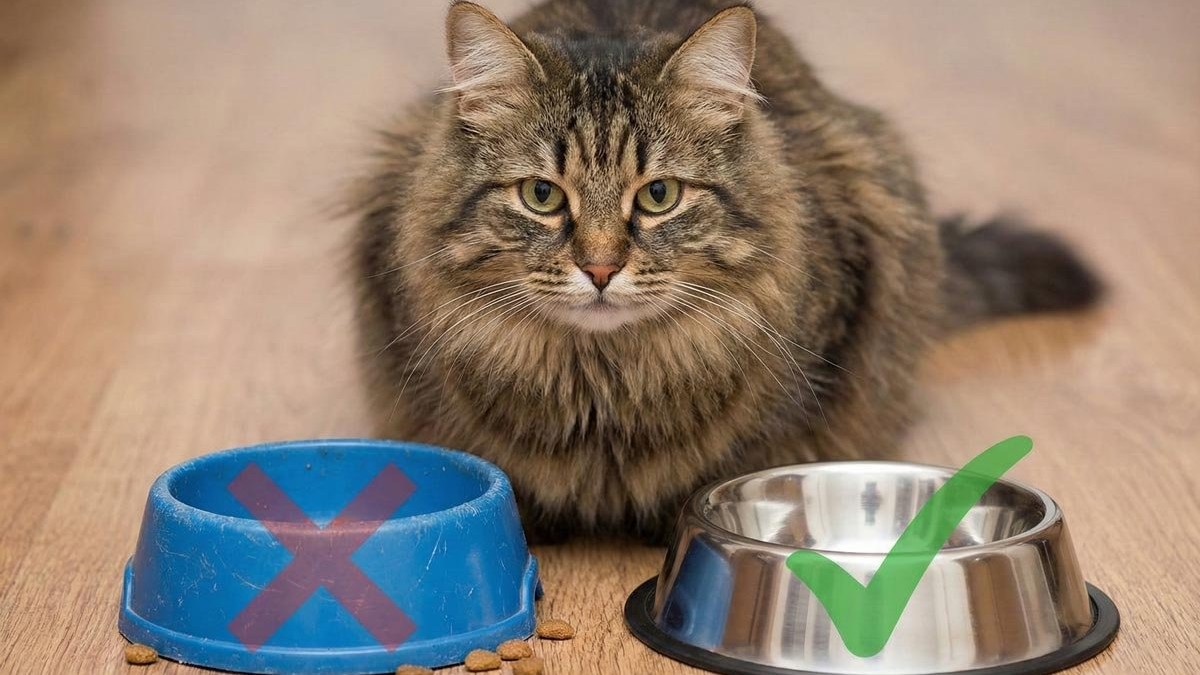
The average cat owner replaces their plastic food bowl roughly every few years. Or never. Most of us rinse it, give it a cursory scrub, and leave it back on the floor without a second thought. But look closely at that bowl, really closely, and what you’ll find living inside the scratches is enough to prompt an immediate trip to the recycling bin.
Key takeaways
- Microscopic scratches in plastic bowls create biofilm havens where dangerous bacteria like E. coli multiply invisibly
- Your cat’s chin acne and recurring health issues might trace back to one overlooked source: that old plastic dish
- Heat and washing accelerate plastic breakdown, releasing chemicals directly into your cat’s food and water
What’s actually growing in those scratches
To the naked eye, the bowl looks perfectly clean. Under a microscope, though, those scratches are like deep canyons where bacteria, mould, and saliva build up, forming a biofilm, a slimy layer of bacteria that is incredibly difficult to remove, even with hot soapy water or a run through the dishwasher. This isn’t just a theoretical concern. NSF International, a public health and safety organisation, found that pet bowls were the fourth germiest household item tested — ranking below only kitchen sponges, kitchen sinks, and toothbrush holders in terms of bacteria, yeast, and mould.
The combination of moisture, food particles, and saliva present in food and water bowls creates an ideal environment for bacterial overgrowth, which can present as a biofilm, a thin, slimy layer of bacteria and other materials that sticks to the bowl. The truly alarming part? Sometimes biofilms are visible, but they may also be completely transparent — feel the bottom of your cat’s water bowl after dumping out old water and check for any sliminess. If you’ve ever felt that slippery coating, that is a biofilm, and it means bacteria have been quietly multiplying between meals.
Harmful bacteria including E. coli and Staphylococcus can flourish in those scratches, leading to potential health issues for your cat. Biofilm bacteria have also been linked to systemic inflammation, cardiovascular disease, urinary tract infections, and chronic kidney disease in pets, particularly in cats. That’s a serious list of conditions to be risking over an old bowl.
The feline acne connection nobody talks about
Here’s something that surprises most cat owners: small black dots, red bumps, or dirty-looking patches on your cat’s chin are likely feline chin acne, a condition linked by animal health experts to poor hygiene and the use of plastic food bowls. Cat chin acne is a disease in which the hair follicles on a cat’s chin produce too much keratin and become plugged up, resulting in red bumps, blackheads, and infected pimple-like lesions.
Plastic bowls develop microscopic scratches and grooves that harbour bacteria, promoting biofilm formation on the surface where a cat’s chin contacts the bowl. These bacterial colonies thrive in the warm, moist environment, increasing the risk of folliculitis and chin acne. The mechanics are straightforward and rather grim: every time your cat lowers their head to eat, the chin grazes that bacteria-filled surface.
Cat acne can be a one-and-done experience for some cats, or a long-standing, chronic problem lasting months or years for others. Cat chin acne does become painful if it reaches the point where lesions swell and scab, at which stage, more aggressive treatment is required. If you notice black specks or bumps forming on your cat’s chin, stop using plastic bowls immediately and consult your vet. Treatment typically begins with switching any plastic food or water bowls out immediately for stainless steel — and that change alone, along with supportive care, may be all that is needed.
The chemical problem hiding beneath the surface
Bacteria aside, there’s a second reason to be concerned about ageing plastic bowls. Exposure to heat, sunlight, and repeated washing causes plastic to break down, releasing chemicals like BPA (bisphenol A) and phthalates that can leach into food and water, potentially disrupting a cat’s endocrine system. Bowls made of plastic containing BPA and phthalates should be avoided, as these chemicals are known to cause serious health concerns in humans including disruptions in endocrine function, changes in the nervous system, and altered reproductive physiology, and similar effects are suspected in companion animals, though research remains limited.
The degradation of plastic bowls accelerates over time: scratches, cracks, and wear from cleaning create crevices where bacteria thrive and chemicals leach more readily. The irony is that washing the bowl, the very act meant to keep it clean, can speed up this chemical breakdown when done with hot water or in a dishwasher. High temperatures can actually cause plastic chemicals to leach more readily. So the diligent cat owner who runs their plastic bowl through a hot dishwasher daily may inadvertently be making things worse.
A plastic bowl that looks well-used, with that network of fine scratches and a slightly dull surface, is in the worst possible state: even frequent and thorough cleaning cannot get all bacteria out, because plastic bowls develop tiny cracks and scratches that are impossible to fully sanitise, bacteria can remain inside these tiny crevices even after the surface appears clean.
What to use instead, and how to keep it clean
Texas A&M College of Veterinary Medicine & Biomedical Sciences advises that “plastic food dishes tend to harbour microbes, so we recommend that owners switch to metallic dishes and clean them daily.” Stainless steel is non-porous, easy to clean, and resistant to bacterial growth, making it ideal for both food and water. Ceramic is a good option too, though ceramic bowls should be checked for lead-free glazing to avoid another set of potential toxins. Glass works well for calm cats, but the risk of breakage makes it impractical in a busy household.
Switching materials is only half the battle. Food bowls should be washed after every meal, and water bowls at least once a day. According to a Petco survey, 20% of pet parents clean their pet bowls only once per month, which is nowhere near often enough. For those feeding wet food, the bar is higher still: wet food bowls should be cleaned after every single meal, as bacteria multiply rapidly in moist environments and leaving remnants creates a bacterial breeding ground.
Don’t overlook water fountains either. Pet water fountains can also harbour biofilm, so they need cleaning daily as well. Ensure filters are changed regularly and the pump is fully disassembled for cleaning, as slime buildup is a common trigger for chin acne flare-ups. Owning two or three stainless steel bowls and rotating them makes daily washing much less of a chore, one goes into the dishwasher while the other is in use.
One final detail worth knowing: your cat’s sense of smell is roughly twenty times stronger than yours, and a bad smell from a biofilm-coated bowl can actually deter them from eating. What looks to you like an indifferent cat ignoring their dinner may simply be a cat refusing to eat from a bowl that smells, to them, absolutely foul. Clean dishes don’t just protect health, they may solve a mystery that’s had you reaching for a new flavour of cat food for months.
Sources : catknowy.com | alibaba.com