
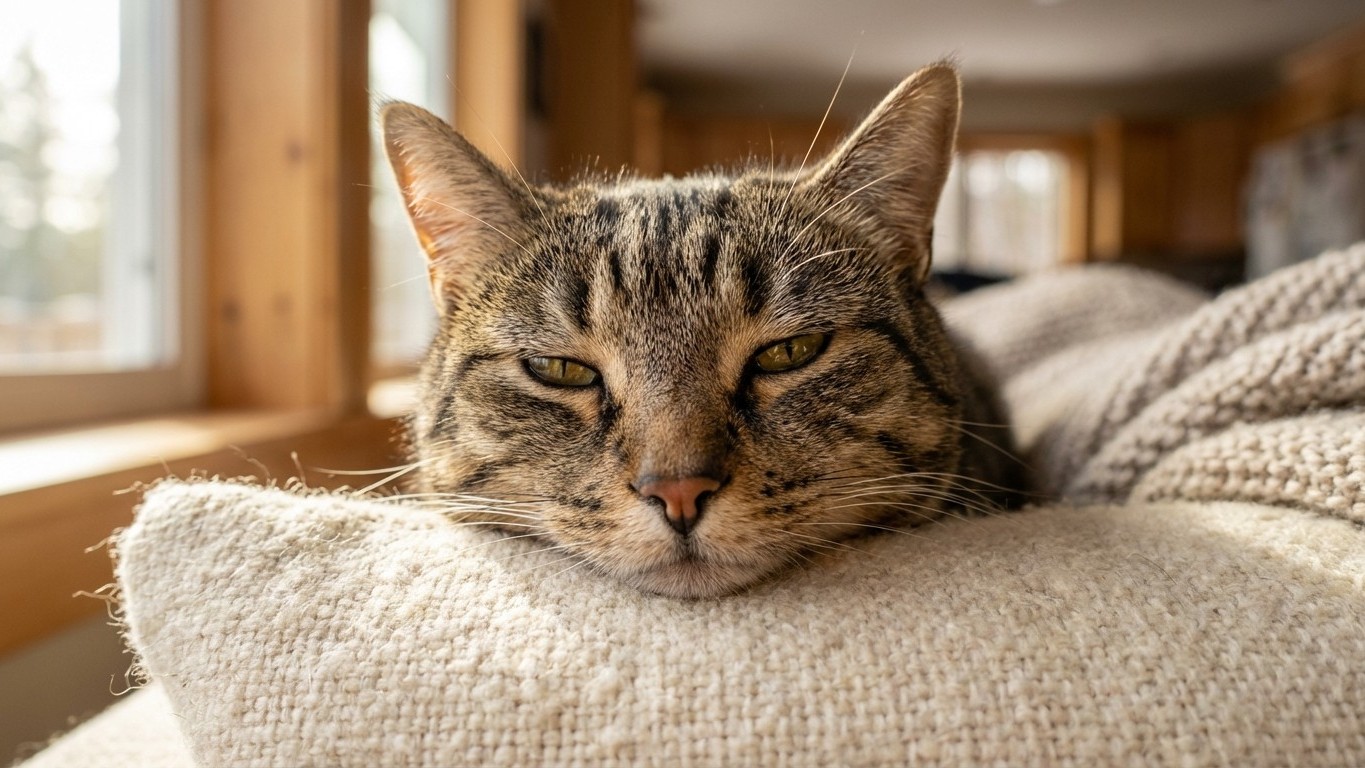
You’re curled up on the sofa, your cat draped across your lap, that deep rumbling vibration filling the room. Bliss. But what if that soft, rhythmic sound isn’t always the serenade of contentment you’ve always assumed it was? Scientists and vets have known for years that a cat’s purr is far more layered than most owners realise, and one particular type is so cleverly disguised as happiness that it regularly fools even the most devoted cat lovers.
Key takeaways
- Cats hide pain so well they could be suffering right in front of you—and still purr
- The vibrations in a purr actually help cats self-soothe when they’re in distress
- A seemingly happy purr combined with behavior changes is your biggest red flag
Not all purrs are created equal
Researchers have identified various types of purrs that cats use in different contexts. The one most of us are familiar with, the slow, low, even rumble of a cat blissed out on a warm radiator — is the contentment purr. This steady, rhythmic sound typically occurs when your cat is relaxed, comfortable, and happy, often during petting or while settled in their favourite spot.
Then there’s the one that should make you pause. The “solicitation purr” is a mix of a purr, a cry, and a meow, a vocalization that occurs at a similar frequency to a baby’s cry and is designed to get a pet owner’s attention. Research from the University of Sussex, published in the journal Current Biology, revealed something rather startling about it. The crucial factor determining whether a purr sounds urgent or pleasant is an unusual high-frequency element, reminiscent of a cry or meow, embedded within the naturally low-pitched purr. When scientists stripped that element out while keeping Everything else the same, the urgency ratings for those purrs decreased significantly.
By employing such an embedded “cry”, cats appear to be exploiting innate tendencies that humans have for nurturing offspring, subtly burying their “feed me” messages in an otherwise pleasant purr. Devious? Absolutely. But also rather brilliant. The really sobering bit is that when both types of purrs were played at the same volume, nearly everyone, whether or not they owned a cat, found the solicitation purrs significantly more urgent and less pleasant; though the difference in reaction was stronger in those who had a cat. We’ve been trained by our cats without ever noticing.
Not every cat uses solicitation purring, it seems to develop most often in cats that have a one-on-one relationship with their owner, and typically occurs at anti-social hours, such as first thing in the morning. Sound familiar?
When the purr becomes a cry for help
Here’s where things shift from charming to genuinely important. Cats can purr when they are healthy and feeling good, but they can also purr when they are sick or in pain, and by purring, the cat may be asking for care. Yes, cats in pain will still purr. Even though cats also purr when they’re content, purring can be a sign that a cat has severe pain.
The mechanism behind this is thought to be self-soothing. The vibrations produced during purring occur at a frequency of 25 to 150 Hertz, which has been shown to promote healing and tissue regeneration, and is known to positively affect bone density and tendon and muscle repair. So a cat in distress may purr precisely because it helps them cope, not because they’re fine. Purring may actually increase in a cat experiencing pain, which makes this one of the most counter-intuitive signals in the animal world. A louder, more insistent purr from an otherwise quiet cat deserves a second look, not a reassuring stroke and a cup of tea.
Cats are renowned for their ability to mask pain and discomfort, they do it so well that they could be in excruciating pain Without You Knowing it, even if you’re the person closest to them. This is a survival instinct rooted in the wild, where showing weakness invites predators. The domestic sofa hasn’t entirely overridden millions of years of hard wiring.
Reading the full picture: what to look for
The purr itself cannot tell you Everything. When a cat is purring, look at their body language and the situation to determine why. A pain-related purr rarely comes alone. Pain-related purring may be accompanied by withdrawal, hiding, or other signs of discomfort. One of the first signs that a cat is in pain is if they begin to hide, under the bed, behind furniture, or anywhere they feel unseen.
Other red flags worth watching alongside an unusual purr include changes in mobility, cats might become less active and sleep more hours than they used to, or stiff, arthritic cats may be reluctant to jump onto high surfaces like they did before. Changes in grooming habits are also telling: pain or illness can stop a cat from grooming themselves, as they may feel too tired or uncomfortable to do so. A change in the character of vocalisation, frequency, or volume may also be an indication of pain.
If your cat is in pain or has a respiratory issue, they may find it hard to breathe. They may still purr to reassure themselves, but the purring will be more rapid and short. Any breathing difficulty with changes in your cat’s purring is a reason to get them checked by your vet.
The golden rule, repeated by vets consistently: if a cat is purring but refuses to engage, play, or move, assume they are in pain, not happy, and never let the sound of a purr delay your trip to the vet. If you notice a change in your cat’s behaviour combined with unusual purring, this could be a sign that your cat is in pain and should see a veterinarian.
Your cat’s secret language, and why it matters
There’s something deeply moving about all of this. A small animal, evolutionarily wired to conceal weakness, quietly vibrating away in your lap as a way of managing pain it cannot otherwise express. Sometimes, cats purr to communicate vulnerability or distress subtly, especially when they don’t want to attract attention or cause alarm. They’re not deceiving us, they’re doing the best they can with the tools they have.
The practical takeaway is simple but transformative: learn your cat’s baseline. Cats are particularly good at hiding signs of pain, and the signs are sometimes subtle and easy to miss, but chances are you know your cat’s “normal” routine, their attitude, energy level, appetite, thirst, and sleep pattern. Deviation from that baseline, combined with any change in purring pattern, is your signal to act. If your cat’s purring feels unusual or is accompanied by changes in behaviour, contact your vet — they can help determine whether purring is a sign of comfort, stress, or illness.
There’s a version of attentive cat ownership where you know not just that your cat is purring, but how they’re purring. Whether it’s the slow, melting contentment of a cat truly at peace, the urgent embedded cry of a cat angling for breakfast at 5am, or a quiet, persistent hum from a cat curled somewhere unfamiliar, each tells a different story. The question is whether we’re actually listening.
Sources : whyevolutionistrue.com | aaha.org