
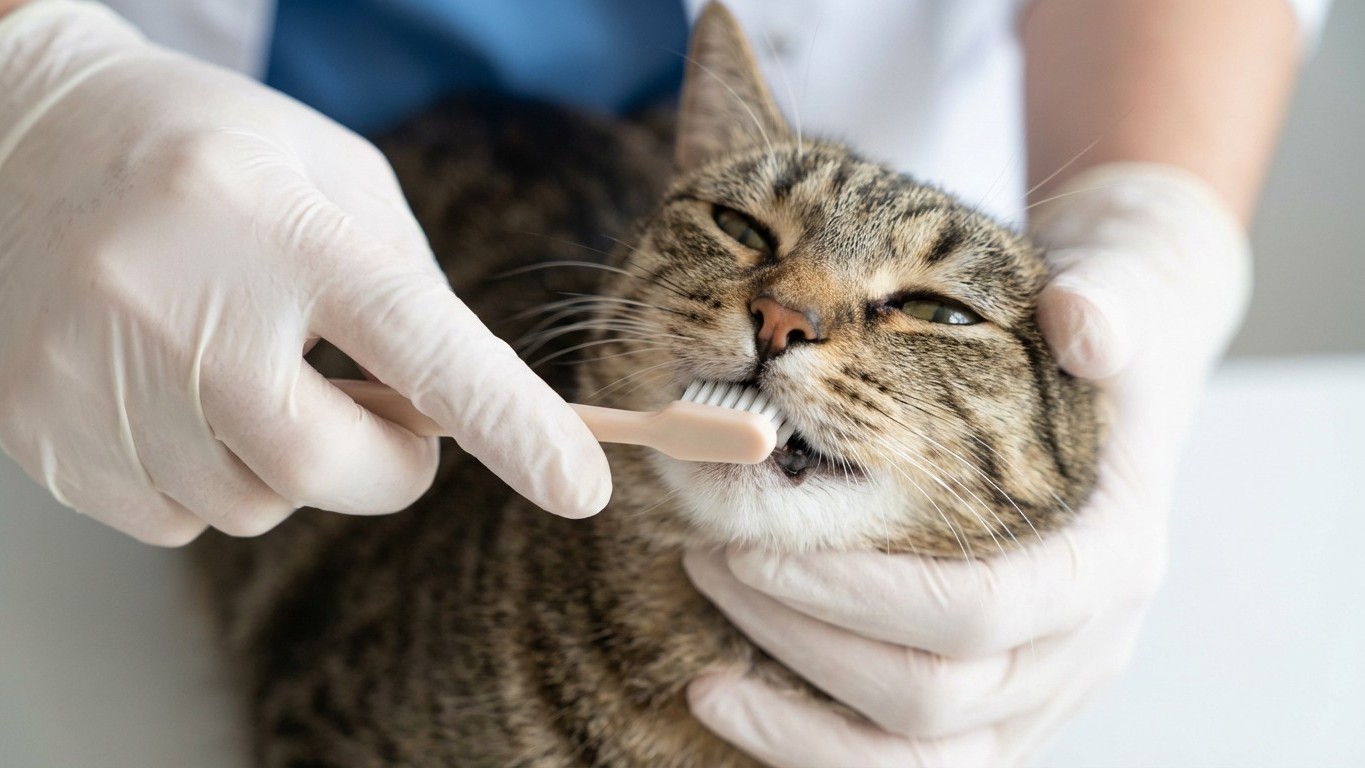
Most cat owners who Actually bother to brush their pet’s teeth deserve genuine credit, because the vast majority never do it at all. But here’s the uncomfortable truth: good intentions paired with the wrong technique can still cause real damage to your cat’s gums. The direction, angle, pressure, and motion of the brush all matter far more than most people realise, and getting it wrong consistently is just as problematic as not brushing at all.
Key takeaways
- The horizontal scrubbing motion you use on your own teeth is damaging your cat’s gums
- Aggressive brushing causes the same inflammation as the bacterial infection vets are increasingly diagnosing
- Vets say most dental damage in cats happens on surfaces owners don’t even need to brush
The Scale of the Problem
By two years of age, 70% of cats have some form of periodontal disease, yet it’s estimated that 73% of cat owners never brush their cat’s teeth. That’s a striking number, and it means the small minority of owners who do reach for a toothbrush are carrying a disproportionate responsibility to do it right. The trouble is, most people apply the same broad, back-and-forth scrubbing motion they’d use on their own teeth, and that is where things start to go wrong for feline mouths.
Roughly 50% to 80% of all cats over the age of four have periodontal disease. It is an infection of the tissues surrounding the teeth, starting as gingivitis caused by plaque coming into contact with the gums. If plaque is not removed through regular brushing, it thickens and mineralises, resulting in tartar. Left untreated, gingivitis may progress to destructive periodontal disease, which may be painful and ultimately lead to tooth loss. The stakes, are genuinely high.
Why Direction and Angle Are Everything
Think of a cat’s gum line as the frontline of a slow-moving battle. The moment you start scrubbing horizontally across the teeth, you’re driving plaque and bacteria sideways, not away from where the damage Actually starts. The bristles should be placed at a 45-degree angle to the teeth, aiming for the narrow crevice between teeth and gums. That gap, called the gingival margin, is where plaque quietly accumulates and where gingivitis first takes hold.
Gently rubbing along the area where the gum tissue touches the tooth surface (the gingival margin) is key, because this is the region where plaque accumulates and gingivitis is initiated. A circular motion is what vets and dental specialists consistently recommend, not the long horizontal strokes that feel intuitive. Use a circular motion and focus on your cat’s gum line, initially concentrating on the outside surfaces of their teeth, under the lips.
Applying too much pressure is the other common error. Whatever type of toothbrush you use, be gentle and go slowly, as it is easy to accidentally poke the tip of the toothbrush against the gums and cause some irritation. Aggressive brushing Doesn’t just feel unpleasant for your cat, it physically traumatises the delicate gum tissue over time. And because symptoms of gingivitis and other forms of gum disease can be subtle to cat owners, as cats often hide pain and discomfort, you may not realise you’ve been causing harm until a vet notices the inflammation at a check-up.
There’s also the question of where you focus your efforts. Most periodontal damage occurs on the outer surfaces of the teeth and around the roots; this is where you should direct your efforts. You don’t need to wrestle your cat’s mouth wide open to scrub the inner surfaces. The cat’s abrasive tongue tends to remove plaque from the inner surfaces of the teeth, reducing the need for brushing these surfaces. Knowing this alone can transform a stressful, chaotic brushing attempt into something far more manageable.
What Happens When Brushing Is Done Wrong (or Not at All)
Without daily brushing, plaque quickly builds and eventually mineralises over 36–48 hours, forming hard tartar. Once tartar sets in, no amount of home brushing will shift it. Disease-causing bacteria that accumulate on and below the gums produce substances that damage the cells that form a barrier between the gums and the teeth. This is the mechanism behind the gum damage vets are increasingly seeing in cats who’ve been brushed incorrectly but regularly, because repeated trauma to the gingival margin (through aggressive or misdirected brushing) causes a different kind of inflammation to the bacterial kind, and the two can compound each other nastily.
Unbrushed teeth tend to become infected and may loosen and fall out. This is painful and unhealthy, and the bacteria in dental disease can affect the whole body, especially the kidneys, heart, lungs and liver. The mouth, as vets often say, is not a closed system. A poorly maintained set of teeth can quietly undermine organ health over years, which is exactly why technique matters as much as frequency.
Getting It Right: A Practical Approach
The good news is that the correct technique isn’t complicated once you understand the logic behind it. Start by choosing the right tools. It is preferable to use a brush where the bristles can reach just below the gumline at the tooth/gum interface. A child’s soft toothbrush works well, as does a purpose-made feline toothbrush. What doesn’t work is a standard adult human brush, which is too large and too stiff for a cat’s small mouth.
Never use human toothpaste. Human toothpaste can be toxic to cats. Cat-specific toothpaste comes in flavours like chicken, fish, and beef, which makes the whole experience considerably more appealing from your cat’s perspective. Concentrate on brushing the large cheek teeth and the canine teeth first, as these are where plaque and tartar accumulate most quickly.
The process involves starting with the back teeth and moving in small, circular motions. Begin with just ten seconds on each side, gradually building up to 30 seconds on each side. Frequency matters enormously. Daily brushing is most beneficial and will help to establish a routine. Brushing three times a week is the minimum recommendation to help remove plaque and prevent tartar accumulation.
If your cat has never been brushed before and their gums already look red, swollen, or bleed at the slightest touch, don’t push through regardless. If a cat has severe gingivitis, tooth brushing can be quite painful, so consult with a veterinarian before considering brushing the teeth of a cat with gingivitis. A professional scale and polish under anaesthetic may be needed first, clearing the slate before home care can be effective. If your cat shows signs of pain, or their gums look sore or bleed when you are brushing, stop the process and speak to your vet for further advice.
For cats who flatly refuse a brush, wipes are often better tolerated than brushing and are a good option to help remove plaque. Dental chews, water additives, and prescription dental diets can all provide supplementary support, though none replaces the mechanical action of bristles at the gum line. The Veterinary Oral Health Council (VOHC) independently reviews and accredits dental products for pets, and checking their list before buying is a good habit.
Ultimately, the question worth sitting with is this: if the majority of cats over four already have some form of gum disease, and most owners aren’t brushing at all, what might be quietly happening in the mouths of cats who are being brushed, but wrongly? The answer is that technique is the hidden variable nobody talks about. Getting a quick demonstration from your vet nurse during a routine appointment could be one of the most valuable ten minutes you spend on your cat’s health this year.
Sources : chewy.com | vetster.com