
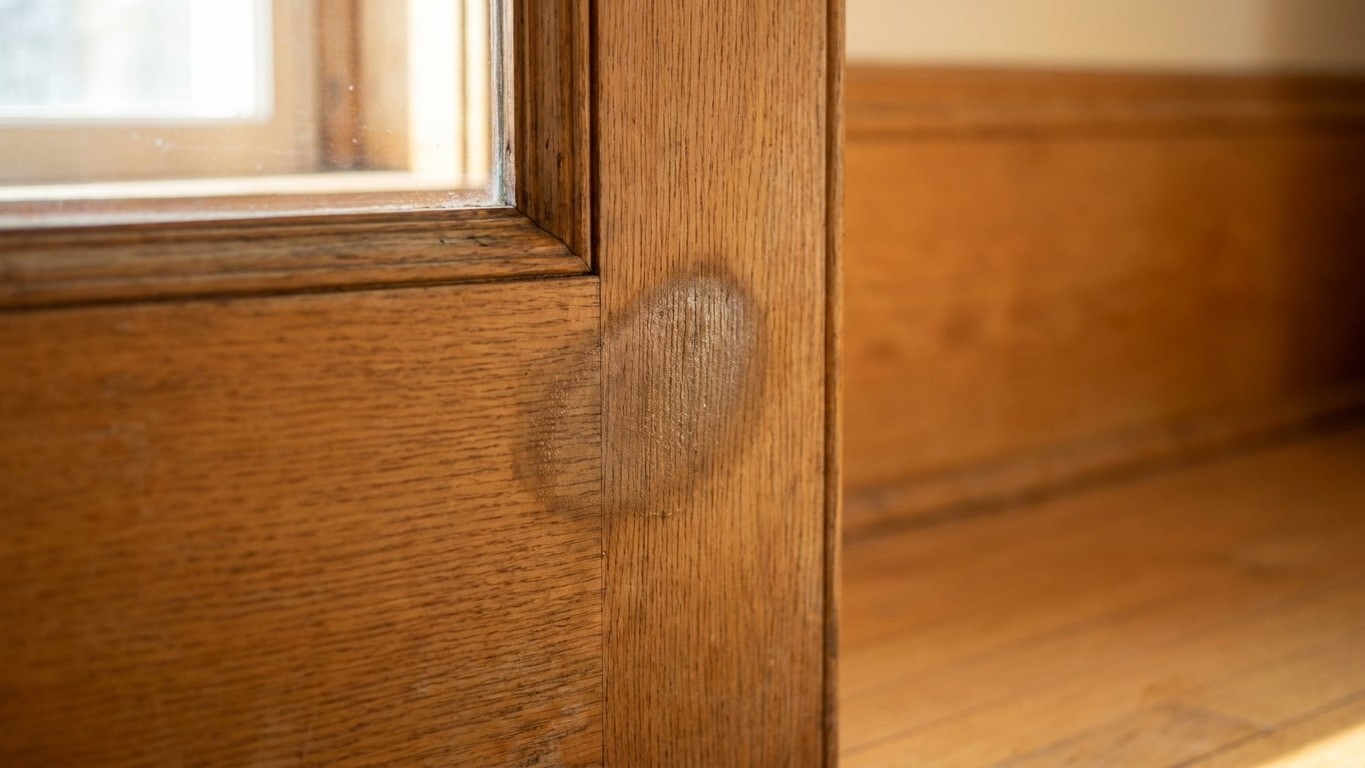
That dark, slightly sticky smudge around your door frame at cat height isn’t dirt, and it isn’t grime from your own hands either. It’s sebum, an oily secretion loaded with pheromones that your cat deliberately deposits every time she rubs her face against that particular spot. Cats mark territories by rubbing their face on objects and depositing a layer of sebum laced with feline facial pheromones, and sebum is a mixture of fatty acids. Scrub it away and it comes back within days, because your cat is essentially rewriting her diary on your woodwork, over and over again.
The behaviour has a proper name: bunting. Specific scent rubbing behaviours include bunting, in which an animal butts the front of its head against an object or individual. Using the scent glands located on the head and around the mouth, cats will frequently rub against protruding objects in their territory, including doorways, table legs, chair edges and even the corners of a box or book. Door frames are prime real estate for this because cats choose edges to rub against as these tend to be more prominent points, and the corners allow them to apply more pressure to the glandular skin. Nothing sinister about it. Quite the opposite, really.
Key takeaways
- Cats deliberately deposit sebum-based pheromones on door frames through ‘bunting’—a behavior that looks like rubbing but is actually territory marking and bonding
- A consistent greasy mark proves your cat feels physically comfortable and emotionally secure enough to patrol and claim her territory
- When the mark vanishes without explanation, it often signals pain, illness, stress, or cognitive decline that your cat is hiding from you
Why your cat is leaving chemical love notes on your woodwork
Those glands aren’t producing random goo. The cheek and perioral gland areas consist of several structures that secrete pheromones around the chin, cheeks, and lips, alongside temporal glands on the sides of the forehead and the circumoral gland around the lips. Scientists have actually catalogued five distinct feline facial pheromones, labelled F1 through F5, identified from the chin, lip, and cheek sebaceous secretions. Unlike the urine spraying that signals “keep out”, face rubbing carries a gentler message. Cats will often leave neutral or comforting pheromones behind by rubbing their face and head on surfaces, and although these chemicals do impart some territorial markers, they are associated with feelings of comfort and calm.
There’s a bonding element too. Cats that live together often develop a communal scent which helps them recognise and bond with each other, and this is why close companions frequently rub against one another, a behaviour known as allogrooming that reinforces social bonds. When your cat headbutts your ankle before headbutting the door frame, she’s blending you into the same familiar smell as her favourite scratching post and the cat flap. Given that a cat’s nose has about 200 million scent receptors compared to our mere 5 million, this whole invisible network of smells is a far richer language than we’ll ever fully appreciate. What starts as an odourless dab of oil, invisible to us, eventually builds into the visible smudge we’re forever wiping off, because as one feline behaviour writer put it, “what starts out as an invisible chemical sticky note eventually becomes an oily, dirty billboard.”
So why should the mark disappearing worry anyone?
Here’s the bit most cat owners never think about: consistent bunting is a sign of a cat who feels settled, mobile and comfortable enough to patrol and personalise her territory. When that behaviour quietly stops, and the door frame stays suspiciously clean, it’s rarely because your cat has simply lost interest in interior decorating. Behaviour changes in cats are often one of the earliest signs that something is wrong, including pain, stress, anxiety, cognitive decline, or medical illness, and sudden changes such as reduced interaction should prompt a veterinary visit.
Grooming and rubbing both demand a level of physical comfort that illness quietly erodes. Cats are usually fastidious creatures, and if they aren’t taking care of their fur this may be a sign that something is wrong, since a tangled and dirty coat usually means they are too tired or uncomfortable to tend it; arthritic or injured cats may lack the mobility to groom themselves. The same logic applies squarely to face rubbing. It requires a cat to stretch her neck, lean her weight against a fixed object and hold that position, which is exactly the sort of movement an arthritic hip, a sore jaw or early dental disease can make unappealing. Vets frequently describe cats as expert concealers of discomfort, and since cats are masters of disguise and like to hide their symptoms, it can be tricky to work out the answer to whether something’s wrong. A vanishing greasy mark might be one of the few honest clues you get before more obvious symptoms appear.
Stress and territorial insecurity can shut the behaviour down too. It seems that cats are soothed by the presence of their own pheromones, and cats that live indoors without sufficient access to social and environmental enrichment may experience stress that manifests as marking changes. A cat who no longer feels her home is worth claiming, perhaps after a house move, a new pet, or a falling-out with another cat in the household, may stop bunting simply because the emotional payoff has gone. Anxiety and physical discomfort often travel together in cats, which is precisely why vets tend to investigate medical causes before assuming a behaviour problem, since the same outward sign can come from very different problems.
What to actually watch for besides the mark itself
One disappearing smudge on its own isn’t a five-alarm emergency; cats have quiet weeks, and marking habits do fluctuate. But treat it as worth a second look if it coincides with any of the following:
- Reduced or patchy grooming, leaving the coat looking dull, greasy or matted
- Reluctance to jump, stretch or reach up, which can point to joint pain
- Hiding more than usual, or a noticeable drop in affectionate head-butting generally
- Changes in appetite, thirst or litter tray habits
None of these should be diagnosed at home, and none of them replace a proper veterinary examination. If your cat has gone quiet on the bunting front alongside any of the signs above, a vet visit is the sensible next step rather than a wait-and-see approach, particularly for older cats where arthritis and cognitive changes creep in gradually. Next time you’re reaching for the kitchen spray to attack that greasy smudge, spare it a second’s thought first. That grubby little mark is proof your cat is still confidently, physically claiming her patch of the world, one headbutt at a time. It’s only when the wall stays suspiciously clean that the real questions should start.
Sources : aol.com | loveyourcat.com