
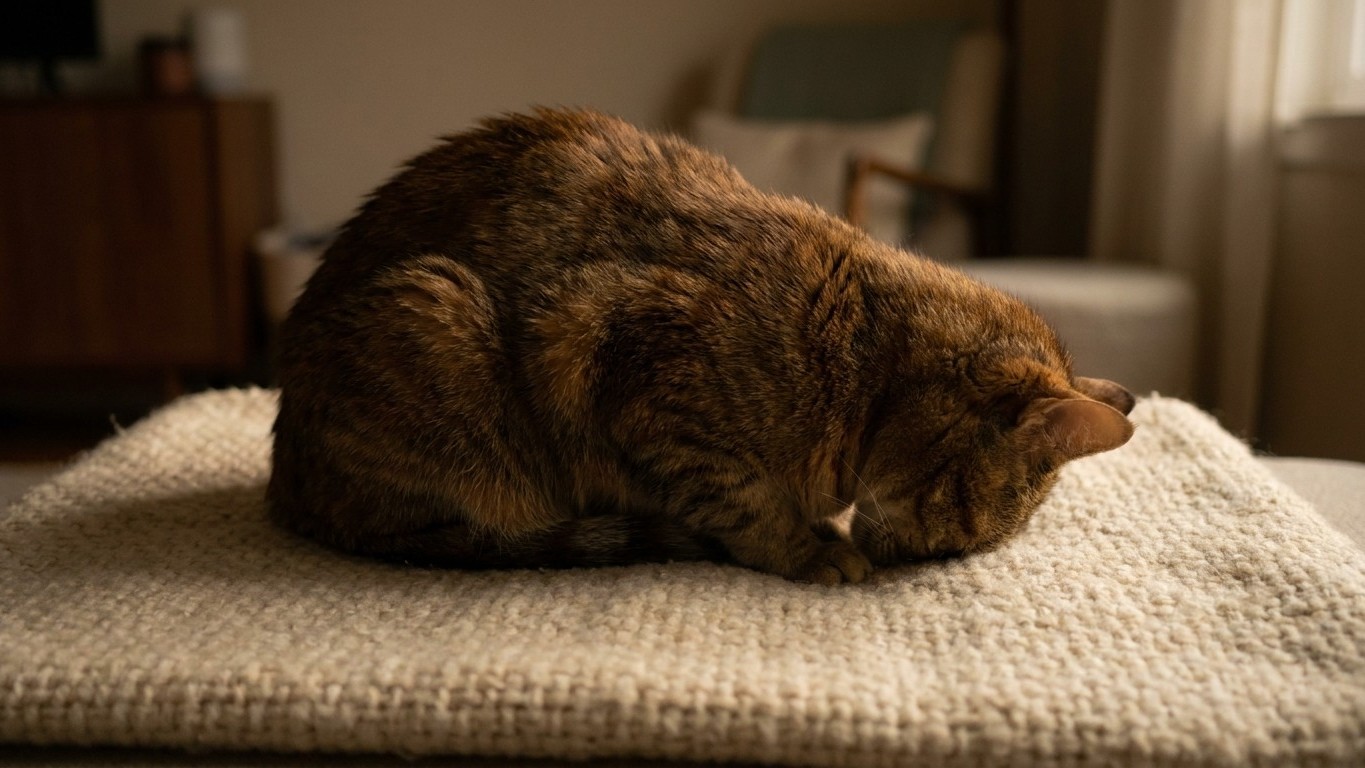
That rumble radiating from a tightly curled senior cat every evening isn’t a lullaby of contentment. It can just as easily be the sound of a body coping with discomfort, and the tight coil she folds herself into is often less about cosiness than about survival instincts that predate the sofa she’s sleeping on.
Purring gets a soft-focus reputation it doesn’t fully deserve. Yes, kittens purr against their mother within days of birth, and yes, a cat sprawled in a sunbeam purring away is usually a picture of bliss. But research suggests that cats may also purr when they are in pain or under stress, and the frequency of a cat’s purr, ranging from 25 to 150 Hz, is believed to have therapeutic properties, with studies showing these frequencies can promote bone healing, muscle repair, and pain relief. that motor isn’t just an emotional broadcast, it’s closer to a built-in physiotherapy session your cat runs on herself.
Key takeaways
- Cats purr when they’re in pain or distress, not just when happy—it’s a self-soothing mechanism like human humming
- Over 90% of cats over 12 have osteoarthritis, yet 99% of cases go undiagnosed because cats hide pain differently than dogs do
- A tightly hunched curl paired with reduced jumping, grooming changes, or litter tray accidents could signal serious joint disease
A purr can be a coping mechanism, not a compliment
Vets who’ve spent years with paws on examination tables will tell you the same unsettling thing: cats purr when they’re injured, ill, or in pain, and a cat with a broken leg purrs, a cat with an infected wound purrs, a dying cat purrs. That’s not a contradiction of the “happy cat” purr, it’s simply proof the sound has more than one job. Purring is not just a sign of a cat’s happiness; cats also purr when they’re in pain or distress, and many experts believe purring is a form of self-soothing that helps cats calm down and reduce stress levels. Think of it as the feline equivalent of humming to yourself in a waiting room, except her waiting room might be an arthritic hip flaring up after a chilly afternoon.
There’s a genuinely interesting evolutionary angle here too. Purring is a self-soothing mechanism similar to a human nervously humming or rocking, and a “pain purr” is usually accompanied by a hunched posture, hiding, or lethargy. So if your old girl’s evening purr comes bundled with a tucked head, stiffness on standing, or reluctance to be stroked along her back, that’s context worth clocking rather than dismissing as quirky charm.
Why the tight ball matters more as cats age
The posture itself carries information too. The classic curl minimises the surface area exposed to cool air and traps body heat, while also tucking the belly and throat away, so it doubles as a lightly protective position. Cats run warmer than we do, and because they have a higher core body temperature than humans, they need to work harder to stay warm, which is why curling into a ball conserves body heat. On a cool British evening, a loose, gently curved cat is probably just chasing warmth.
But there’s a meaningful difference between a relaxed crescent and the rigid, compact ball an older cat retreats into every single night without fail. When a cat feels unwell or is in pain, it may curl up in a tighter, more hunched, more withdrawn way than usual, and far more often, since cats instinctively hide pain and illness as a leftover survival strategy from a time when showing weakness invited predators. A sore spine or an aching hip gets protected by pulling Everything inward, chin to tail, paws hidden. It looks adorable. It can also be a cat quietly bracing herself.
The arthritis nobody notices
This is where the numbers become genuinely startling. Cats are masters at hiding their pain, making osteoarthritis a grossly underdiagnosed condition that affects up to 90% of cats over 12 years old, yet remains less acknowledged due to its subtle clinical signs. A landmark study cited by North Carolina State University’s pain research centre found that over 90% of cats show radiographic evidence of degenerative joint disease as they age, although not every cat with joint changes shows obvious signs of pain. Even in cats as young as six, the picture isn’t much better: a 2011 study found that 61% of cats ages six years and older had X-ray evidence of osteoarthritis in at least one joint, and 48% were affected in more than one joint.
What’s most damning isn’t the prevalence, it’s the blind spot around it. A recent study covered by veterinary news outlets found that implementation of a validated screening checklist increased osteoarthritis identification from 1% to 39% in general practice, exposing just how many painful cats have been sent home undiagnosed for years. Part of the problem is us, frankly. We wait for limping, and cats simply don’t limp the way dogs do. The clinical signs of feline osteoarthritis are vastly different due to cats’ ability to mask injury, and while limping or stiffness typically point to arthritis in dogs, these signs seem considerably less common in cats.
What to actually watch for
Rather than fixating on one evening ritual, look at the whole pattern. Vets flag a handful of quiet giveaways worth tracking over a week or two:
- Reduced or patchy grooming, especially around the lower back and tail base
- Hesitation or refusal to jump onto favourite high spots
- Changes in litter tray posture, or accidents near (but not in) the tray
- Increased time spent hiding or sleeping in unusual, out-of-the-way corners
- A dislike of being stroked or picked up in ways she previously tolerated
A senior cat that suddenly stops jumping onto the couch, the bed or the kitchen counter is very often dealing with joint pain, not simply losing interest in those spots, because jumping puts sudden, concentrated force through the elbows, hips, and knees. If your cat’s evening curl has always looked exactly the same, that’s less concerning than a curl that’s grown noticeably tighter, more hunched, or paired with any of the signs above.
None of this means every tightly curled senior cat is suffering. Plenty simply prefer a snug spot and a good purr because it feels lovely, full stop. But given how effectively cats disguise pain, and how common joint disease becomes with age, a proper vet check with a hands-on joint assessment (and X-rays if warranted) costs you an afternoon and could spare her months of unnecessary discomfort. Pain relief options for feline arthritis have genuinely improved in recent years, and an old cat who finally gets comfortable again tends to show it in ways far more obvious than a nightly purr ever could.
Sources : catsily.com | iere.org