
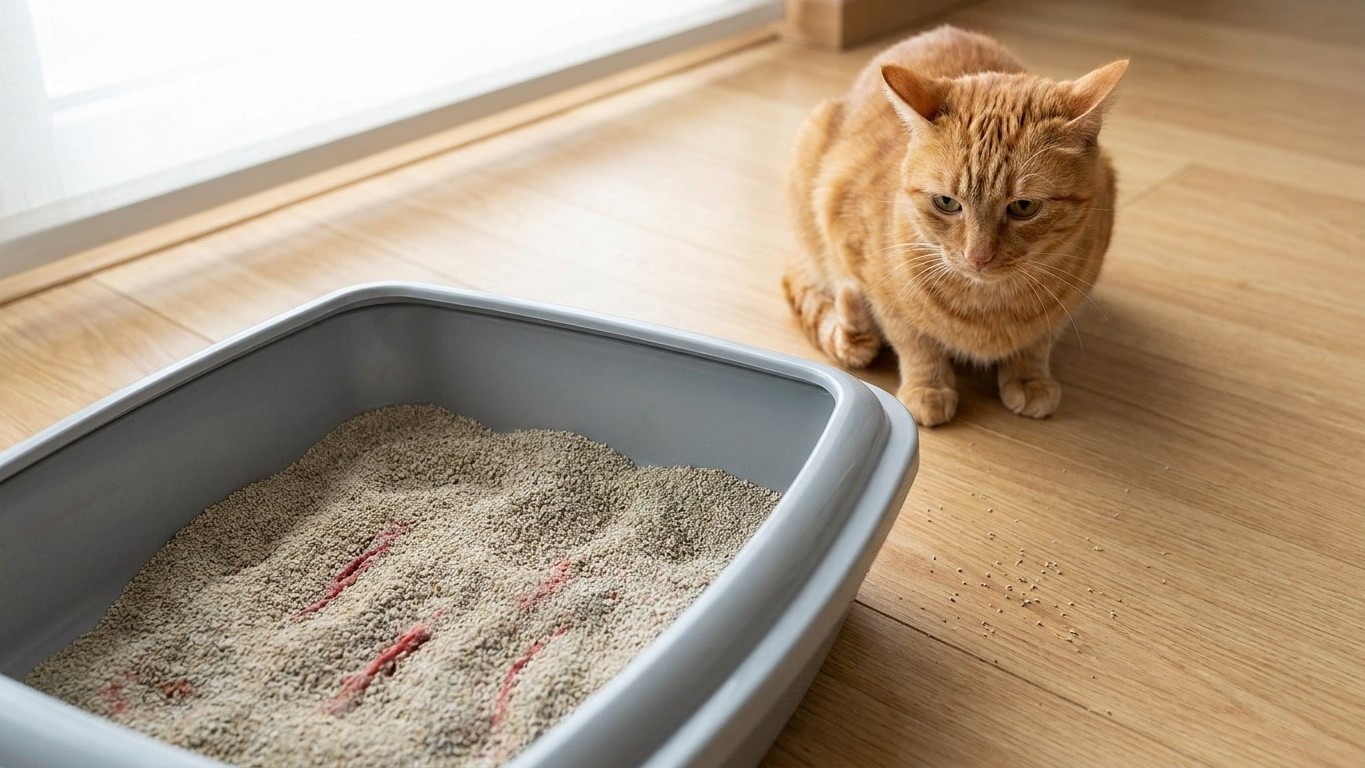
Three days of watching those crimson streaks appear in the litter tray, and still no answer from the usual suspects. No fever, no off-food days, nothing that screamed “urinary tract infection” in the textbook sense. The truth, once the vet ran the tests, turned out to be something far more common and far more tied to the calendar than anyone would expect: feline idiopathic cystitis, a stress-driven bladder inflammation that has nothing to do with bacteria. Many cases of a cat peeing blood are caused by feline idiopathic cystitis (FIC), where stress leads to bladder inflammation, and as the bladder wall becomes irritated and exposed to urine, bloody urination can result. FIC is not caused by a bacterial infection.
The timing wasn’t coincidence. A cat used to having someone pottering about the house all summer suddenly finds itself alone from eight in the morning until mid-afternoon, five days a week. That’s not a minor tweak to daily life, it’s a total upheaval of routine, and cats notice these things far more than we give them credit for.
Key takeaways
- Those crimson streaks in the litter tray might not be what the vet’s textbook first suggests
- A cat’s entire world can collapse when one person suddenly leaves for eight hours every weekday
- The difference between manageable and life-threatening can hinge on a single sign—and a matter of hours
Why the Litter Tray, of All Places
Blood in a cat’s urine, medically called haematuria, isn’t something to shrug off, but it’s also not automatically a sign of the same infection that would send a human to the GP. Blood in the urine is medically described as hematuria, and urine with blood in it can appear in a variety of colours depending on how much blood is present, including amber, orange, brown, or red. In cats, the far more frequent culprit is a cystitis flare-up rather than a bacterial invasion. Cats with FIC do not have a bacterial infection and should not be given antibiotics, and urinary tract infections can cause similar signs but are far less common in cats.
What actually happens inside the bladder is genuinely fascinating, if a bit grim. The bladder is lined with a layer of specialised proteins that protect the delicate tissue from urine, much like how the stomach lining protects tissue from acid, and during periods of stress, this protective layer thins. Once that lining is compromised, the bladder wall becomes exposed and irritated, and it bleeds. It’s a bit like a stress ulcer, except the cat’s “stress organ” happens to be its bladder rather than its stomach.
Vets at a research hospital in Montreal recently dug into exactly this link, and their findings are worth knowing. A study of 33 cats by a behavioural medicine team at the animal hospital of Université de Montréal’s Faculty of Veterinary Medicine cast light on a poorly understood and painful condition. One of the researchers, a veterinary behaviourist, drew a striking parallel to human health. “A similar condition with the same symptoms occurs in women and is often linked to high levels of stress or anxiety,” explained Desmarchelier, a veterinary behaviourist and professor.
Term Time Really Does Rattle Cats
Cats are creatures of near-obsessive habit, and the research backs this up rather clearly. Chronic stressors for cats can include inadequate enrichment, lack of predictable routines, or competition for resources such as food, water, or litter boxes. The school run doesn’t just remove a person from the house, it removes the entire rhythm of the day: feeding times shift, the house goes quiet for hours on end, and the comings and goings a cat had learned to predict simply vanish.
PDSA, one of the UK’s leading veterinary charities, puts routine right at the top of its prevention advice. Sticking to a routine matters because cats tend to get very anxious if their routine changes, so it’s worth trying to stick to regular feeding times, even asking someone to feed them at their usual time when you’re away. A five-minute delay to breakfast might seem trivial to us. To a cat whose entire day is scaffolded around a handful of predictable events, it can register as genuine upheaval.
It isn’t just about being left alone, either. Sources of stress for a cat can include seeing another cat outside the window, a change in litter type or location, new furniture disrupting their environment, or even social tension within the home. Add a new school-year schedule into that mix and you’ve got a perfect storm of small irritations stacking up into one very unhappy bladder.
Knowing When It Stops Being “Just Stress”
Here’s where I have to be blunt: most FIC flare-ups resolve on their own within a week, but a small number turn into genuine emergencies, and the difference can be a matter of hours. A cat peeing blood can indicate an emergency, especially if other symptoms are present, so it’s worth seeking emergency care if your cat shows certain clinical signs. The one sign that should never wait for a routine appointment is a cat straining repeatedly in the tray and producing little or nothing. If a cat’s urethra becomes blocked, they will produce little to no urine and cry out often, alongside many of the other typical signs, and this is a Medical Emergency requiring immediate veterinary care.
Male cats carry a much higher risk here purely because of anatomy, their urethra is narrower and more easily obstructed by inflammation or crystals. Male cats who exhibit signs of FIC are at high risk for urinary blockage, a medical emergency, so if a male cat is straining and not producing urine, immediate veterinary attention is needed. One source I’d trust on urgency put it starkly: FIC itself is not fatal, but a urinary blockage, which can result from FIC spasms in males, is fatal within 24 hours. That’s not scaremongering, that’s simply the biology of a blocked bladder and the toxins it traps.
Settling a Stressed Bladder Back Down
The fix isn’t antibiotics, since there’s no infection to treat. It’s about dialing down whatever’s rattling your cat and getting more moisture into their system. Switching from dry kibble to wet food is consistently the top recommendation, since increasing water consumption is one of the most effective ways to prevent cystitis in cats, and switching to wet food naturally provides more moisture than dry kibble. A water fountain helps too, since most cats have a curious preference for movement over stillness in their water bowl.
Beyond hydration, the environment itself needs attention:
- Keep feeding times fixed even when the household schedule shifts
- Provide one litter tray per cat plus a spare, kept scrupulously clean
- Offer hiding spots and vertical space so a stressed cat can retreat
- Consider a pheromone diffuser near the litter tray and resting areas
None of this replaces a vet visit, mind. Blood in urine always warrants a check-up, if only to rule out the rarer but nastier causes like bladder stones. What’s genuinely worth remembering, though, is a statistic that surprised me: research has shown that 46% of cats who have an episode will never have another one, but an unlucky 12% have more than six recurrences. For nearly half of cats, that frightening first flare-up in September might just be a one-off blip as they adjust to the new rhythm of the house, rather than the start of a lifelong pattern.
Sources : petmd.com | ladynpet.com