
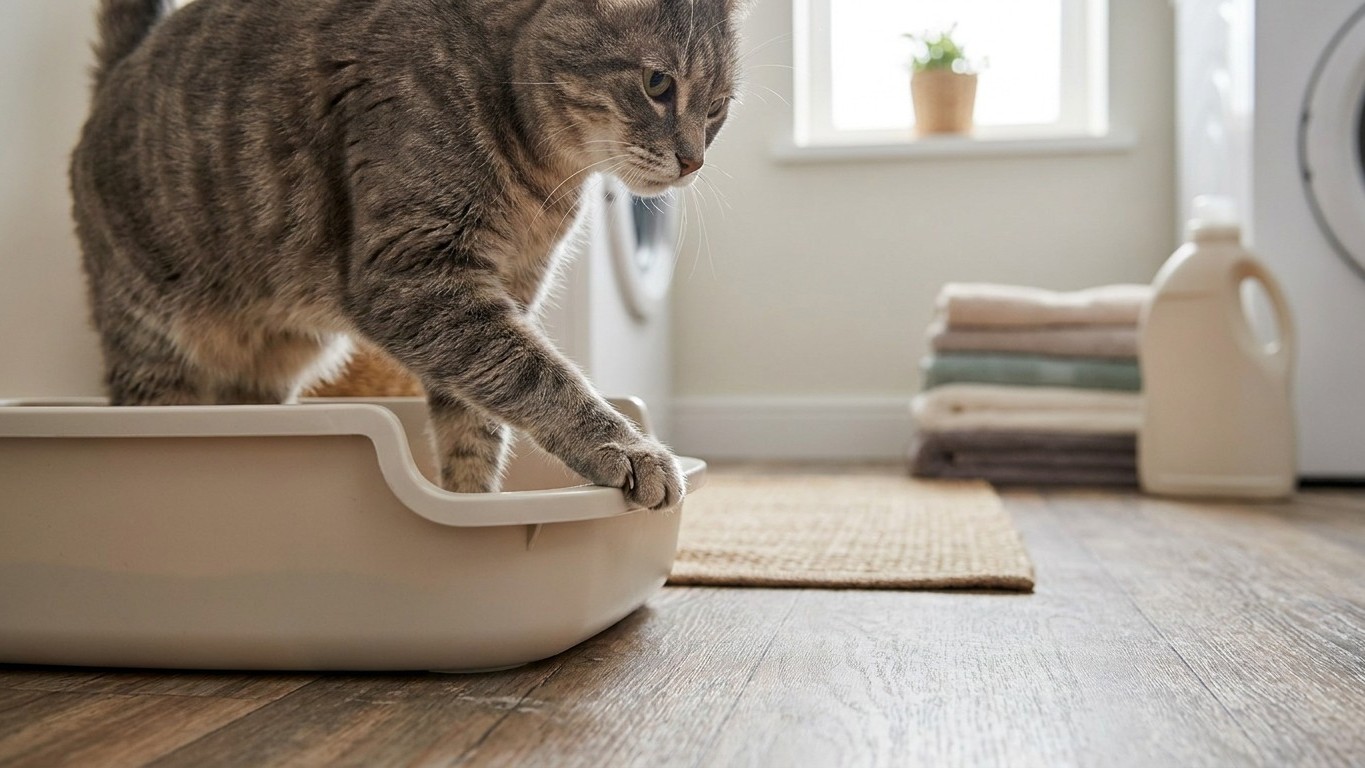
Two years of wiping wee off the same patch of laminate flooring, and I genuinely thought it was just something that came with owning an elderly cat. My tabby, Mabel, was nineteen, arthritic in both back legs, and I’d assumed the odd puddle beside her box was simply old age catching up with her bladder. Then my vet walked into the utility room, glanced at her litter tray for about four seconds, and told me to throw it straight in the bin.
The problem wasn’t Mabel. It was the box. High plastic sides, a lip she had to haul herself over every single time, and a design that had suited her perfectly well as a spritely six-year-old but had become a genuine physical ordeal a decade later. She wasn’t missing the tray out of confusion or spite. She was struggling to clear the rim, and the mess I’d been mopping up each morning was the direct result of a cat trying to do her business while wincing.
Key takeaways
- Over 60% of cats aged 6+ have arthritis, but most owners don’t realize it affects their litter box habits
- A vet identified the problem in seconds—and it wasn’t the cat, it was the box design
- The solution was simple but specific, and changed everything within days
Why one look at the box told my vet everything
Feline arthritis is far more common than most owners realise, and it’s chronically under-diagnosed because cats are so good at masking pain. Over 60 percent of cats over the age of 6 have arthritis in at least one joint, according to Cincinnati-based veterinarian Dr Amanda Steffen. That statistic stopped me in my tracks. Mabel wasn’t an outlier struggling with some rare condition; she was firmly in the majority, and I’d simply never connected her stiff mornings with her toileting habits.
This pain can affect a cat’s ability to both step into and manoeuvre within a litter box, especially if the sides are too high or the cover too small. My vet explained that a tray designed for a spry adult cat becomes a small obstacle course for one with sore hips and shoulders. Every time Mabel lifted a back leg over that rim, she was pushing through discomfort, which meant she often didn’t commit fully to the movement, leaving her perched half in, half out when she squatted. Hence my mopping routine.
There are some fairly reliable signs that a litter box has become a physical challenge rather than a behavioural quirk, and it’s worth watching for them in any cat over the age of about ten:
- Weeing or pooing just outside the box rather than inside it
- Hesitating at the entrance before stepping in
- Vocalising, grunting, or crying while using the tray
- Standing with front paws in and back legs still outside
I’d noticed every single one of these in Mabel and put them down to fussiness. They were, in fact, textbook signals that her joints were making the box itself the barrier.
What a genuinely senior-friendly litter tray looks like
Once the old box was gone, my vet was specific about what should replace it, and the advice lines up closely with what veterinary behaviour guidelines actually recommend. The entry point matters more than almost anything else. Rather than a high-sided rectangular tray, older or arthritic cats do far better with a dropped or low entry, ideally somewhere in the four-to-six-inch range, so they can walk in rather than jump.
The litter box edges should not be too high in order for a kitten or senior cat to enter and exit easily, according to guidance from the American Animal Hospital Association’s feline life stage recommendations. That single sentence undid two years of guesswork for me.
Size matters just as much as height, and this is where most shop-bought trays fall short regardless of a cat’s age. Veterinary guidelines call for a rectangular box that is 1.5 times the length of the cat, from nose to base of tail, or a minimum of 22 by 17 inches. Most commercial litter trays simply aren’t built to that scale, which is presumably why vets often encourage owners to look at alternatives such as under-the-bed storage containers instead of the standard pet shop offering. Mabel, a fairly average-sized tabby, needed a tray roomier than anything I’d have picked off a shelf without that guidance.
If you’ve got more than one cat, there’s an extra layer to consider. The rule of thumb is one litter box for each cat plus one additional box, or one litter box for each social group plus one additional box, if the number of social groups is known. It sounds excessive until you remember that cats are famously particular about sharing a toilet, senior or otherwise.
The daily habit that actually made the difference
Swapping the tray solved the mobility side of things almost overnight, but hygiene turned out to matter just as much as design. Litter boxes should be cleaned regularly and replaced, as well as scooped daily, and soap or strong chemicals should be avoided, with hot water being the best option for cleaning. I’d been scooping most days out of habit, but I hadn’t realised how sensitive an older, arthritic cat can be to a tray that isn’t spotless, on top of everything else already working against her.
Some cats seem quite sensitive to dirty litter boxes, and for a cat already reluctant to commit to a full squat because of joint pain, a soiled tray gives her one more reason to hover at the edge rather than step properly inside.
Mabel’s new tray cost me less than a decent bag of premium kibble, and the mopping stopped within days. What still surprises me, months on, is how easily I’d normalised what was, in hindsight, an obvious sign of pain. If your own cat is greying around the muzzle and you’ve started keeping a mop within arm’s reach of the litter tray, it’s worth having a vet actually look at the box rather than just the cat. Sometimes the diagnosis is standing right there in plastic, six inches off the floor, and nobody’s thought to measure it.
Sources : seniorcatscare.com | furrbby.com