
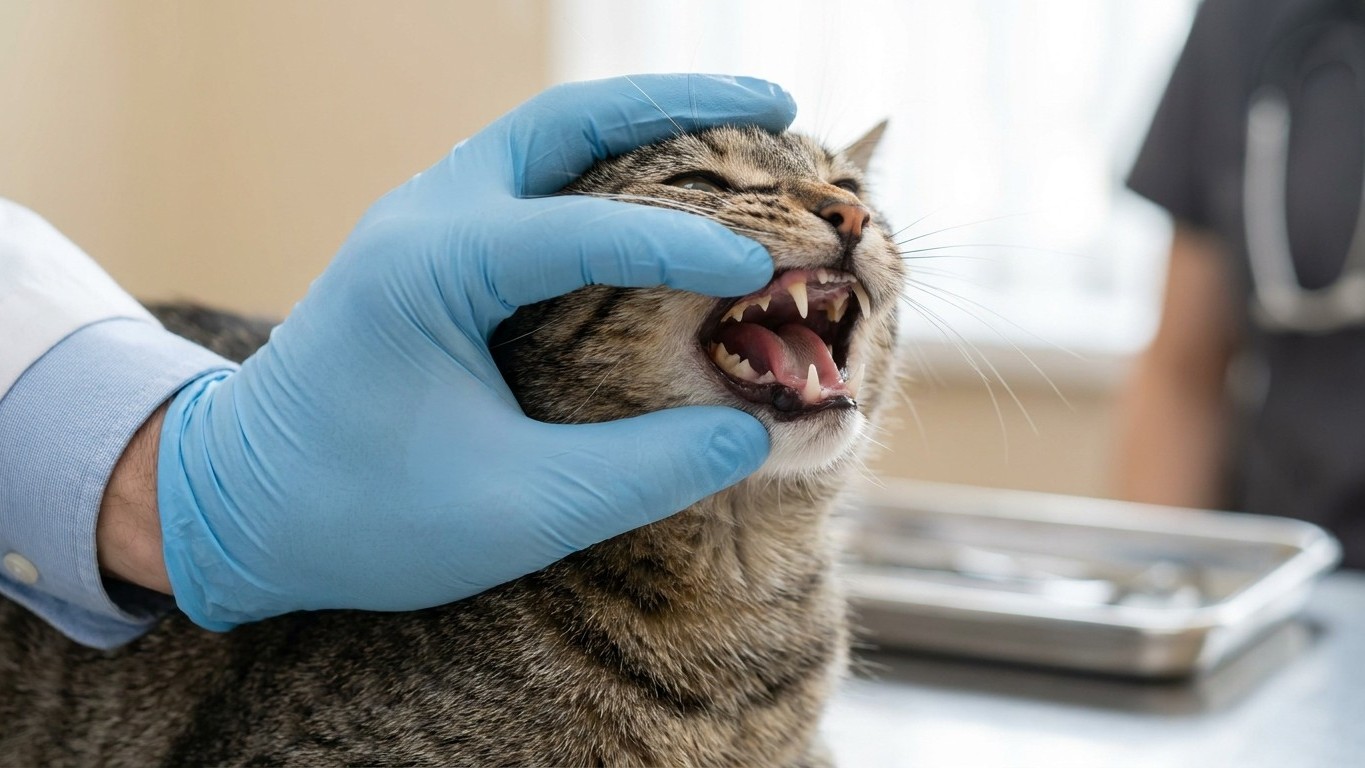
A tooth that looks flawless on the outside can be quietly disintegrating underneath. This is the strange, frustrating truth behind feline tooth resorption, a condition so sneaky that a cat can chew on one side of its mouth for months, even years, while the offending tooth appears completely healthy to the naked eye. It’s only under X-ray, with the cat under anaesthetic, that the damage reveals itself.
Key takeaways
- A tooth that looks flawless to your vet might be quietly crumbling beneath the gum line—and your cat won’t show obvious signs of pain
- X-rays catch tooth resorption in nearly 50% of cases where no damage is visible during a physical exam alone
- This condition affects more than half of all cats at some point, yet most owners mistake the warning signs for mere fussiness
The tooth that lied to everyone
Here’s what makes this condition so maddening for cat owners and vets alike: once resorption extends into the oral cavity, above the gum line, it causes pain but cats rarely show clinical signs. A cat favouring one side of its jaw isn’t being fussy. It’s coping. As Dr Rawlinson from Cornell puts it, “The owner may notice that the animal’s appetite appears to be normal but that it tilts its head and tries to chew on just one side of its mouth.”
The visual trickery goes both ways, too. In one study, 53% of cats had an obvious tooth resorption lesion, and where no obvious lesion was noted clinically, X-rays revealed one almost 50% of the time. a vet peering into a healthy-looking mouth still has roughly a coin-flip’s chance of missing something that only radiography would catch. This isn’t a failure of skill. It’s the nature of the disease. The lower third premolar is commonly the first tooth affected and is considered a sentinel tooth, meaning it’s often where problems start brewing long before anything looks wrong at the surface.
What’s actually happening inside that “perfect looking” tooth is a case of the body attacking itself. Tooth resorption starts when odontoclast cells, which usually play a healthy role by breaking down baby teeth so they fall out, begin attacking healthy, adult teeth instead. The mechanism that should have stopped switching on around kittenhood simply doesn’t switch off. Nobody fully understands why. The exact cause of tooth resorption is unknown, though diet is believed to play a role, alongside factors like frequent vomiting, periodontal disease, and mineral excesses or deficiencies in food or water.
How common is this, really?
Startlingly common, as it turns out. Feline tooth resorption is diagnosed in 28.5 to 67 percent of pet cats with one or more resorptive lesions, and the odds climb steeply with age. Some referral dental clinics see rates that are even higher, though naturally those practices see cats already flagged for dental trouble. Older cats bear the brunt of it too, as the disease progressed with age, though gender and breed had no influence on its severity in one Polish study of 174 affected cats.
There’s also a useful distinction to make here, because owners often assume this is simply the feline version of a human cavity. It isn’t. Tooth resorption is different from cavities, which are caused by bacteria that create acid that breaks down the enamel and dentin of the tooth. Genuine cavities are, in fact, remarkably rare in cats because cavities are extremely rare, since a cat’s diet is low in the sugar and carbohydrates that bacteria in plaque need to form cavity-causing acid. Resorption is something else entirely, an internal demolition job that doesn’t need sugar or bacteria to get started.
Why the X-ray changes everything
Here’s the bit that surprises most owners: two teeth that look identical during a physical exam can be radiographically worlds apart. Type 1 tooth resorption means the tooth’s crown is damaged, but on the X-ray, the root looks normal and the periodontal ligament can be easily recognised. Type 2, however, is a different beast entirely. With type 2, the tooth root will look like it is disintegrating, making it hard to differentiate from the bone on the radiograph. That distinction isn’t academic. It dictates the entire treatment plan, because in Type 2, the root has fused to bone and there may be nothing solid left to grab, so a full extraction can do more harm than good.
This is precisely why a visual check alone will never be the full story. You cannot tell the type by looking in the mouth. Only a dental X-ray can, which is why imaging is not optional. Cornell’s own guidance backs this up plainly: the best way of confirming the suspected presence of the condition is a full-mouth intra-oral radiograph, and cats should be visually examined annually, then x-rayed if a resorptive lesion is suspected.
The subtlety of symptoms doesn’t help matters. Cats rarely go off their food outright unless the disease is severe. A cat could be off its food for 24 to 72 hours in extreme cases, but generally the condition has to reach an extreme level before that happens; instead, one of the earliest signs is that the cat starts swallowing food without chewing, or suddenly prefers soft food. Watch, too, for mild drooling, sometimes with a pink tinge of blood, or bad breath that wasn’t there before. None of these scream emergency. That’s exactly the problem.
What to actually do about it
There’s no getting around the anaesthetic requirement, which puts some owners off, understandably. But it’s non-negotiable for accurate diagnosis. A thorough dental examination and full-mouth radiographs are necessary for proper diagnosis and treatment, and general anaesthesia is required. There’s no home test, no app, no clever trick that substitutes for this. Unfortunately, there is no way to prevent feline tooth resorption, though good habits still help around the edges. Brushing your cat’s teeth daily or every other day with a cat-safe toothbrush and toothpaste helps decrease plaque and bacteria, slowing gingivitis and periodontal disease.
The single most useful habit any cat owner can adopt is simply booking that annual check-up and not skipping it once the cat “seems fine.” Taking your cat for yearly wellness exams, anaesthetic dental exams, cleanings, and dental X-rays is the best way to prevent your cat from quietly suffering from tooth resorption. If your cat starts favouring one side of its jaw, dropping kibble, or turning its nose up at dry food after years of loving it, don’t file it under personality quirks. Ring your vet and ask specifically about dental X-rays, not just a visual check. That “perfect-looking” tooth might be telling a very different story just beneath the surface, and only imaging will translate it.
Sources : ncbi.nlm.nih.gov | webvet.com