
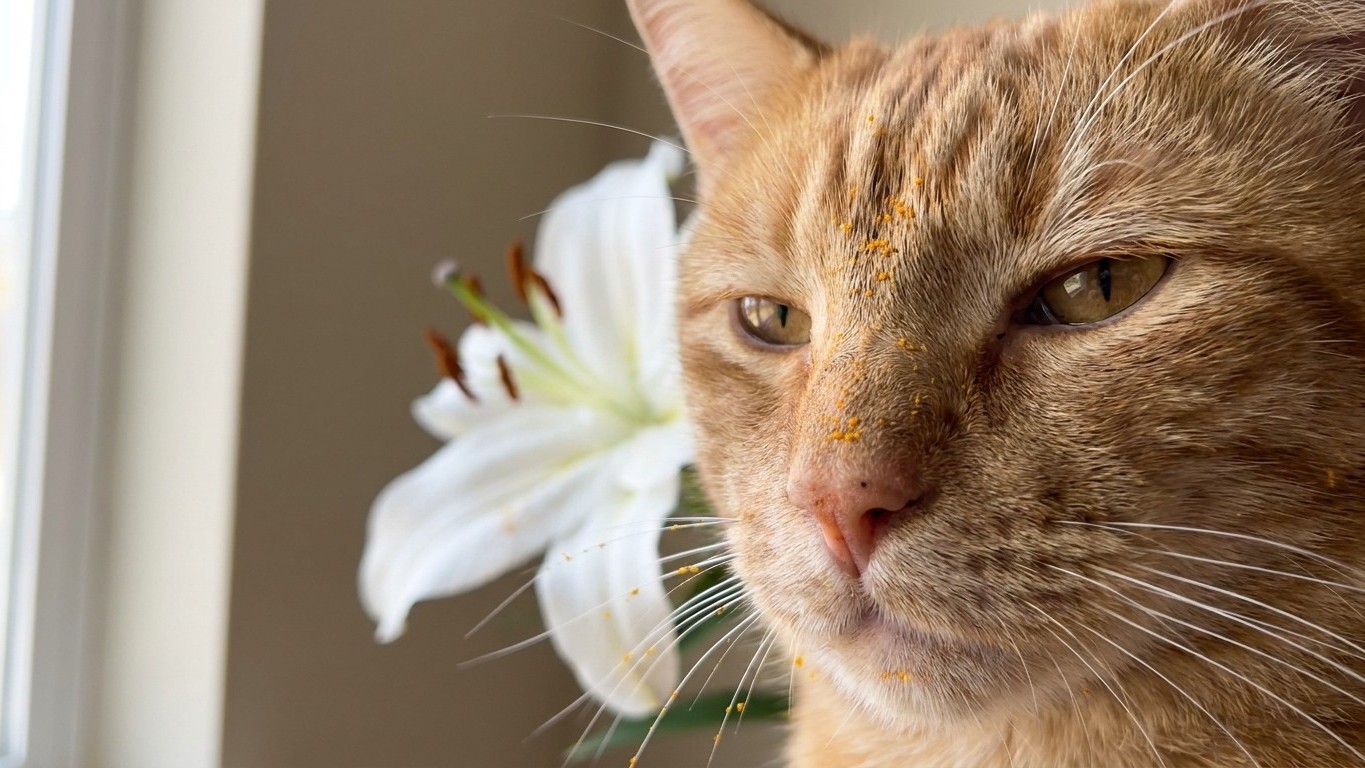
A cat brushes past a beautiful bouquet of stargazer lilies sitting on the kitchen table. Barely a second of contact, a few orange pollen grains dust onto her fur. She wanders off, grooms herself as cats always do, and within two days the vet is showing her owner bloodwork results that are genuinely shocking. This is not a dramatic edge case. It happens every week in households across Britain, and the biology behind it is as brutal as it is fast.
Key takeaways
- Your cat doesn’t have to eat the lily—just brushing against pollen or grooming it off triggers the poisoning
- Kidney damage becomes irreversible within 24-72 hours, but the cat may show no symptoms until it’s too late
- If exposure happens, you have a narrow window: treatment within 6 hours offers excellent chances; after 24 hours, kidney failure is likely
The pollen itself is the problem, and it doesn’t need to be eaten
Just brushing against the pollen or chewing on part of the plant can quickly lead to lily poisoning in cats. That’s the part most people don’t know. The assumption is that a cat would have to actually chew on a stem or eat a leaf for anything serious to happen. The truth is far more alarming. Cats can be exposed just by grooming pollen off their fur or drinking vase water. The act of self-cleaning, the very behaviour we associate with feline fastidiousness, becomes the mechanism of poisoning. A cat brushes past a lily, a few grains stick to her coat, and thirty minutes later she’s licking them off without a second thought.
The entire lily plant is toxic: the stem, leaves, flowers, pollen, and even the water in a vase. Eating just a small amount of a leaf or flower petal, licking a few pollen grains off its fur while grooming, or drinking the water from the vase can cause your cat to develop fatal kidney failure in less than 3 days. What makes this particularly sobering is that the toxin, which only affects cats, has not yet been identified. Scientists know it destroys kidney tissue with terrifying efficiency; they just don’t yet know exactly which compound is responsible. Dogs that eat lilies may have minor stomach upset, but they don’t develop kidney failure. Cats are uniquely, fatally susceptible.
The lilies you need to worry about most are the ones that appear most commonly in British florist bouquets. Easter lilies, Stargazer lilies, and Asiatic lilies seem to be the most hazardous. Daylilies, which are in the genus Hemerocallis, are also toxic to cats and can cause kidney failure. Calla lilies and peace lilies, while toxic, contain insoluble oxalate crystals and usually cause oral irritation, not kidney failure, so the distinction between lily types genuinely matters, though identifying them confidently isn’t always easy in a mixed bouquet.
What 48 hours actually does to a cat’s kidneys
The timeline is what makes lily poisoning so merciless. The effects of lily toxicity are rapid. Within one to three hours of ingestion, cats become nauseous, showing a decreased appetite, drooling and vomiting, as well as signs of depression and lethargy. Many owners see these early signs and wait, assuming it’s a passing upset stomach. That wait can cost the cat its life.
These early symptoms can seem mild or even resolve temporarily, which tricks some owners into thinking the cat is fine. This false plateau is one of the most dangerous aspects of the condition. While the cat appears to be settling, kidney destruction is already underway. Signs of kidney damage start about 12 to 24 hours after ingestion and include increased urination and dehydration. By 24 hours after ingestion, the cat may stop urinating, an indicator of irreversible kidney failure. That single clinical sign, the absence of urine, is the point at which even aggressive veterinary treatment may be unable to turn things around. If your cat is not producing enough urine, that is a sign that the kidneys are shutting down and treatment might not be successful.
The toxins in lilies begin to damage the kidneys rapidly, often before symptoms fully appear. Irreversible kidney damage may occur within 24 to 72 hours. The vet showing that 48-hour bloodwork to a distraught owner isn’t being alarmist. The numbers on that panel, elevated creatinine and BUN levels, tell a story the cat can’t tell herself.
What happens at the vet, and why speed is everything
There’s no antidote for lily poisoning, so the entire strategy is about buying the kidneys enough time and support to survive the assault. That means aggressive intravenous fluid therapy, which is the cornerstone of treatment. IV fluids are the most important treatment, as they help support kidney function and prevent dehydration and electrolyte disturbances. These fluids should be given for a minimum of 48 to 72 hours while monitoring the amount of urine produced, which may require a urinary catheter.
If the cat was exposed very recently, the vet may induce vomiting or use activated charcoal to limit absorption. Kidney function is evaluated through testing of blood and urine, and those results can reveal damage that has no outward signs yet. If possible, bring the plant, or a picture of the plant, with you to the veterinary clinic to aid in the diagnosis, knowing whether you’re dealing with an Asiatic lily or a peace lily changes the severity assessment significantly.
The prognosis hinges almost entirely on the clock. Within six hours of exposure, the prognosis is excellent. Within 12 to 24 hours, there’s a good chance with aggressive care. After 24 hours, there is a high risk of kidney failure. If treatment is delayed for more than 18 hours from ingestion, kidney failure is likely to develop. Left untreated for more than 24 hours, the prognosis is very poor. Those are the numbers a vet is weighing silently when you walk in the door.
The practical reality for cat owners in Britain
Even if your cat is not known to chew plants, accidental exposure is common. Be cautious with bouquets, especially on holidays like Easter or Mother’s Day, the two points in the British calendar when lily-heavy bouquets flood the nation’s homes. A gift-giver can have no idea they’ve brought a potential emergency through the front door.
The safest rule is simple: if you live with a cat, the safest choice is to avoid lilies entirely in your home and yard. If a bouquet arrives as a gift, either remove the lilies before bringing it inside, or keep the flowers in a room the cat cannot access. Removing the stamens (the pollen-producing parts) from the flowers reduces, but does not eliminate, the risk, pollen already shed onto surfaces or into the water remains dangerous. And even water from a vase containing lilies can pose a risk to your feline companion.
If your cat has had any contact with lilies at all, even just walking past a vase and sniffing, call your vet immediately and explain exactly what happened, including the type of lily if you know it. Do not wait for symptoms. Even if your cat seems fine, poisoning may already be underway. It’s one of those situations where being wrong and rushing to the vet costs you a consultation fee. Being wrong and waiting costs you your cat. One other thing worth knowing: outdoor cats are more likely to be exposed, and exposure may increase in spring and during times of year when lilies are more commonly found in the house and garden, which means this is a year-round conversation, not just a seasonal one.
Sources : petnation.care | topazvet.com