
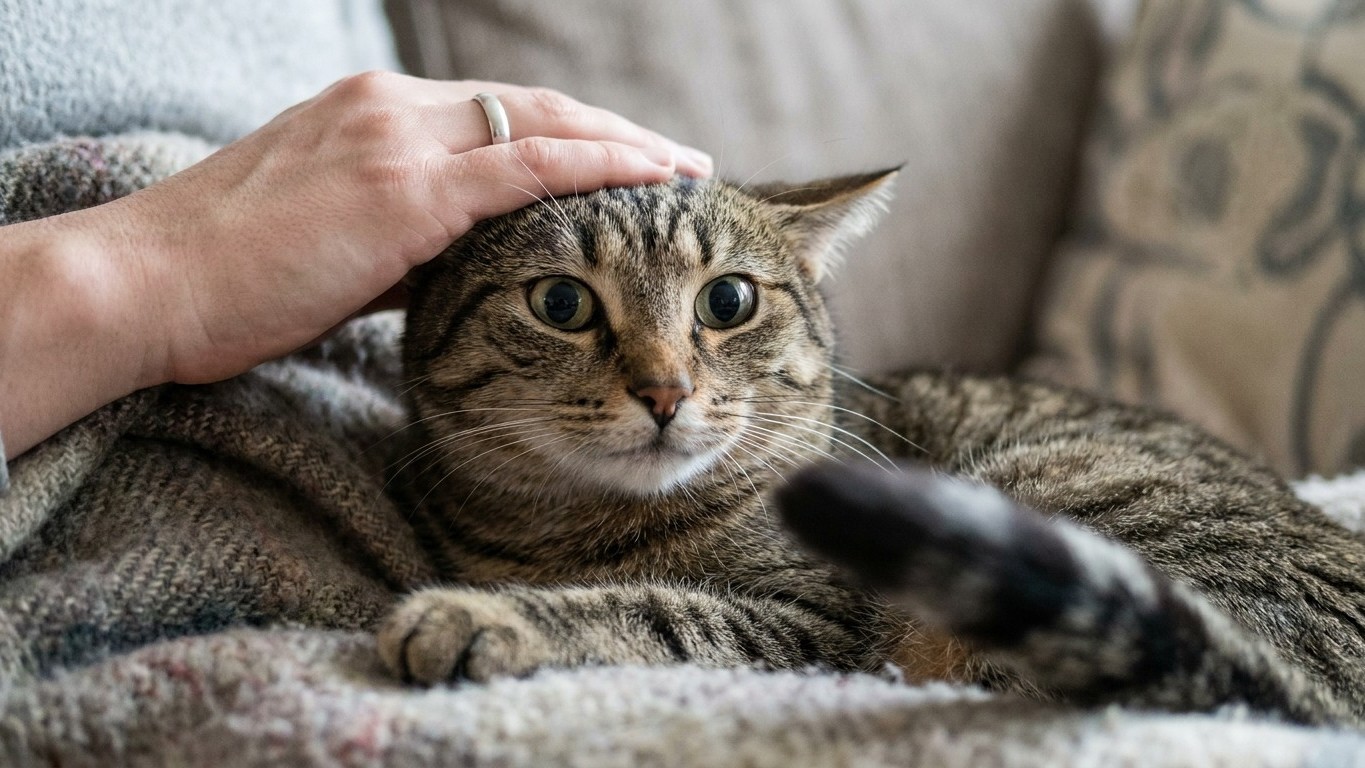
Your cat is on your lap, rumbling away contentedly, and you’re stroking her back. Then, without warning, she sinks her teeth into your hand and bolts. You’re left staring at the damage, baffled. She was purring. How could she possibly have been unhappy? The answer is that the purr alone tells you almost nothing, and the tail was screaming at you the entire time.
Key takeaways
- Cats purr for reasons beyond happiness—stress, coping mechanisms, even illness trigger purring
- A swishing tail during petting is a red alert; most owners miss these signals until the bite happens
- Overstimulation is real: your affectionate cat can suddenly become aggressive due to sensory overload
The purr is not a happiness meter
Cats purr for many reasons, not just happiness. Purring can signal contentment, stress, a desire for attention, or even illness, depending on the situation and your cat’s body language. That’s the single most important thing to understand about feline communication, and it’s the part most owners skip straight past.
When a cat feels uneasy or experiences discomfort, purring can act as a natural coping mechanism, helping them calm down in unfamiliar or stressful situations, such as visiting the vet or recovering from an injury. the purr can be a sign that something is wrong, not right. Some cats purr when they are anxious, walking around the house and alternating between purring and meowing, a coping mechanism to help reduce their anxiety.
There’s a fascinating wrinkle to the biology here, too. Researchers found a low-frequency hum of purring at 25–50 Hz could stimulate muscles and even promote bone healing, next time you see your cat purring before one of its afternoon naps, it may actually be in self-repair mode. Domestic cats, servals, ocelots, and pumas produce fundamental frequencies at exactly 25 Hz and 50 Hz, the two low frequencies that best promote bone growth and fracture healing. The purr, in short, is a biological Swiss Army knife — and reading it as a simple “happy signal” is like reading a single word out of a whole sentence.
Some experts describe a cat’s stress purr as being more high-pitched than usual, and it may be accompanied by wide eyes, showing teeth, panting, or tense body language. When cats are purring out of happiness, the purr tends to be lower pitched, while a stressed-out cat might have a higher-pitched purr. Pitch, then, is your first clue. The second is Everything happening below the neck.
What the tail is actually saying
A cat’s tail is like a mood barometer, offering insights into their emotional state. Unlike dogs, whose tail wags are relatively straightforward, cats use their tails to communicate a complex array of emotions and messages. This is where most people come unstuck. Dog owners are trained to read tail wags as enthusiasm. Cat owners often import the same assumption, and pay for it.
A quick flick of the tail is a warning to other cats and humans to back off. These cats are agitated and may become aggressive if stressed further. The stronger the movement, the stronger the emotion. The flicking tail movement, known as the low flick, is a quick back-and-forth action, if you notice this cat tail swishing, give them space, as it means that they’re angry, stressed, or unhappy and want to be left alone.
Cats who are swishing or lashing their tails left to right are indicating that they are to some degree conflicted, stressed, anxious, or upset. Some experts believe this type of tail movement may be a biologically hardwired response to overstimulation or a cat feeling frustrated and conflicted. Context matters too: a cat’s tail movements can mean different things depending on the situation. Tail twitching during play is normal, but if it occurs while resting, it may indicate discomfort or irritation.
Not all tail movement spells danger. The tail quiver is quite possibly the cutest tail action, as it means that they’re excited to see you, your cat will approach with their tail high in the air and the tip will do a little quivering movement. An upright tail is often a sign of confidence and contentment, and an upright, quivering tail can also be a greeting gesture, especially when the cat is particularly excited to see someone. Rapid, hard flicking while sitting on your lap: bad. Gentle quiver at the tip while trotting toward you: delightful.
The overstimulation trap, and how to escape it
Overstimulation is when cats experience sensory overload from too much petting, caused by a painful nerve reaction, stress or built-up frustration. It has nothing to do with a cat’s temperament, but is an actual physiological response to touch, basically, their nervous system goes into overdrive and they feel significant discomfort. The really maddening part is that most often cats become overstimulated during petting, but it can also occur during play time. And in many cases, it is the cats who solicit attention who tend to become overstimulated. Your cat came to you, climbed on your lap, started purring — and then bit you. Yes. That is entirely possible, and it is very common.
Cats can sometimes purr as a sign that they are stimulated, maybe because they are being stroked or played with. If they become overstimulated, they may suddenly grab you and bite. Don’t punish them for this, as it will make them stressed and could lead to other problem behaviours.
The warning signs come well before the bite, and they are readable, you just have to know what to look for. Common signals include tail swishing or flicking, skin twitching over the back, flattening of the ears, freezing, tenseness or staring, a quick head turn to watch your hand as you pet, pupillary dilation, a low growl, or walking away and lying down. The cat will likely start out with small signals, like ears going back, the tail swishing, or the body tensing up. If these are ignored, they have to say it a little louder — in the form of a hiss, swat, or bite.
The practical fix is straightforward. When touching a cat who becomes overstimulated, try to focus petting on the head and chin, not down the body toward the tail, and never the belly. Keep pets brief and watch the cat’s body language to see if there are subtle cues that they’ve had enough. If the cat is signalling that its limit has been reached, it’s time to back off. If you know your cat may get overstimulated after about two minutes of petting, then only pet the cat for one minute and give it a break.
Reading the whole picture, not just the sound
When a cat is purring with contentment, they have a relaxed facial expression and body language. Ears forward and soft, eyes half-closed, body loose, tail still or gently curled, that is a genuinely happy cat. If your cat is purring while their ears are flat or turned to the side, their eyes are wide open with wide pupils, and their whiskers are pointing forwards or down, they are likely stressed.
If your cat is purring while hiding, not eating, or acting lethargic, it’s time to consult your veterinarian. Purring doesn’t always mean things are fine, it may be their way of coping with discomfort. Always flag sudden changes in purring patterns to your vet, particularly if they come alongside changes in appetite, weight, or behaviour.
One genuinely surprising detail that most owners never learn: a study conducted at the University of Sussex found that cats have a “solicitous” purr when trying to communicate hunger. This particular purr is coupled with a meow that has a similar frequency to the cry of a human baby, and researchers who played a recording of the solicitous purr to people without cats reported that it still incited feelings of urgency. Cats have, evolved a specific purr designed to be difficult for humans to ignore. They’ve essentially learned to hack our parental instincts. So the next time your cat purrs at 6am and you haul yourself out of bed to fill the bowl, know that you’ve been very deliberately manipulated — and that’s rather brilliant.
Sources : quora.com | usefulbs.com