
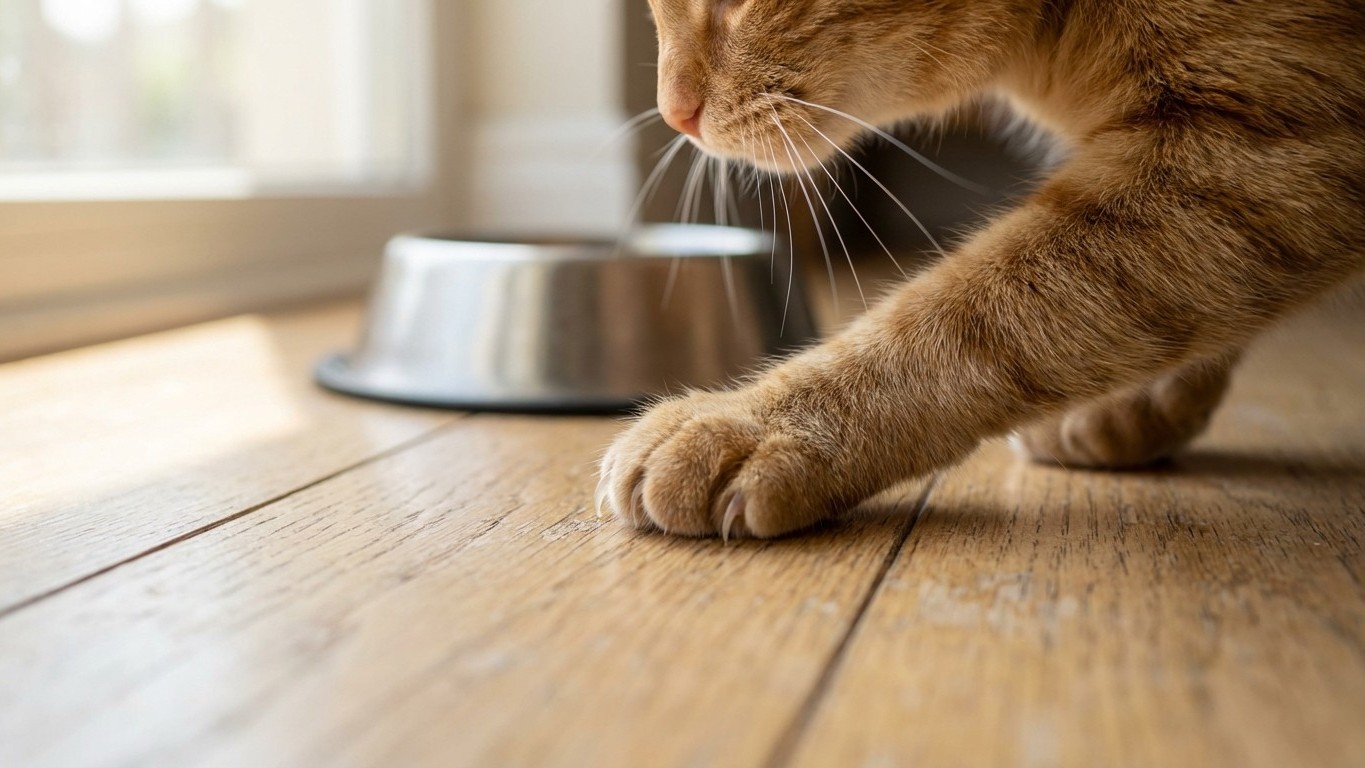
Your cat polishes off its dinner, steps back, and then proceeds to scratch frantically at the kitchen tiles, dragging the nearby tea towel across its bowl as if performing some ancient ritual. You’ve watched this happen a hundred times. It turns out, there’s a whole lot going on behind that peculiar little display, and some of it is very much about you.
Key takeaways
- Your cat’s post-meal scratching traces back to wild ancestor survival tactics that no amount of training can eliminate
- Sometimes that dramatic floor-pawing is actually your cat’s way of rejecting your food choice or expressing discomfort
- A sudden change in this behavior could signal stress, health issues, or whisker fatigue—and might warrant a vet visit
The ghost of the hunt: what’s really driving this behaviour
Your domestic cat might be cute and fluffy on the outside, but on the inside, it retains instincts from its wild ancestors. When your cat tries to bury or otherwise cover its food, it’s performing something called “caching”, used by wild cats to protect food from other cats or scavengers, to stop it from spoiling, or to have a meal to return to later. The fact that there’s no soil on your laminate floor is entirely irrelevant to your cat’s brain. This instinct is so deeply ingrained that cats will perform the scratching motion on hardwood or tile, even when there is no soil to move — a biological drive to save for a “rainy day” that no longer exists in a domestic setting.
The origins of this behaviour trace back to wild cats who survived in environments where food was neither predictable nor abundant. Wild cats who successfully caught prey larger than they could consume in one sitting needed strategies for preserving their extra food and preventing competitors from stealing their hard-earned meals. Burying or caching food kept meat fresher longer and concealed it from other predators. Think of it as the feline equivalent of cling-filming your leftovers, except rather more dramatic. The act of covering food is linked to the same instinct that drives cats to meticulously bury their waste; it’s about maintaining a clean, scent-controlled safe zone. This is why the pawing motion used to bury food is often identical to the motion used to cover waste in the litter box.
It is thought that food burying is not learned from the mother cat when kittens are young, but rather is driven by ancestral roots and is embedded in their genes. your cat was born doing this. No one taught it. This behaviour requires no reinforcement to maintain and cannot be eliminated through training because it operates below the level of conscious decision-making. Trying to scold it away is, frankly, a waste of everyone’s energy.
Yes, sometimes it really is about the food
Here’s where it gets personal. One reason cats scratch around their bowls is that they simply don’t like the food, this is more likely after you’ve introduced a new food or different flavour, and they’ve left most of it uneaten before trying to cover it. Many owners know this well: switch to a new brand and your cat becomes suddenly very theatrical about mealtimes. If a cat tries to bury the food immediately with little interest in eating, it can be a clear sign of dissatisfaction — treating the unwanted food as something that needs to be disposed of, much like waste.
Portion size matters too. A cat may like its food perfectly well, but if there’s too much in the bowl and it can’t finish it, cats being quite clean animals will sometimes prefer to cover or bury the excess rather than leave it sitting out all day. Wet food has a much stronger odour than dry kibble, and that potent smell can more strongly trigger the instinct to hide evidence from competitors. If your cat isn’t a fan of a particular wet food, it’ll be even more likely to try and “dispose” of it.
There’s also the environment to consider. Cats are creatures of habit and often prefer a quiet, safe place to eat. If the food bowl is in a busy or noisy area of your home, your cat may scratch around it as a way to express Discomfort or anxiety, and moving it to a calmer spot could reduce the behaviour. Almost all cats like to eat with their back facing a wall so that they can see the room while eating; it helps calm the instinctual need to be on the lookout for predators while they’ve got their face buried in their meal. Worth checking before you blame the kibble.
When scratching turns into something worth noticing
Scratching is an instinct and not a learned behaviour, and not all cats do it. Some will scratch the floor for a long time, or drag objects such as towels and rugs to their food bowl. That last one always raises eyebrows. Perfectly normal, deeply weird-looking. For female cats, particularly those with kittens, scratching after eating can also be linked to maternal instincts. Mother cats are extremely protective and may be more driven to hide food traces, in the wild, this would reduce the risk of predators finding their young. Indoors, the behaviour may appear stronger during nursing, even if no actual danger exists.
The distinction worth making is between the everyday post-dinner scratch and something more concerning. If the burying behaviour is accompanied by lethargy, lip-licking, or gagging, the cat may be experiencing gastrointestinal distress, the act of burying becoming an attempt to distance itself from a scent that is making it feel unwell. A sudden change in behaviour, if a cat that never did this starts doing it frequently, could indicate new stress, a dietary issue, or even an underlying medical problem such as dental pain or nausea. Always worth a call to your vet if you notice a real shift in your cat’s habits.
Some health concerns, such as whisker fatigue, may also make it difficult for a cat to eat comfortably. Some professionals believe whisker fatigue occurs when a cat’s whiskers touch the sides of a bowl too often, potentially causing the cat to tip over the bowl and then paw at the food to “clean up.” Switching to a wider, shallower dish can make a noticeable difference for some cats.
What you can actually do about it
If the scratching is harmless, the honest answer is: nothing. You should not stop your cat from trying to bury its food, this is an instinctual behaviour and your cat may not even know why it’s doing it in the first place. However, if the behaviour becomes obsessive or starts to take a toll on your floors or their paws, some intervention may be useful.
Your cat will have nothing to bury if it finishes its food in one sitting. Dividing feeds into smaller portions rather than one or two large ones will prevent it from having any food left to scratch around or attempt to bury. The behaviour is more common in multi-cat households, where cats may feel they are competing for resources and can get a little obsessive about it. Making sure each cat has its own food and water bowl and privacy while eating goes a long way.
A silicone feeding mat under the bowl protects your floors and gives your cat an acceptable surface to scratch without doing any damage. No matter what, never punish a cat for scratching or pawing at its food, it’s natural, not harmful behaviour, and the cat will not understand the reason for the punishment anyway.
One last thing worth knowing: a cat’s sense of smell is up to 16 times stronger than a human’s. Any trace of food that lingers in an “empty” bowl will make a nervous cat feel insecure. So if your cat keeps pawing an apparently spotless bowl, it may simply be reacting to residual scent that you genuinely cannot detect. Washing bowls thoroughly after every meal, rather than just rinsing them, can be enough to stop the whole Performance before it starts.
Sources : pawtracks.com | quora.com