
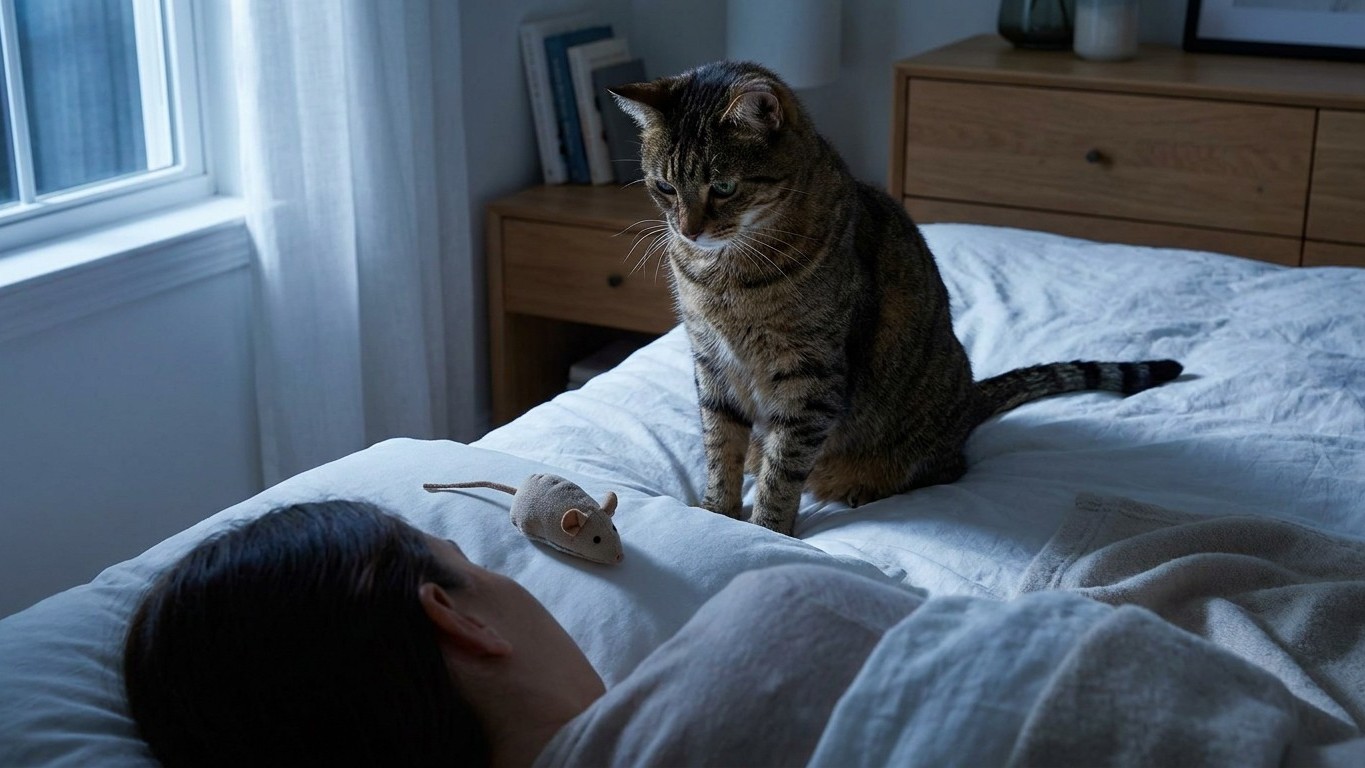
Three in the morning. You’re dead asleep, and then comes the sound: a soft thud, a chirp, a tiny plastic rattle. Your cat has just deposited a toy mouse by your pillow with the gravity of someone presenting a Michelin-starred meal. This isn’t random. Your cat, in its utterly sincere feline way, believes you are a hopeless hunter who cannot feed yourself, and it has decided to do something about it.
Key takeaways
- Your cat genuinely thinks you cannot hunt and has appointed itself your survival trainer
- This happens at night because cats are crepuscular predators—and feeding them won’t stop it
- The behavior signals deep trust: in the wild, cats only share food with family members they truly care about
The hunting lesson your cat genuinely thinks you need
One theory among animal behaviourists is that cats with no young still naturally want to pass on their hunting skills, and since their human family members are clearly very poor hunters from a cat’s point of view, they may be trying to help train us to provide for ourselves. It sounds absurd until you consider the alternative: your cat watches you every single day, and you never once catch your own food. You just open cupboards and tins. From a predator’s perspective, that’s frankly embarrassing.
One of the most widely accepted theories is that your cat is attempting to teach you. In the wild, mother cats bring back prey to their kittens, first dead animals to introduce them to the concept, and later live animals to let them practise. Your cat may well view you as part of their family unit and, frankly, may have concluded that you’re a rather poor hunter who needs some guidance. The toy mouse on your pillow, then, isn’t a quirk. It’s lesson one of a curriculum you never signed up for.
In multi-cat households, dominant females often bring prey to subordinate cats or kittens. By extension, your cat may see you as a kitten-like figure, dependent, clumsy, and in need of protection or training. The dead mouse isn’t a threat; it’s a lesson. Some cats even vocalise while presenting their catch, a soft chirp or trill that mirrors the call a mother cat uses to summon her young to a fresh kill. That little sound at 3 a.m. is your cat announcing the lesson has begun.
Why it happens at night (and why hunger has nothing to do with it)
The timing of these gifts is no accident. Cats are crepuscular, meaning they are most active at dawn and dusk. Late night and early morning hours are prime time for hunting behaviour, even in indoor cats. So the nocturnal delivery is not your cat being theatrical. Its internal clock is simply doing exactly what millennia of evolution designed it to do.
Feeding your cat will have some effect on their hunting behaviour, but because hunting is not entirely motivated by hunger, providing your cat with greater amounts of food won’t reduce their desire to hunt, and instead risks them overeating and gaining weight. This trips up a lot of owners who assume that a well-fed cat has no reason to “play hunt.” One study found domestic cats only eat 30 percent of prey killed. If cats relied on their own catches to sustain them, they would have to catch around 10 to 20 animals per day, and on average, cat hunting attempts are successful less than 50 percent of the time. Hunting, for the domestic cat, is sport and instinct rolled into one. The full food bowl genuinely changes nothing.
Unlike dogs, which have been selectively bred for centuries to work alongside humans, cats essentially domesticated themselves, and they’ve retained far more of their wild instincts as a result. That solitary, self-sufficient hunter still lives very much inside your cat, whether they’re prowling the garden or lounging on the sofa. Until quite recently, cats were mainly kept to control rodent populations rather than as pets, and during this time, only the best hunters survived and reproduced. There has been very little selective breeding of cats, so their instinctive need to hunt remains strong.
What to do with the “gift” (and what absolutely not to do)
The worst response is punishment. It’s important not to punish your cat for catching wildlife or bringing their prey home. They won’t understand what they’ve done wrong. As hunting is a natural instinct for cats, shouting at them won’t deter them from doing it again. It will only cause them stress, which could lead to other unwanted behaviours. If your cat has brought home real prey rather than a toy, there are some practical health considerations to keep in mind. Small rodents, such as mice or rats, that your cat might put in their mouth can carry parasites like tapeworms or might have ingested rodenticide poisons, both of which can make your cat sick. Always consult your vet if you’re concerned your cat has come into contact with wild animals, and keep up to date with regular parasite prevention treatments.
The most effective way to redirect this behaviour is play, and specific kinds of play. Short, frequent play sessions most closely resemble a cat’s natural predatory pattern. Choose toys that look and feel like their natural prey to increase engagement. Immediately after your cat catches a toy, give them a high-protein treat or their dinner. This final “eating” step signals to their brain that the hunt is successful and over, allowing them to relax and sleep rather than staring out the window for more prey. That simple sequence, stalk, pounce, catch, eat, is the full predatory loop, and completing it genuinely settles cats down.
Studies have found that adult cats show more intense and prolonged play with toys that resemble actual prey items. Similarly, the hungrier the cat is at the time of object play, the more intense and prolonged the play sessions are. Both factors indicate that cats consider these toys to be prey when they are playing. A limp feather wand dragged half-heartedly across the carpet won’t cut it. Move it like something alive, dart it under a blanket, let it pause, then bolt. Your cat will be absolutely riveted, and the toy mouse by your bed at midnight becomes far less necessary.
The trust underneath the gesture
There is something genuinely touching buried in this odd behaviour, even when you’re standing barefoot in the dark trying not to step on a plastic mouse. When cats catch prey they may not want to eat it or leave it where other animals could steal it from them. This is why they bring it back to their core territory, where they know they can eat it undisturbed, or store it safely for later. While it’s not a gift or present for you, it can still be considered a sign of love, as it shows they feel safe with you.
In feline terms, sharing food is a profound act of trust. Wild cats rarely share kills unless with close kin. So when your cat brings you a bird, it’s essentially saying, “I consider you family.” Some cats extend this to non-prey objects entirely: some cats may bring home random objects such as leaves, human or cat food, and even the neighbour’s laundry hung out to dry. Just like with bringing home dead or live animals, these objects aren’t actually a gift for you, the cat will have brought the object home because they find it interesting, perhaps because it smells appealing or moves in a similar way to their prey. One thing worth knowing: neutered cats are just as likely to hunt as intact ones, debunking the myth that hunting is tied to mating drives. The toy mouse arrival at 3 a.m. will not be solved by a trip to the vet for that reason alone.
Sources : catster.com | platopettreats.com