
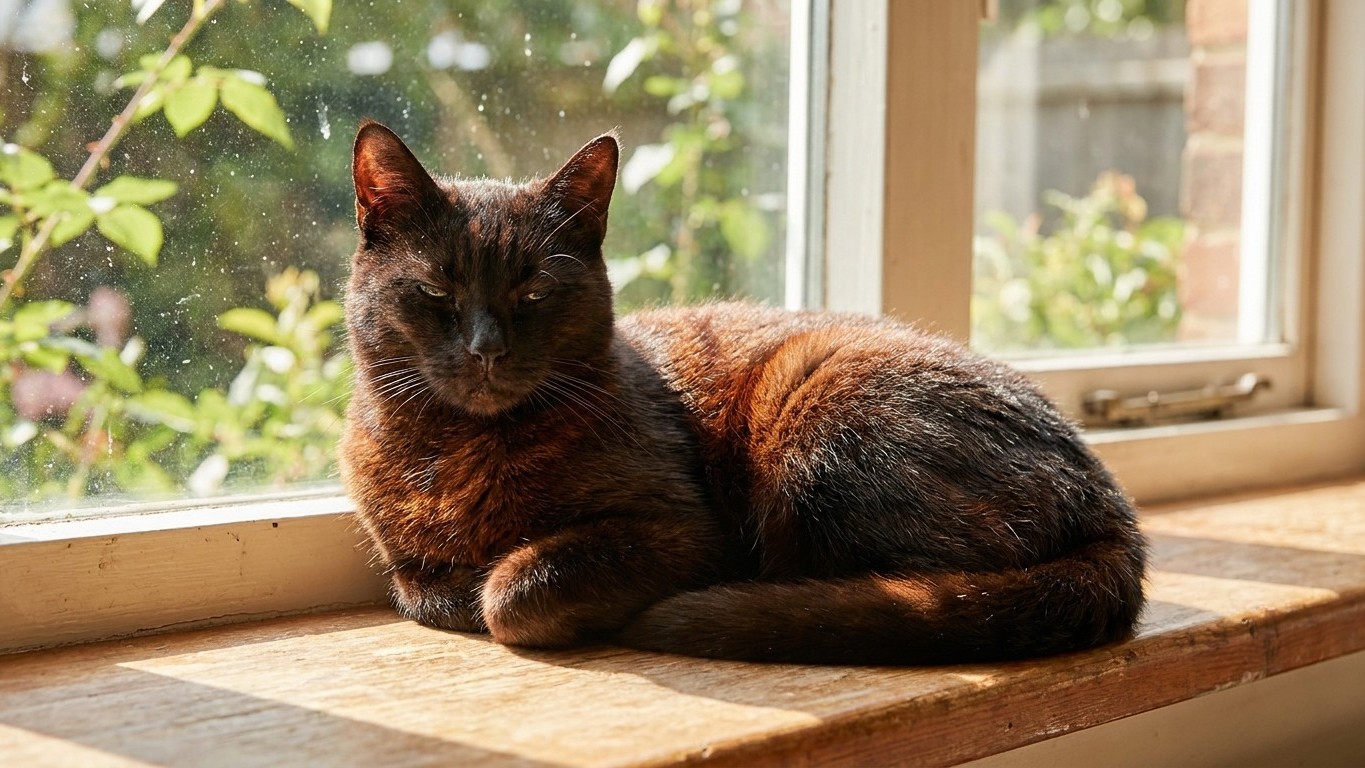
That brownish-red shimmer creeping across your black cat’s coat has a name in veterinary circles: “rusting”. Cat rust gets this name because of its tendency to appear as a rust-brown colour, making it look like your seemingly black cat has literally rusted. For most owners, it’s a purely cosmetic curiosity spotted during a sunny afternoon on the sofa. But the windowsill that seems so harmless can occasionally be a signal worth paying attention to, sometimes of something going on far beneath the fur.
Key takeaways
- Your black cat’s fur doesn’t actually rust, but something similar happens when melanin breaks down in sunlight
- A nutritional deficiency in tyrosine or copper can cause the same reddish-brown discoloration—sometimes signaling deeper health issues
- That cozy sunny windowsill might be doing more than bleaching fur: prolonged UV exposure can lead to skin cancer in cats
The science of a black cat going rusty
Black cats get their striking colour from melanin, specifically eumelanin, which produces black pigmentation. Various factors can affect melanin production and distribution, leading to noticeable colour changes in the coat. The most common culprit is simply the sun. A cat’s fur contains melanin that can break down with prolonged UV exposure, and cats who spend time lounging in sunny windows or outdoors may develop a rusty or reddish-brown tinge to their coat, particularly on areas that receive the most sun exposure. The technical term for this is photobleaching: when black fur is exposed to sunlight, the eumelanin pigment begins to break down due to the high energy of the sun’s ultraviolet radiation.
Here’s the part that surprises most cat owners: indoor cats are at risk too. Regular windows do not filter out harmful UV rays, so cats who like to nap in windowsills or snooze in sunbeams can still be affected. While sun exposure can cause temporary colour changes, new fur growth will be the original black colour, but continued sun exposure will affect that new growth as well. So if your cat’s favourite perch gets several hours of direct light each day, the rust effect can become self-perpetuating.
The good news is that sun-induced rusting is generally harmless from a coat perspective. This type of colour change is often temporary, when the season shifts and the days become chillier, the fur may actually regain its original tone. One cat owner online described their black moggy turning brown every summer then reverting to jet black by November. The sun, essentially, is running a slow bleach cycle on your pet.
When it’s more than sunshine: nutrition and the pigment chain
A less common cause of rusting in cats is a tyrosine deficiency. Tyrosine is crucial for the production of eumelanin, the pigment responsible for black fur, and cats can produce tyrosine by converting phenylalanine, an essential amino acid obtained through their diet. If their diet is deficient in both tyrosine and phenylalanine, eumelanin production may decrease, causing black fur to take on a reddish-brown hue.
A study published in the Journal of Nutrition in 2002 found that cats fed a diet containing less than 16g of combined phenylalanine plus tyrosine developed reddish-brown hair. Intriguingly, research at the University of California Davis found that the current amount of phenylalanine and tyrosine recommended for normal growth and health may not be enough to maintain maximal melanin production for a fully black coat colour. a cat eating a technically “complete” diet might still show some rusting, particularly a very dark individual with higher pigment demands. Black cats fed an adequate diet with sufficient phenylalanine and tyrosine will regain their black fur.
While tyrosine deficiency is rare in cats eating commercial pet food, it can occur with homemade diets or underlying health conditions. Copper is another piece of this puzzle. A deficiency of the mineral copper can cause depigmentation of coloured coats, this is because copper is required to convert the amino acid tyrosine into the pigment melanin. And in an unexpected twist, excessive zinc can interfere with copper absorption in the body. If zinc blocks copper absorption, it can create a copper deficiency even when there’s enough copper in the diet, leading to reddish or brownish tones especially in black cats.
The darker concern: when the windowsill becomes a health risk
The coat change itself is rarely the thing to worry about. What matters is what might be causing it, and whether prolonged sun exposure is doing anything more than bleaching a few hair fibres. Solar dermatitis, also known as photodermatitis or actinic dermatitis, is a type of skin inflammation that comes from sunburn or too much UV light exposure over time. It’s most common on areas of the face with thin fur, especially the tips of the ears, and over time, solar dermatitis can progress to squamous cell carcinoma or other forms of skin cancer.
Feline cutaneous squamous cell carcinoma is the most common form of skin cancer in cats, typically developing on areas exposed to the sun, such as the ears, nose, eyelids, and lips. White cats who sit in sunny windowsills all day are most at risk, with tumours often appearing on areas where the cat’s fur offers little protection. But it’s well established that sun exposure, sunburn, and solar dermatitis increase that risk for any cat. Even a predominantly dark-coated cat has exposed skin around the nose and ears, and those areas are vulnerable.
The windowsill question specifically is worth raising with your vet if your cat logs hours there daily. UVA rays can penetrate standard window glass, so if your cat’s favourite lounging spot is by a sunny window, they are still at risk. If caught early and treated appropriately, the prognosis for cats with feline squamous cell carcinoma is generally good and surgery offers the best chance for a cure, but the prognosis worsens if the cancer is allowed to progress.
What to actually do about it
If your black cat is going rusty only in summer, seems perfectly well in herself, and eats a complete commercial diet, the most likely explanation is photobleaching. Enjoyable sunbathing, cosmetically annoying, clinically unremarkable. Still, any persistent or worsening coat change warrants a vet conversation, if your cat is developing noticeable rusting in conjunction with signs like abnormal gait, hyperactivity, or weight loss, she needs to be seen by a vet to get a proper diagnosis. Another cause for a black cat’s fur changing colour is thyroid, kidney, or liver issues. These organs all have some relationship with tyrosine, which is metabolised in the liver and is necessary for the production of thyroxin. If either of these organs are not functioning properly, the required amount of tyrosine may not be produced, resulting in a discoloured coat.
For the windowsill itself, there are practical steps worth taking. Keeping cats inside during the hottest part of the day (between 10am and 4pm) helps, and UV-filtering films can be added to windows to protect cats that persistently seek out sunny spots. A cat-friendly sunscreen can be used on vulnerable areas like the ear tips, products made for cats are best, and if a human sunscreen must be used, avoid zinc oxide and salicylate ingredients, as both can be toxic if ingested when cats groom themselves. Always check with your vet before applying anything to your cat’s skin.
One genuinely surprising footnote: studies have recorded cases of black kittens being born with a reddish coat colour as a result of the mother cat’s tyrosine-deficient diet during pregnancy. A queen’s nutrition during gestation shapes her kittens’ very pigmentation, which rather suggests that what looks like a simple colour quirk can carry more biological weight than most of us imagine.
Sources : thedailymews.com | hospital.vetmed.wsu.edu