
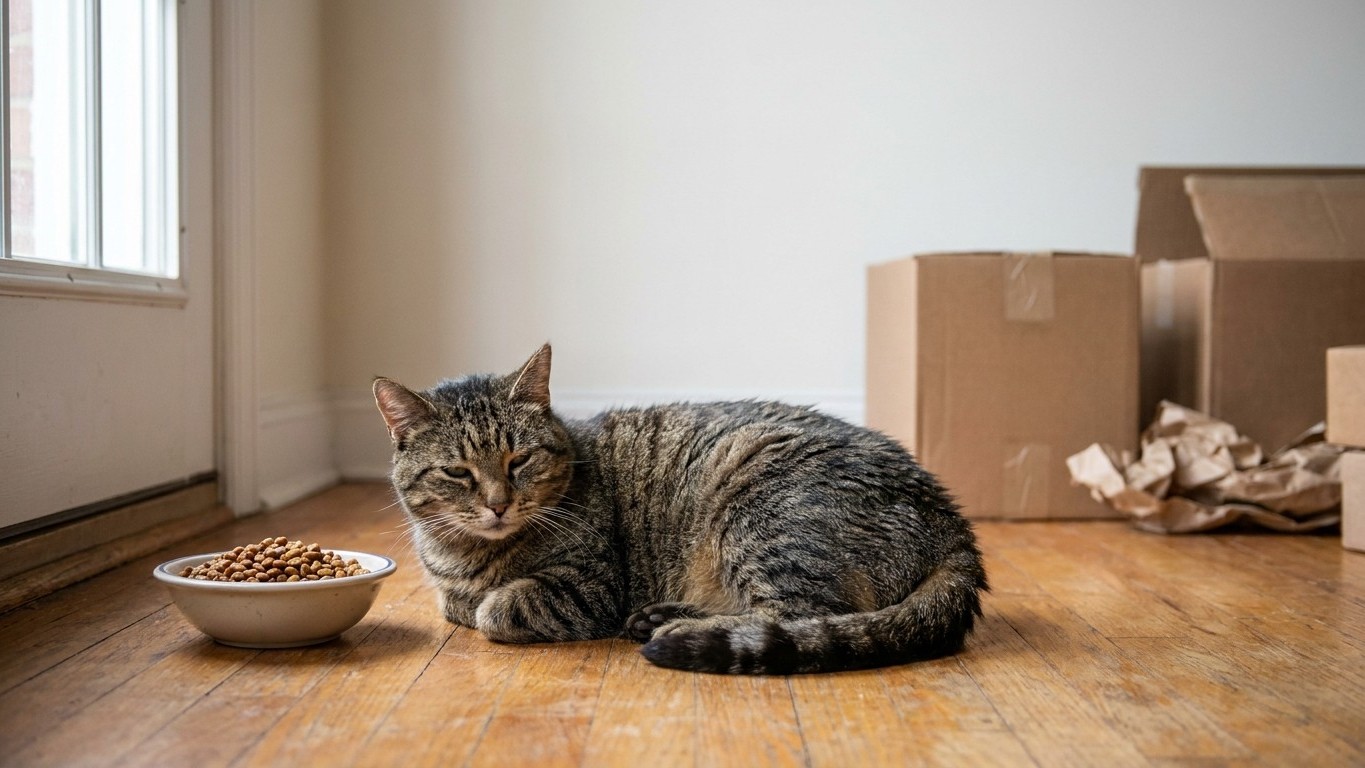
A cat that turns his nose up at dinner the day after a house move is usually just sulking. Give it 24 hours, though, and sulking becomes something the vet needs to know about, particularly if that cat carries a bit of extra padding around the middle. The stomach isn’t what pays the price for a prolonged strop. It’s the liver.
The condition is called hepatic lipidosis, or fatty liver disease, and it’s one of the more brutal ironies in feline medicine: a chunky cat’s own fat reserves become the thing that could kill him. This condition is called “hepatic lipidosis” or “fatty liver” and is most common in overweight cats, although it can occur in any cat. Vets I’ve spoken to over the years describe it as the single biggest reason a stressed, food-refusing cat needs attention within a day, not a week.
Key takeaways
- A stressed cat’s body mobilizes fat to the liver so rapidly that the organ becomes overwhelmed within days—and overweight cats are at highest risk
- Moving house, new pets, or boarding are textbook triggers, but most owners don’t realize the 24-hour window before it becomes an emergency
- The treatment requires a feeding tube, not coaxing—and the condition has a stark either/or outcome that depends entirely on timing
Why a chubby cat’s own fat turns against him
Cats are not small dogs with fur, whatever the pet food aisle might suggest, and nowhere is that clearer than in how their bodies handle starvation. When a cat stops eating, the body starts breaking down stored fat for energy. In cats, that fat is processed through the liver inefficiently, and within one to two days it can overwhelm the liver and trigger a condition called hepatic lipidosis. Put a cat off his food for a couple of days and his own body starts cannibalising itself, sending fat pouring into an organ that simply can’t cope with the volume.
Large amounts of fat get sent to the liver and end up inside liver cells, sometimes so much fat that the cells can no longer function normally, and this is what’s known as hepatic lipidosis or fatty liver disease. An overweight moggy is at particular risk simply because there’s more fat sitting around waiting to be mobilised. A 6kg cat that should weigh 4.5kg has significantly more fat available for mobilisation, which means the liver gets overwhelmed faster. Vets at Purina’s veterinary research arm note that healthy cats can develop the condition too, purely from stress, a rejected new diet, or simply not having access to food, no underlying illness required. It’s a rare example of a disease that punishes an animal for having too much of a good thing (energy reserves) at exactly the wrong moment.
Moving house sits near the top of the trigger list
Vets see this pattern often enough that it’s practically a textbook entry. According to Wikipedia’s summary of veterinary literature on the condition, one of the reasons a cat may stop eating is separation anxiety and the emotional stress that results, with moving, gaining or losing housemates or pets, going on vacation, or prolonged boarding all common situations that pet owners report just prior to the onset of the disease. The Merck Veterinary Manual lists exactly the same culprits, describing moving to a new household, newly introduced pets, loss of pets or family members, boarding, or accidental confinement as recognised environmental stresses that push a cat off his food.
None of this means every cat who’s a bit off his kibble after a move is in danger. Most bounce back within a day, sniffing suspiciously at the new kitchen before eventually tucking in. The trouble starts when that fussy phase stretches past the 24-hour mark. Research summarised by veterinary sources puts the onset window firmly in the “days, not weeks” category: hepatic lipidosis can develop in as little as 48 to 72 hours of complete food refusal in overweight cats, and it can be fatal without treatment. Some clinicians see it moving even faster in cats carrying significant excess weight, which is why the advice from most practices is blunt: timeline can develop in 2-7 days without food, faster in overweight cats.
Spotting it before it becomes an emergency
The early warning signs are easy to dismiss because they overlap with ordinary stress. A cat hiding under the bed after a move isn’t unusual. Vomiting, drooling and a general flatness are worth watching, but the giveaway sign, and the one that means you shouldn’t wait any longer, is jaundice: a yellowish tinge visible in the whites of the eyes, the gums, or even the inside of the ears. Cats with hepatic lipidosis are often depressed and dehydrated, may vomit or drool, and may have a yellow tint to their eyes and skin. By the time that colour change appears, the liver is already struggling badly.
Weight loss is another red flag, and it can be dramatic. Affected cats are often middle-aged and have lost at least 25% of their body weight by the time the condition is properly diagnosed, which tells you how quickly the fat mobilisation runs away with itself once it starts. A vet will usually want blood work alongside a physical exam and a history of recent stress or dietary changes, since specific blood work should be done including a complete blood count and biochemistry panel, which will look at the white and red blood cells, kidney and liver function, electrolytes, and protein levels.
What treatment actually looks like
Here’s the genuinely frustrating part: a cat with hepatic lipidosis often can’t be coaxed back to eating with treats and patience alone, however tempting that feels. Most cats with hepatic lipidosis will not eat enough on their own to overcome this condition, so a feeding tube is the best option to help stabilise the cat’s health. Force-feeding with a syringe is actively discouraged, since the use of a syringe or “force” feeding is strongly discouraged since this causes additional stress and may potentially lead to food aversion or aspiration. Instead, vets typically place an oesophagostomy tube, a small feeding tube inserted through the side of the neck under a brief anaesthetic, which most cats tolerate remarkably well once it’s in.
The tube usually stays in for weeks rather than days, and the disease itself has a stark either/or quality to it. Hepatic lipidosis either resolves within 14–21 days or the patient dies, chronic survival does not occur, and recurrence after recovery is rare. That’s a sobering statistic, but it cuts both ways: caught early, most cats make a full recovery and never see the condition again. The lesson for anyone whose cat has just moved house, gained a new housemate, or endured a stint in the cattery isn’t to panic over a skipped breakfast. It’s to start the clock the moment the bowl stays full, and to pick up the phone well before day two.
Sources : petmd.com | vcahospitals.com