
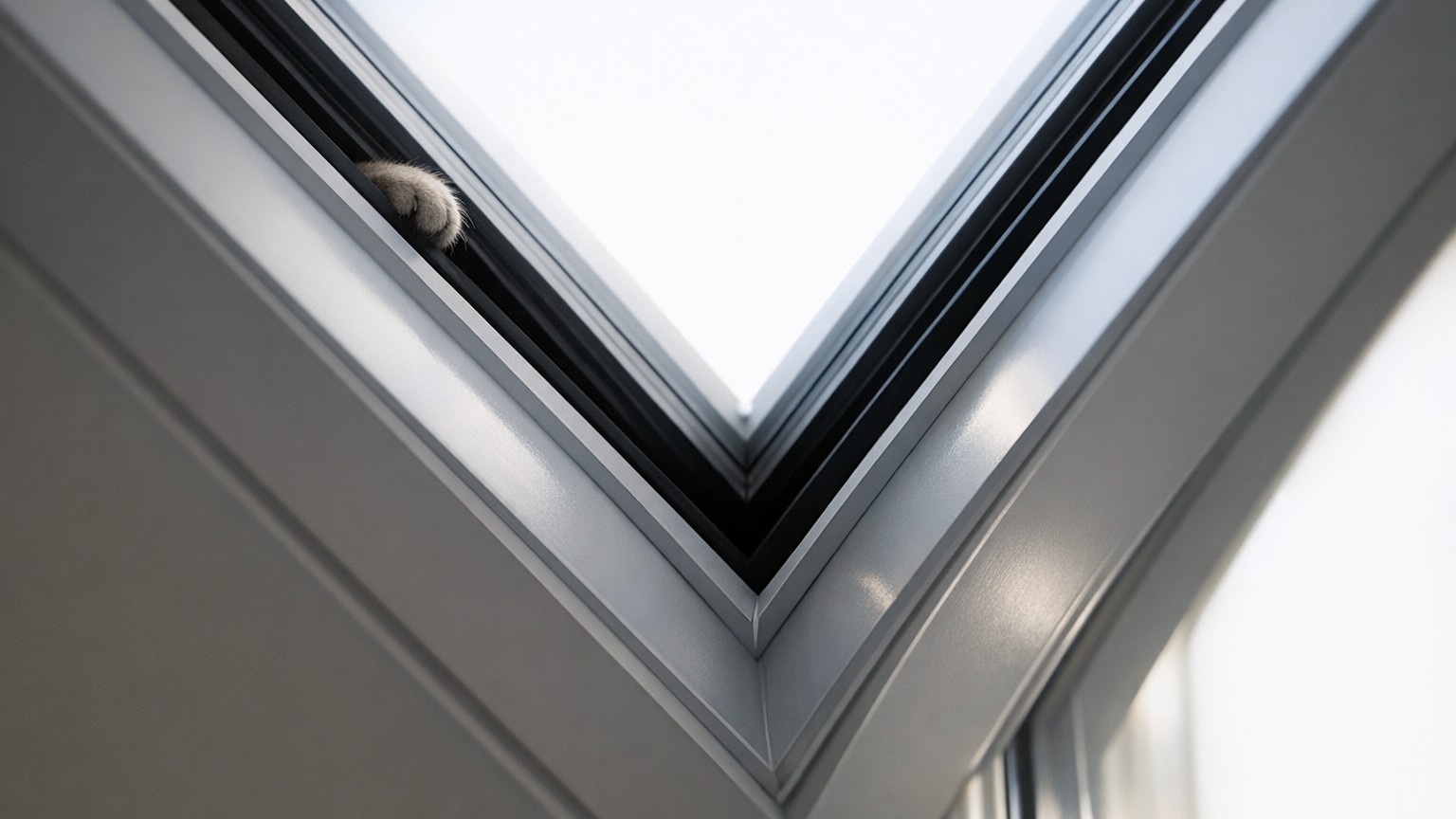
Every June, the same ritual plays out in homes across the UK: the temperature nudges 25°C, the flat warms up like a greenhouse, and the tilt-and-turn window gets cracked open a few inches so everyone can breathe. It feels sensible. It feels safe. The gap is barely large enough for a hand, let alone a cat. Except that assumption is precisely what lands hundreds of cats in veterinary emergency rooms each summer.
Key takeaways
- A seemingly tiny gap in a tilted window can trap a cat with devastating consequences—but most owners have no idea the danger exists
- Indoor and young cats are at highest risk during summer months, and the damage happens faster than most people realize
- Simple, affordable safety solutions exist that don’t require drilling or sealing your home like a bunker
A V-shaped gap that becomes a vice
The opening of a tilt window has the shape of a pointed, downward-facing triangle. That geometry is the entire problem. Cats can try to climb outside using a tilting window. In many cases they lose grip because of the smooth frame, and fall into the gap of the tilted window. Once a cat slides into that narrowing V, it can no longer free itself and slips into the trap more and more deeply when trying to escape the problematic situation.
The condition even has a clinical name borrowed from German: Kippfenster syndrome (Kippfenster simply meaning “tilt window”). It occurs when cats get trapped in these tilted windows, causing severe injuries including nerve damage, circulation problems, and potentially fatal complications. A published study in the journal Veterinary Record looked specifically at this injury pattern: this trauma syndrome occurs when cats try to escape through the small V-shaped opening at the top of bottom-hung windows, but instead become trapped. The animals had reportedly been lodged in the window between the last rib and the pelvis or caught by a single limb; when attempting to free themselves, they slid even further forward, ending up with clinical signs of ischaemia of the affected limbs.
Typically, cats rescued from a tilted window end up with numb hind legs, because of their blood vessels getting “trapped” by the position. The pressure cuts off circulation to the rear of the body, and the longer the cat remains stuck, the more severe the damage becomes. According to veterinary research from the Vetmeduni Vienna, depending on the duration, being stuck in the window gap can lead to a life-threatening situation for cats. Even after a cat is freed, the danger is not over: the pressure from being wedged in the narrow opening can cut off blood circulation, leading to reperfusion syndrome when the cat is finally freed, a condition that can be life-threatening even after rescue.
Why June, July and August are the worst months
Research has found that statistically June, July and August are the most dangerous months for cats and open windows. The logic is obvious: we want air. The cat wants what is outside. A cracked-open sash in a terrace, a top-floor casement in a flat, or a tilt-and-turn window in a modern block can all look manageable until a cat climbs, leans, or pushes where you didn’t expect.
The cats most at risk are not necessarily the bold outdoor adventurers. Indoor cats might not often encounter heights outside, so they may lack the awareness and caution needed to judge distances correctly. Young cats, too, are particularly vulnerable: according to research from the Clinical Unit of Small Animal Surgery at the Vetmeduni Vienna, accidents are on average more frequent among younger cats than among older ones. A kitten encountering its first summer of open windows, driven by curiosity and that irresistible scent of the outside world, is a kitten genuinely at risk.
There is one piece of received wisdom worth challenging: the idea that a low window is safer. Falls from lower heights actually pose a higher risk of serious injury because cats don’t have enough time to properly orient themselves for landing. This means ground-floor windows and low balconies can be just as dangerous as higher locations. With tilt windows specifically, the floor height is largely irrelevant anyway, because the injury comes from entrapment, not from falling.
What happens if you find your cat stuck
The instinct is to pull the cat free as quickly as possible. Resist it. Never attempt to pull a trapped cat free forcefully, as this can worsen injuries. Instead, try to gently support their body weight while carefully manoeuvring them to safety. The goal is to reduce the pressure on the torso and hind limbs rather than adding traction in the opposite direction.
Once free, the cat needs to see a vet immediately, even if it seems physically unharmed. Even if there are no visible injuries after a window accident, the cat should undergo a check by a vet. Internal injuries can lead to a life-threatening situation even hours or days after the accident. Cats are, frankly, experts at masking pain, and cats are good at hiding discomfort until a condition becomes critical. Circulation damage to the hind legs in particular can look deceptively mild in the first hour. Clinical signs that can be related to ischaemia include coldness of the affected limbs, no palpable femoral pulses and low rectal temperatures. A vet can assess for these signs and act quickly. Never wait and see.
How to keep the windows open safely
The good news is that the fix is genuinely simple, and it does not require sealing the flat up like a tomb. Several practical options exist for UK homes, including many in rented accommodation where drilling is off the table.
The most straightforward solution for tilt windows is a protective grille or fencing panel that covers the V-shaped gap when the window is open. Tilt windows require specialised protection devices; effective options include safety grills that cover the gap when windows are tilted, window stoppers that limit how far a window can open, and protective blocks that prevent the window from creating dangerous narrow openings. These can be screwed to the frame for a permanent fit, or fixed using heavy-duty adhesive strips for renters, as heavy-duty double-sided foam tape works without drilling and covers all the gaps that matter, at reasonable cost.
For windows that open fully, sash windows, casements, patio doors, a full-panel mesh screen is the better choice. The critical failure point for cat window mesh is often frame disengagement rather than the mesh itself tearing, especially at corners and the sill. That means measuring carefully and choosing a product with a secure perimeter fit, not just a light magnetic hold. Simple fly screens are completely insufficient for cat safety and should never be relied upon as protection.
A cheaper, temporary stopgap (no pun intended) works surprisingly well: placing a thick towel into the gap on both sides can prevent the cat from getting stuck in the narrowest part of the window. It is not elegant, and a determined cat may dislodge it, but for an afternoon when you simply need air and have no grille to hand, it genuinely reduces the risk.
One detail that often catches people out: if you go on holiday and leave someone else in charge of the house, they may not know about your window precautions at all. It is worth specifically instructing anyone watching over your home during a holiday not to open a tilting window without using any protection. That single conversation could make the difference. The Kippfenster hazard is well known in Germany and the Netherlands, where tilt-and-turn windows have been standard for decades, but in the UK, where these windows became widespread only in the UPVC era, awareness is still catching up to the architecture.
Sources : pmc.ncbi.nlm.nih.gov | flyscreens.biz