
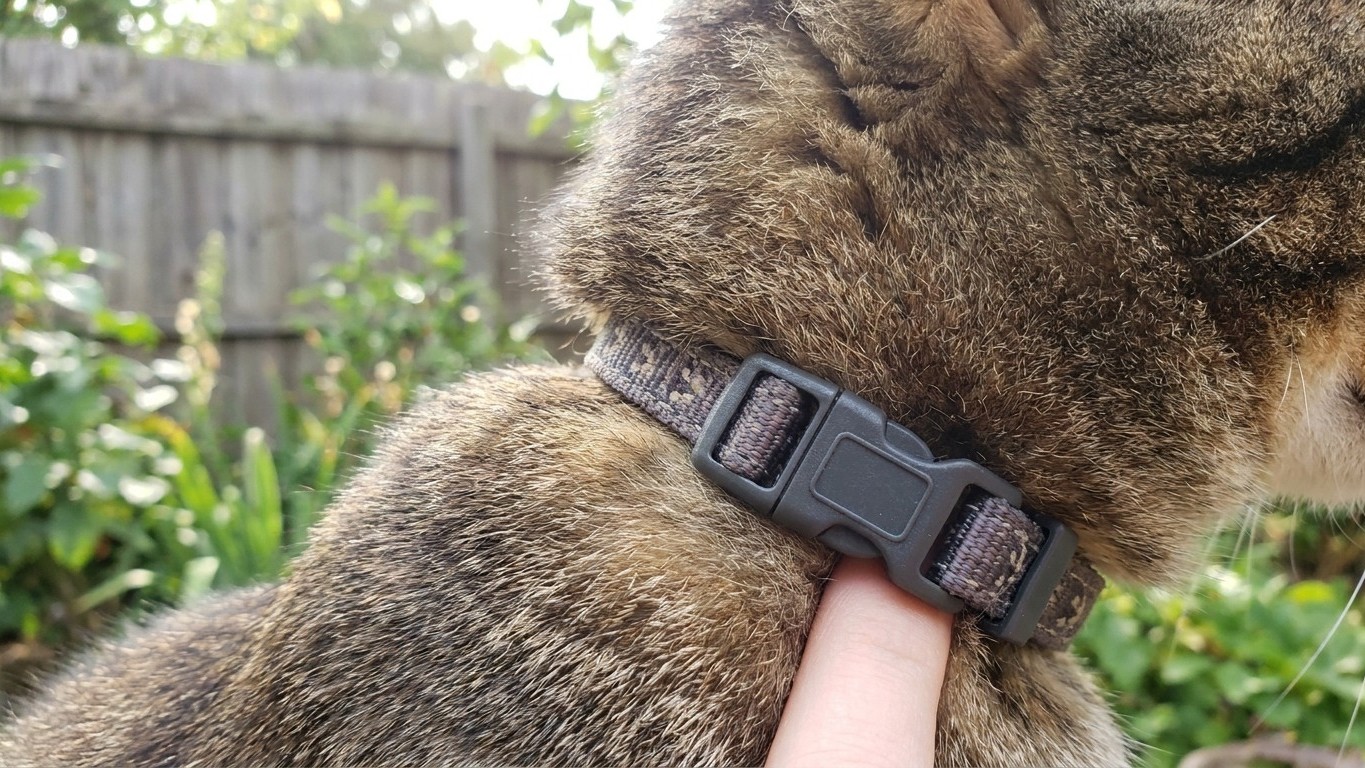
The two-finger rule for cat collars is one of those pieces of advice that gets passed along so routinely it feels ironclad. When you fit a collar on your cat, you should be able to fit two fingers underneath comfortably. Reasonable enough. But here’s the problem nobody mentions in the same breath: your cat’s collar can get stuck on things such as a branch or fence post, and if it does not easily release, your cat can become distressed, injure themselves in their attempts to pull away, or even be put at risk of choking. That two-finger gap, the one you were told was perfectly safe, is exactly what can hook on a splintered post top, a gate latch, or a loop of wire and refuse to let go.
Key takeaways
- A seemingly harmless gap in your cat’s collar could turn any garden fence into a choking hazard
- The ‘safe’ elastic collars that stretch to release actually cause 39% of collar injuries studied
- One design feature consistently prevents collar strangulation—but most pet owners don’t know it exists
A Surprisingly Common Hazard
The RSPCA receives hundreds of reports of cats being injured by their collars every year. Behind each of those reports is a real animal in genuine distress. Collar strangulation occurs when a pet’s collar gets caught on an object, fence, or even another animal, and while attempting to get away, the collar tightens around their neck restricting airflow. A panicked cat doesn’t sit still and wait for help. This often involves climbing or squeezing through hedges and undergrowth, which means they could easily catch their collar on a branch and become trapped, and even if they manage to get free, it’s very easy for them to hurt themselves as they struggle to get loose.
The collar snagging on a fence post is not a fringe scenario. It is the kind of thing that happens on an ordinary Tuesday afternoon in an ordinary British garden. Cats can become caught or trapped on fences, gate posts or branches, which can lead to them being unable to escape or potentially choking. And the risk grows with accessories. Bells, discs, and other collar accessories can be hazardous — they can easily get caught or trapped in small areas, for example between fence panels, causing your cat to become trapped. That chirpy little bell you attached to warn the local sparrows? It could be the very thing that gets your cat killed.
The injuries that follow entrapment are frequently severe. The RSPCA has documented case after case: one cat had got her leg stuck in her collar, which had been cutting into the skin under her arm. She was rushed to an RSPCA animal hospital, but she died just as the vet was about to bring her in. It was so incredibly sad. In another case, a collar had become completely embedded into a cat’s neck and the wound was infected. It is thought he had been injured for around three weeks. He underwent surgery and made a full recovery. Three weeks. Stuck, in pain, and invisible to everyone who loved him.
The Hidden Flaw in “Safe” Collar Designs
Many cat owners reach for what they think is the responsible choice, an elasticated collar. The idea being that if a cat gets snagged, the elastic will stretch and the cat will wriggle free. In practice, 39% of collar injuries seen in one study were caused by elasticated collars — people thought that letting the collar stretch would be helpful, but vets were finding that cats were able to stretch the collar enough to get a paw through and then got stuck, leading to injuries. That’s a majority of collar-related injuries caused by the very design meant to prevent them.
When a cat gets caught on something, it struggles and twists. An elasticated collar will potentially twist and strangle the cat. The RSPCA warns against collars made from elastic, and says the majority of flea collars are also dangerous. Flea collars, in particular, rarely have a breakaway mechanism and are typically made from rigid materials. The chemicals they emit don’t compensate for the structural hazard they present.
The collar design that animal welfare organisations consistently recommend is the quick-release or breakaway collar. Also known as a breakaway or safety design collar, this design means that if your cat’s collar becomes stuck on something, they can pull away and leave the collar behind, instead of getting trapped themselves. The key detail is in how it releases: equipped with a breakaway buckle, these collars automatically open under sufficient force, such as when a cat gets snagged or caught. In that same study of collar injuries, no injuries were associated with cats wearing a breakaway buckle collar.
There is one practical wrinkle worth knowing. You should test the quick-release mechanism before you put the collar on your cat. It should open under a light amount of pressure. If the collar won’t come apart at all, then it can be dangerous. Some cheaper quick-release collars on the market have buckles that are far too stiff to open reliably under a cat’s bodyweight, rendering the safety feature effectively useless. Pull the clasp apart with your own hands before it ever goes near your cat’s neck.
Fitting It Right, and Why Two Fingers Might Not Be Enough
When you fit the collar on your cat, you should be able to fit two fingers under comfortably. Too tight and it will be uncomfortable for your cat; too loose and they could seriously hurt themselves. The problem is that “two fingers” varies enormously depending on who’s doing the checking. For smaller cats or kittens, you might want to use just one finger as your guide. The point isn’t the fingers themselves, it’s achieving a fit that is snug without any excess band flopping about, which is precisely what catches on protruding nails, fence post tops, and metal gate loops.
If a collar is too loose, your cat might even be able to get it stuck around their body, which will gradually cut into their skin over time. If a cat goes missing and gets stuck this way when there is nobody around to help them, the wound can become infected and cause severe problems. Once you’ve fit the collar, check the fit again after a few minutes. When you first put it on, cats may hunch or tense their neck muscles, so you’ll need to double-check the fit before letting them venture out.
Kittens need particular attention. It is inadvisable to place collars on young kittens. However, if you do choose to fit your kitten with a collar, bear in mind that young cats grow very quickly and you’ll need to check the collar every few weeks to ensure it’s not too tight. A collar that fit perfectly in September can be embedded in skin by December if nobody has checked it. Check the collar every few days to make sure it hasn’t become loose or tight, and that it doesn’t have any damage or loose threads that could hurt your cat.
The Microchip Question
The most common reason British cat owners put a collar on in the first place is identification, the hope that a neighbour or a vet will be able to return a lost cat. But the most effective alternative to a collar is to ensure that your cat is microchipped — and even if you decide to use a collar, you need to have your cat microchipped. This is no longer merely good advice in England. All cat owners must ensure their cat is microchipped from the 10th of June 2024. Cats must be microchipped before they reach the age of 20 weeks, and their contact details must be stored and kept up to date in a government-approved pet microchipping database.
A collar with an ID tag still has genuine value, a member of the public who spots your cat in a garden won’t have a microchip scanner in their pocket, but they can read a phone number embroidered on a collar at a glance. The solution most welfare organisations endorse is both: collars must be fitted correctly, checked regularly, and have a safety breakaway piece to prevent strangulation if caught on something — and losing collars over the years indicates just how often they can get caught. Which, if you think about it, is actually reassuring. Every lost breakaway collar is one that did its job.
One aspect of this debate that tends to go unreported: even “safety collars” with a breakaway clip or elastic parts do not fully prevent severe incidents, albeit rarely. Nevertheless, the use of breakaway collars is considered vital. No collar design eliminates all risk entirely. But a well-fitted, quick-release collar on a microchipped cat gives your pet the best of both worlds, visible identification that actively works to free them if things go wrong. If you have any concerns about the right collar for your individual cat, especially if they have a health condition or are very young, always speak to your vet first.
Sources : justanswer.com | justcatcafe.com