
Every spring, as gardening season kicks off and neighbourhood lawns get their first chemical treatment of the year, millions of households unknowingly turn their front doorstep into a contamination corridor. The culprit is not visible, has no smell, and is certainly not something a doormat can stop. Weed killers and other pesticides applied to lawns can be tracked into homes by people and pets up to a week after treatment, causing unnecessary exposure. You walk across the neighbour’s freshly treated path, or stroll through the park, or cut through a gleaming-green council lawn on your way home, and then you bring spring right indoors with you, on the soles of your shoes.
My cat paid the price before I put two and two together. She started overgrooming, then vomiting intermittently. The vet found nothing obviously wrong, but asked, quietly and without alarm, whether I’d been walking on treated grass. I had. Often.
Key takeaways
- A common spring habit is silently poisoning your indoor cat through a pathway you’ve never considered
- The chemicals linger far longer than product labels claim, and your neighbours’ lawns matter as much as your own
- One biological quirk of cats makes them fatally vulnerable to exposure levels that would barely affect a dog
The real contamination route: it’s not your shoes, it’s your floor
Here is the part that genuinely changes how you think about this. Indoor pets may be affected by cleaning products and pollutants tracked in on the bottoms of our shoes, and as with children, pets breathe more air and take in a greater amount of toxins than adult humans. But the reason cats are especially vulnerable has nothing to do with breathing. It is their grooming habit that Transforms every particle on your floor into something they can swallow.
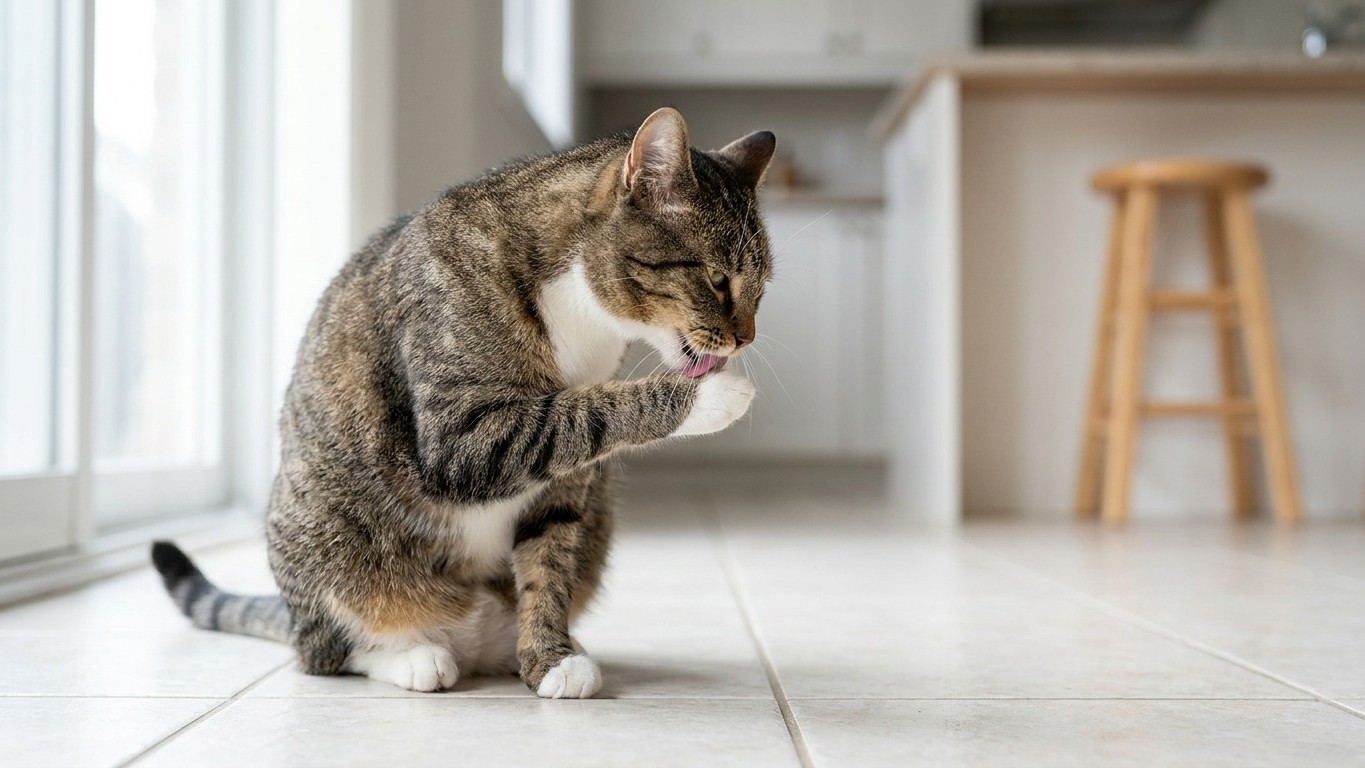
Grooming behaviour turns every other exposure route into an ingestion problem. Your cat walks across a treated floor, then spends twenty minutes cleaning her paws. Surface residue becomes oral intake. Think about that for a moment. You wipe your shoes at the door, feel virtuous, walk across the kitchen tiles, and your cat follows ten minutes later, licks her feet, and has ingested whatever herbicide or insecticide residue came home with you. The doormat barely registers in this equation. Cats live at floor level where pesticide particles settle. They sleep there, they breathe there, they exist in the zone where exposure hits hardest.
Chemicals from a treated lawn can travel inside on your pet’s paws as well as the soles of your shoes, bringing chemicals into the home, which can then expose other pets in your household, including cats. So if you share a household with both a dog who goes outside and an indoor-only cat, the indoor cat is not protected. Not even slightly. The dog is the carrier.
What these chemicals actually do to a cat’s body
Although both dogs and cats can absorb pesticides through licking their fur, cats are particularly vulnerable to this accidental ingestion due to their grooming habits. But there is a deeper Biological reason why cats suffer more acutely than other animals. When cats eat something they shouldn’t, their small body size, ability to hide (so that signs of poisoning aren’t immediately obvious), and the fact that their livers are unable to break down certain chemicals, means when they do ingest something toxic, recovery is more difficult.
Cats are highly sensitive to synthetic pyrethroids (often found in insecticides) which trigger seizures, tremors, muscle spasms, and even death. These pyrethroids appear in garden insecticide sprays. Also, in some flea treatments designed for dogs, which is why You Should Never apply a dog’s flea product to a cat, and why even handling your cat after treating your dog can be risky. Common lawn care pesticides contain chemicals that are known to pose a serious risk to your pet’s health, including several types of cancer, respiratory and reproductive problems, and endocrine disruption, and pesticide residues can remain on lawn surfaces for weeks or months.
The herbicide glyphosate is particularly worth discussing, not because it is the most immediately toxic compound, but because of how widespread its presence has become in the bodies of our pets. A study determined concentrations of glyphosate and its derivatives in urine collected from 30 dogs and 30 cats in New York State, finding glyphosate was the most predominant compound in pet urine, with mean urinary concentrations in cats roughly twice as high as in dogs. Researchers believe much of this exposure comes via pet food ingredients, but environmental contact (treated lawns, contaminated soil carried indoors) contributes meaningfully too.
The signs of low-level, chronic pesticide exposure in cats are easy to miss or misattribute. Toxins may produce gastrointestinal signs such as drooling, lack of appetite, gagging, vomiting and diarrhoea; neurological signs including hiding, hyperexcitability, incoordination, tremors, seizures, lethargy or coma; and respiratory signs such as coughing, sneezing, panting or difficulty breathing. : the kind of thing a worried owner attributes to a dodgy bit of food or a passing bug, and waits a few days to see if it resolves. If your cat shows any of these signs and you have recently been walking on treated grass, please contact your vet.
The spring risk is higher than you think, and it’s not just your garden
Spring is when this matters most. Councils treat parks and verges, neighbours haul out the weed killer for the first time in months, professional lawn services start their schedules. Common lawn care pesticides contain chemicals that pose a serious risk to your pet’s health, including several types of cancer, respiratory and reproductive problems, and endocrine disruption. Pesticide residues can remain on lawn surfaces and leaves for weeks or months, depending on rainfall and watering practices.
Studies show that even though most weed killer bottles say that you and your pets should keep off sprayed lawns for only 6 to 24 hours, chemical residue can linger on surfaces for up to 48 hours after application. And that assumes it is your own garden where you know when treatment happened. Out in the street, at the park, on the path to the shops, you have no idea. Pesticide residues can remain on lawn surfaces and leaves for weeks or months, depending on rainfall and watering practices. A perfectly dry, sunny week after a park treatment is the worst scenario: no rain to dilute, plenty of residue clinging to shoes and paws.
The neighbour’s lawn is a real factor too. Even if you don’t use these products in your own yard, your neighbours might, which becomes a concern if you allow your cat to roam outdoors. If neighbours spray their properties or use a chemical lawn service, try to keep your pets indoors during and for about a half-hour afterward to avoid airborne drift.
What actually helps
Taking shoes off at the door is the single most impactful habit change, and it genuinely works. “The consistent removal of outdoor shoes at the door by both the homeowner applicator and children can reduce the levels brought indoors. Carpeting at the door, rather than a bare floor there, can be used to catch the residues that do enter.” A rough-pile doormat inside, combined with shoes left in the porch or hallway, creates a meaningful barrier. Not a perfect one, but a meaningful one.
If your cat ventures outside, or if your dog does and your cat doesn’t: if your pet has been on a pesticide-treated lawn, wash off their paws with a mild soap and water solution before they enter the house or they groom themselves. This will help to avoid accidental ingestion and possible contamination of carpeting, upholstered furniture and household dust. A small bowl of warm water and a few drops of washing-up liquid kept near the back door takes about 20 seconds. Remove your cat from the source of the poison and contact your veterinary team for advice immediately if you suspect exposure; make sure you know when, where, and how the contact occurred, and if possible take the packaging or substance with you to the veterinary clinic.
For your own garden, the approach that protects pets most reliably is simply using fewer chemicals overall. Natural, organic alternatives to lawn chemicals are better for the environment, although some may still present a health hazard, so always check the ingredients before using them around your cat. And you should wait 48 to 72 hours after applying any chemical, including fertiliser, before you allow your pet in the area; erring on the side of caution will help keep your animals safe.
One thing worth knowing: while dogs typically suffer poisoning through direct ingestion of baits or treated grass, felines face a twofold biological threat from their meticulous grooming habits and a highly specialised, enzyme-deficient liver. A cat does not need to eat a pesticide to be fatally poisoned, simply walking across a damp, treated surface and later licking their paws can induce severe neurological failure. The doormat was never the problem. The floor was.
Sources : sciencedaily.com | quora.com