
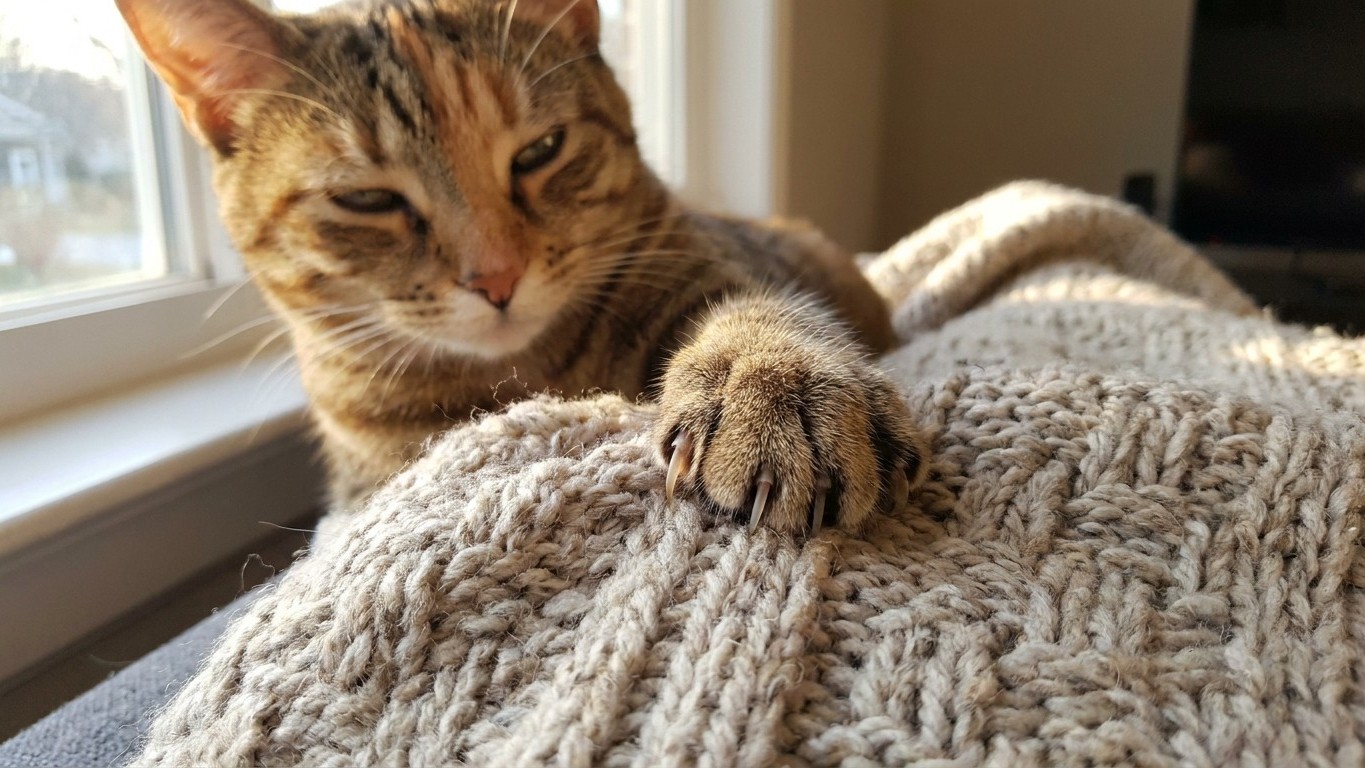
Those rhythmic little pushes against your legs aren’t just a throwback to kittenhood. Every time your cat kneads your lap, its paws are pressing out an invisible signature: pheromones released from glands tucked between the toes, quietly announcing that you belong to them.
Cat owners have long assumed kneading is simply a comfort ritual inherited from nursing kittens, who push against their mother to stimulate milk flow. That origin story holds up scientifically, but it’s only half the picture. When Your Cat Kneads you, it can also be a sign of affection, since kneading is a behavior that he performed as a kitten with his mother, and kneading can convey a sense of comfort and security. What most owners never clock is the second, less sentimental function running alongside the nostalgia: scent deposition.
Key takeaways
- Those rhythmic paw pushes release pheromones from glands cats use to mark what belongs to them
- Your cat’s choice to knead YOUR lap specifically is a powerful trust signal and territorial claim
- The chemistry involved is so sophisticated that other cats can read status, familiarity, and even reproductive information from it
The chemistry hiding in your cat’s paw pads
On the underside of a cat’s paws, there are two pairs of scent glands: the digital scent glands on each toe pad, and the interdigital scent glands situated between the toes. They’re modified sweat glands, working quietly with no smell detectable to us, yet cats have about 67 million scent receptors compared with a human’s five to 20 million, meaning these chemical messages speak volumes to them. Every knead presses that scent straight into whatever, or whoever, is underneath.
The specific compound involved is worth knowing, because it explains why cats are so particular about where they settle. These glands release pheromones, including a sulfur-containing compound called felinine, onto whatever surface the cat presses against. Felinine itself is fairly unremarkable chemically, but combined with a cat’s individual scent profile it becomes a kind of biological fingerprint, unique enough that other cats can read status, familiarity and even reproductive information from it. Scientists studying pedal scent in other carnivores have found similarly rich information encoded in footpad secretions; reindeer use scent left by interdigital glands to find their way back to their herd, while polar bears spend far more time investigating interdigital scent from the opposite sex when searching for a mate. Cats aren’t quite doing mate-searching on your sofa, but the underlying biological toolkit is the same one nature gave to much larger, wilder relatives.
Why your lap specifically?
Kneading isn’t random. Cats often knead on people for the same reasons they knead blankets and other soft objects, whether that’s relaxation, stress relief, or tamping down material in their sleeping spot, and you’ll typically see this before they tuck their paws under themselves for a snooze. But the choice of target matters enormously to a cat. When a cat kneads your lap specifically, it’s marking you. You end up carrying their scent. Behaviourally, that’s no small gesture. Cats that sleep on you regularly and knead you are displaying some of the strongest trust behaviours in the feline repertoire, with no clearer signal that they consider you a safe, permanent part of their world.
There’s a social layer to this too, one that gets overlooked in the “cute cat behaviour” explanations. Facial rubbing and headbutting (bunting) deposit what behaviourists class as “friendly” pheromones, low-intensity signals used between cats who already trust each other. Paw-based scent marking works alongside that system. Scent is used to identify members of the same colony, define territory, create familiarity, announce reproductive status, learn more about unfamiliar cats in the environment, self-soothe, and bond with another. Your lap, in feline terms, becomes an extension of home turf, refreshed and re-claimed every time those paws press down.
When kneading gets sharper (literally) and what to do about it
The claws-out moment mid-knead catches most owners off guard, but it’s rarely aggression. Cats have scent glands located in the soft pads of their paws, and every time they push their paws into a surface, they deposit their own unique pheromones, leaving behind an invisible message that says “This is mine,” which helps a cat feel more secure and claims that person or object as part of their safe territory. Regular claw trims and a folded blanket over your lap solve the practical problem without dampening the affection behind it.
Context Matters More Than most owners realise. In entire (unspayed) females, the behaviour can shift meaning entirely: unspayed female cats sometimes knead differently when approaching or in heat, with the behaviour becoming more persistent and paired with loud vocalisations, rolling on the floor, and an elevated hindquarters posture, because the pheromones released from the scent glands signal reproductive availability to nearby males. That’s a useful clue for owners wondering whether recent changes in their cat’s kneading habits are behavioural or hormonal.
Sudden, obsessive kneading, particularly if it comes with excessive vocalising, wool-sucking, or kneading that seems compulsive rather than settling, is worth flagging to a vet rather than dismissing as quirky. If your cat’s kneading is the result of an underlying medical condition, speaking with a vet about how best to manage the illness may help correct excessive kneading more effectively. And whatever you do, resist the urge to discourage it. Cats should never be punished for kneading; yelling, hitting, or spraying with a squirt bottle may cause fear and anxiety, won’t correct the behaviour, and can actually make it worse.
Next time those paws start their familiar rhythm on your knees, you’ll know there’s rather more going on than a sleepy pre-nap ritual. Somewhere between the toes, glands smaller than a grain of rice are quietly rewriting your lap’s chemical address book, one contented squeeze at a time.
Sources : cats.com | americanpaws.club