
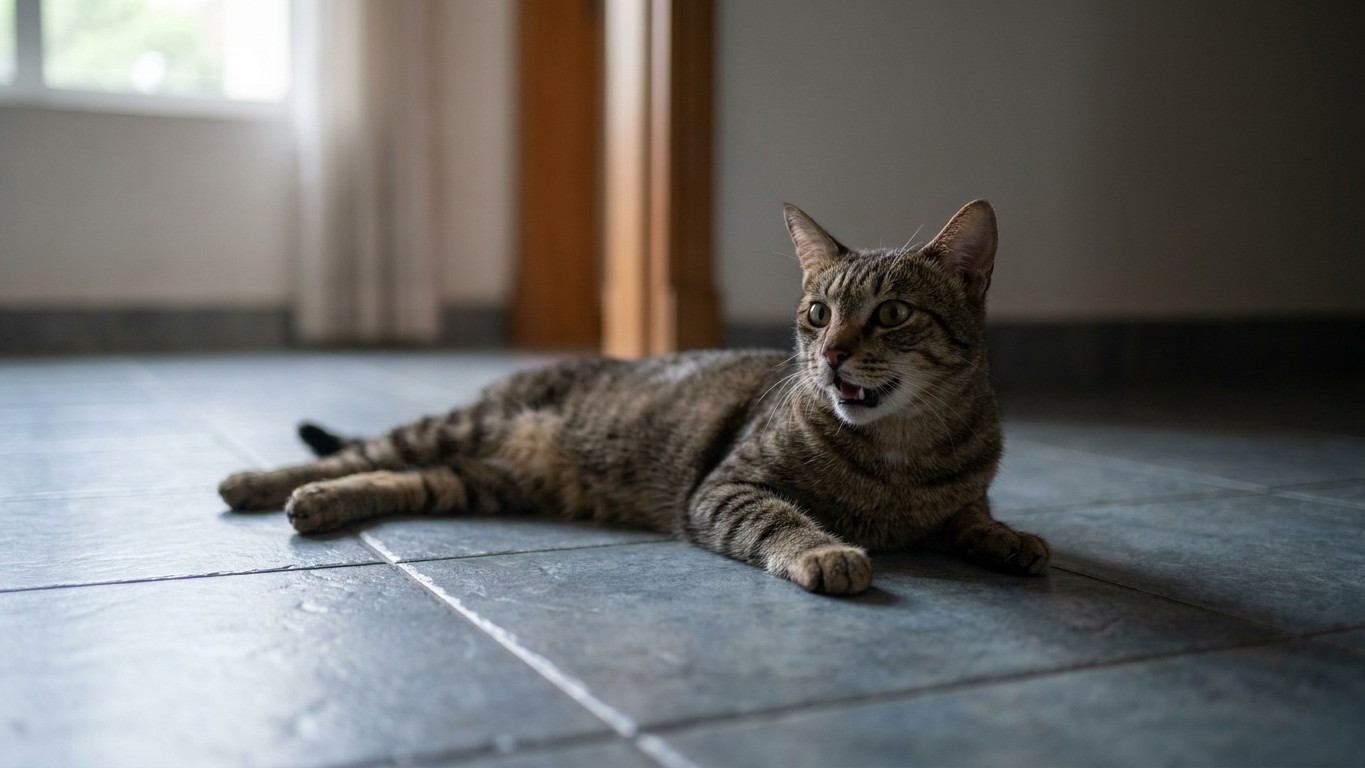
Conservatories turn into greenhouses within minutes once the sun hits the glass, and that’s exactly the trap my own cat fell into last week. I’d shut the door simply to stop the afternoon heat spreading through the rest of the house. When I opened it again barely an hour later, she was crouched low with her mouth slightly open, sides heaving in a way I’d genuinely never witnessed in eleven years of cat ownership. That sight, a healthy adult cat open-mouth breathing, is one every owner should take seriously the moment they see it.
Key takeaways
- Cats actively seek warm spots like conservatories but can’t cool themselves down once trapped—and panting in cats is NEVER normal
- The early signs are subtle: seeking cool surfaces, slightly faster breathing, and warm ears—but deterioration happens fast
- Open-mouth breathing, color-changed gums, or labored breathing means veterinary emergency NOW, not after you cool them at home
Why conservatories are such effective heat traps
Heatstroke in cats occurs most commonly if they get trapped in a hot, unventilated room, shed, conservatory, greenhouse or car during the warmer months. The physics behind it isn’t complicated: glass lets sunlight in easily but traps the resulting heat, and without a through-draught the temperature climbs far higher than outdoors. Most cases of heatstroke develop after being accidentally shut in a hot place such as a shed, greenhouse, conservatory, garage, or car. What makes this particularly cruel is that cats actively seek these spots out. Cats like to sleep in warm places, such as conservatories, greenhouses or sheds, and accidentally being trapped in very hot areas with little air circulation, especially in summer, can increase the risk of Overheating.
Some cats are considerably more vulnerable than others. Obese, long-haired, old, young and brachycephalic/flat-faced cats (such as Persians) are most at risk of developing heatstroke because they find it harder to cool down. Unlike dogs, who’ll overheat mid-walk on a warm day, it’s very unusual for cats to develop heatstroke due to overexerting themselves during exercise, which is precisely why the conservatory scenario catches so many owners off guard. Nobody expects heatstroke from a cat having a nap.
Reading the breathing: what’s normal and what isn’t
Here’s the fact that genuinely alarmed me once I’d calmed down enough to think straight: panting in cats is never normal and is always an emergency. Dogs pant constantly and it means nothing sinister. Cats are built differently. Heavy breathing is normal in dogs after running around but it is much less commonly seen in cats, though it does happen and you should be wary of serious conditions that can cause panting. As one vet-authored source puts it bluntly, cats rarely pant unless they’re overheated or stressed.
The distinction that actually matters in the moment is whether the breathing settles once the cat is somewhere cooler. Any panting that doesn’t improve within minutes of moving to a cooler area needs veterinary attention. Watch for the escalation too, because heat stress doesn’t stay mild for long. Early signs include seeking cool surfaces like tile floors or sinks and increased grooming, with mild low energy, slightly faster breathing, and warm ears meaning you should move your cat to a cooler environment and watch them closely. Left unchecked, things deteriorate quickly. Heat stress can quickly worsen if not addressed, and severe heatstroke shows as heavy panting, drooling, bright red or purple gums, and vomiting, with confusion, unsteady walking, or collapse following. If your cat’s gums have changed colour, that’s a red flag rather than a symptom to sit and monitor. If your cat’s gum colour seems to be a very pale pink, white, grey, blue or purple hued, or their breathing itself is very laboured, this could indicate they are not getting enough oxygen and need to be seen by a vet ASAP.
What I did, and what a vet would want you to do
My instinct was to scoop her up and cuddle her, which is exactly the wrong move. Offer your cat drinking water and don’t cuddle them or place anything over them as this will just make them warmer. Instead, cooling has to be gradual and controlled. Cooling your cat down needs to be gradual to avoid shock and not cause your cat stress, as stress can increase their body temperature further. Cats Protection’s advice matches this: you can use a cloth to wet their coat with lukewarm water and put them somewhere cool and safe before contacting your vet as soon as possible.
I phoned my vet’s out-of-hours line while wetting her coat with cool (not icy) water and sitting her in front of a fan, careful not to aim it directly at her face. That last detail matters. Take your cat to an air-conditioned room or shaded area with good airflow, and place them near a fan if available, but don’t aim it directly at them. This isn’t something to manage at home alone, though. Heatstroke is a medical emergency and can be fatal if not treated quickly. At the practice, they’ll take it from there properly. Your vet will start cooling your cat as quickly as possible using water, fans, ice packs, and possibly a fluid drip, and if they are extremely hot, Struggling to breathe, having seizures or are unconscious, your vet may also use anaesthesia, oxygen and other medications. Even a cat that seems to bounce back quickly may need bloodwork, because severe heatstroke can cause kidney damage and blood clotting problems.
Making sure it never happens again
The changes in my house have been simple but non-negotiable now. Doors to the conservatory stay wedged open on hot days, or she’s shut out of that room entirely with the door closed from the start, never left ajar for her to wander in unnoticed. Cats Protection’s broader hot-weather guidance is worth building into a daily habit rather than something you only remember mid-heatwave:
- Check any conservatory, shed or greenhouse before closing the door, in case a cat has slipped inside unseen
- Keep multiple bowls of fresh water around the house, since dehydration compounds overheating risk
- Provide shaded, well-ventilated spots so a cat isn’t forced to choose between sun and a stuffy corner
- Watch flat-faced, elderly, very young or overweight cats especially closely, as they cool down far less efficiently
What still catches me off guard, weeks on, is how ordinary the whole thing looked from the outside. No dramatic collapse, no yowling, just a slightly open mouth and a faster rise and fall of her ribs. That quietness is apparently the point. Cats are often quieter about discomfort, which makes heatstroke harder to spot. A closed door on a sunny afternoon feels like the most harmless household decision imaginable, right up until it isn’t.
Sources : greensboroncvet.com | vets4pets.com