
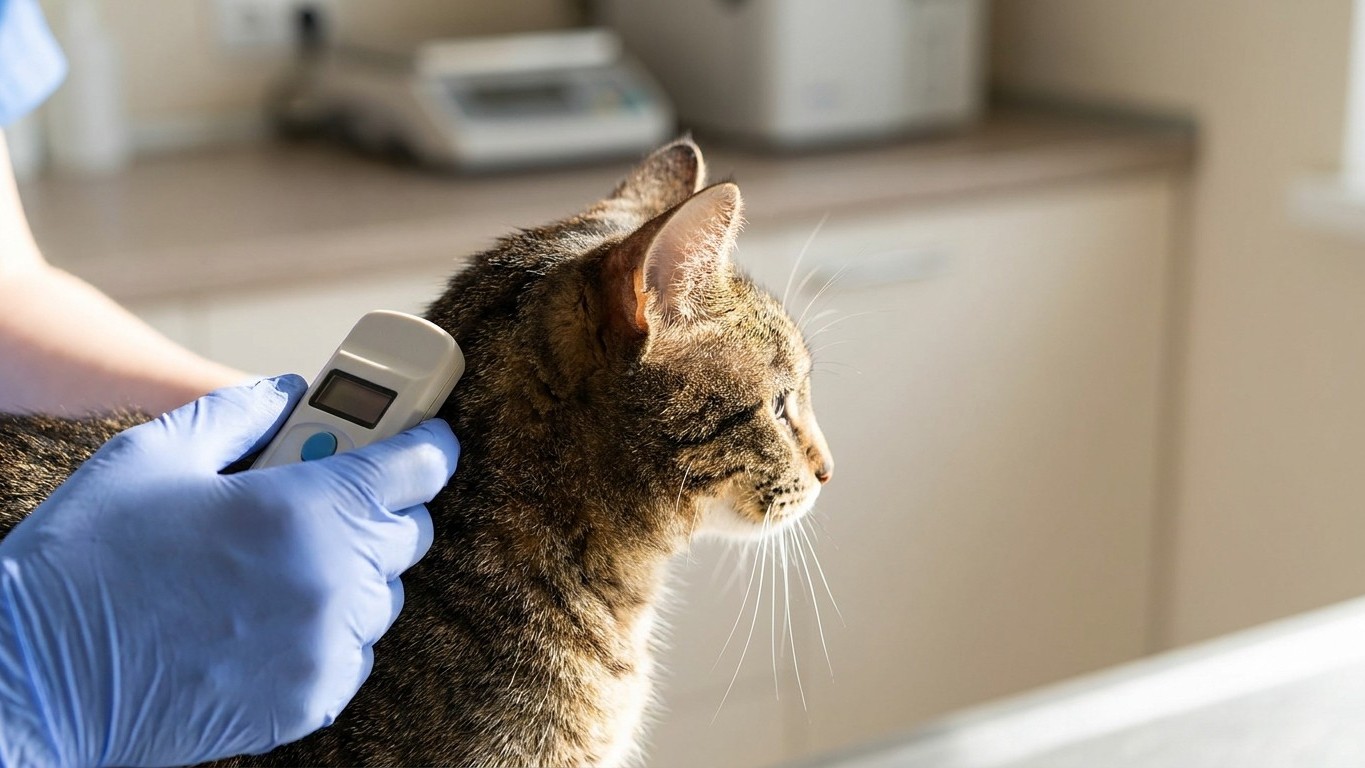
Six years. That’s how long my cat Marmite had been microchipped before a community support officer knocked on my door, scanner in hand, and I still ended up £500 lighter. The chip worked fine. The database entry existed. But one single line on that record, my old address from a house move three years earlier, had never been changed, and that alone was enough to land me with the maximum fine under England’s cat microchipping law.
Key takeaways
- A single outdated address on a microchip database record triggered a maximum £500 fine—years after the chip was implanted
- 54% of cat owners don’t even know microchipping is now legally required in England, and a quarter of cats remain unchipped
- Updating your pet’s details takes 10 minutes and is usually free—but nobody reminds you to do it
The Law Changed What “Chipped” Actually Means
Most people assume microchipping is a one-off job: get it done as a kitten, tick the box, forget about it. That’s not how the rules work anymore. The Microchipping of Cats and Dogs (England) Regulations 2023 requires that, from 10 June 2024, every dog older than 8 weeks and every cat older than 20 weeks must be microchipped and their details recorded on an approved UK database. The key phrase there is “recorded”, not just “implanted”.
A chip with stale information attached to it is, legally speaking, treated almost the same as no chip at all. If you buy or rehome a dog or cat, or if you change your address, you must also update your details on the database, and if your details are not up-to-date, this results in the dog or cat not being properly microchipped in accordance with the regulations, meaning you may be subject to enforcement action. I genuinely didn’t know that until the officer explained it on my doorstep.
The financial stakes are real and enforced. Owners found not to have microchipped their cat will have 21 days to have one implanted, or may face a fine of up to £500. In practice, that 21-day grace period applies to genuinely unchipped animals; when a chip exists but the record is wrong, some authorities treat it as an immediate compliance failure rather than a fresh countdown, which is exactly the trap I fell into.
The One Line That Cost Me £500
My mistake was ordinary, almost boring. Marmite came with us when we moved house, obviously. What didn’t come with us, at least not on paper, was an updated address on his chip database entry. I’d changed my GP, my bank, my council tax, everything except that one form. It sat there quietly wrong for three years.
This is apparently a common gap in compliance. Once microchipped, it is important that ownership details are kept up to date, both to comply with the law and to make sure your pet can be returned if lost, so you must update the microchip details through the microchip database operator whenever there’s a change to your address, telephone number, or owner status. Nobody sends you a reminder. There’s no MOT-style renewal notice landing on your doormat. The responsibility sits entirely with the owner, indefinitely, for the life of the animal.
What struck me most was learning how widespread this problem is, not just with lapsed updates but with cats never chipped at all. A 2024 PAW Report found that 54% of cat owners were not even aware that cats must be microchipped in England. Defra’s own figures paint a similarly patchy picture: there are currently over 9 million pet cats in England, with as many as a quarter of them, roughly 2.3 million, unchipped. An outdated address, in that context, feels like a minor sin. It still cost me the same as having no chip whatsoever.
Checking Your Own Cat’s Record Before an Officer Does
Here’s the bit I wish someone had told me sooner: fixing this takes about ten minutes, and it’s usually free. Contact isn’t made through your vet’s surgery, and it isn’t made through some single government portal either. A pet’s microchip is registered with an individual microchip company’s registry, not with their veterinarian or a single central database. That’s precisely why gaps open up when nobody follows the paper trail after a move or a rehoming.
Practically, you need three things before you call or log in: the microchip number itself, the name of the database it sits on, and proof you’re the current keeper (a vet invoice or adoption paperwork usually does it). If you’re not sure which company holds your cat’s record, your vet can scan the chip and tell you instantly, most practices keep a universal scanner behind the desk for exactly this reason.
A few things worth flagging when you do update your details:
- Address and phone number changes should be logged the same week you move, not “at some point”
- If you rehome a cat, ownership must be formally transferred on the database, not just verbally agreed between old and new keepers
- Check the database itself is on the government’s approved list, since being registered on an unapproved one counts as non-compliant
The irony is that microchipping was never meant to be punitive. The new legal requirement followed a government call for evidence and consultation which found 99% of respondents expressed support for microchipping cats. Almost everyone wants their pet found quickly if it goes missing. The fine exists purely as leverage to make sure the technology actually works when it’s needed, not as a way to catch out owners who did the right thing years ago and simply let one detail slip.
Since Marmite’s chip was implanted, England had already run this exact experiment once before with a different species. Compulsory microchipping of dogs came into effect in April 2016. Eight years of dog-chipping data clearly showed regulators that a chip on its own solves nothing if the contact details behind it are frozen in time. Cats simply inherited the same lesson, and I inherited the fine that proved it.
Sources : oakhill-vets.com | gulfnews.com