
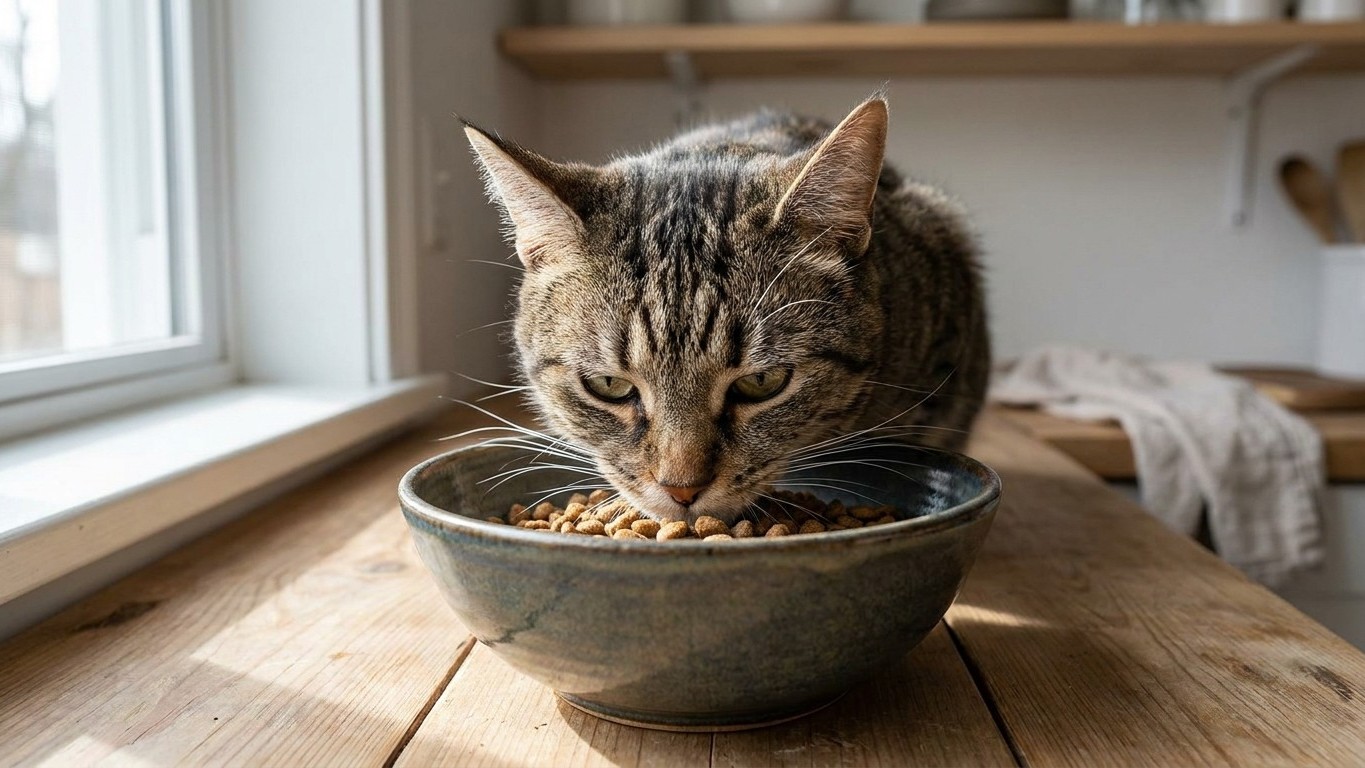
The bowl was full every time, topped up generously, sometimes twice a day, and still the cat would sniff, hesitate, then walk away hungry. It looked like fussiness. It looked like a cat turning his nose up at perfectly good food. But when a vet finally examined the whole set-up, the problem wasn’t the food inside the bowl at all. It was the bowl itself, specifically its depth, and the way it pressed against the cat’s whiskers every single time he tried to eat.
This phenomenon has a name: whisker fatigue, sometimes called whisker stress. Veterinarians use the term to describe the sensory overload cats feel when their sensitive whiskers repeatedly touch a surface, according to an article by Oklahoma State University Veterinary Medical Hospital. The theory sounds almost too delicate to be true, but the underlying anatomy is solid. Whiskers, or vibrissae, are anchored with roughly 100 to 200 neurons each, collecting tactile data about the environment. Each touch activates sensitive nerve endings at the follicle base, and occasional contact is normal, but repeated pressure at every meal may turn useful sensory input into irritation. Unlike us reaching up to brush a fringe out of our eyes, a cat cannot simply move her whiskers out of the way.
Key takeaways
- A vet discovered this cat owner’s ‘picky eater’ was actually experiencing sensory overload from a common household item
- Cats have 100-200 neurons in each whisker, and repeated bowl contact triggers uncomfortable nerve signals
- The solution might be sitting in your kitchen cupboard right now, and it costs almost nothing
What a deep bowl actually does to a cat’s face
Picture the mechanics of it. Every time a cat dips their head into a deep or narrow bowl, the sides press against the whiskers and send signals to the brain. A little brushing is neither here nor there. A little contact is fine, but constant contact, meal after meal, can become uncomfortable, and the result is a cat that may associate eating and drinking with low-grade discomfort. He’s still hungry, he still wants the food, but getting to it feels unpleasant enough that he hovers, paws at the edge, or hooks kibble out onto the floor to eat it somewhere less claustrophobic. Owners, understandably, read this as pickiness. It rarely is.
Tapered bowls make things worse rather than better. Bowls that get narrower toward the bottom are especially tough, since the whiskers get squeezed into a smaller space as the food gets eaten down. That’s a cruel irony: the bowl feels most oppressive right when the cat is hungriest and trying hardest to finish the last mouthfuls. Long-whiskered breeds such as Maine Coons or Persians may feel bowl contact more often, simply because there’s more whisker to catch on the rim. Water bowls deserve equal suspicion. Deep water bowls are especially common offenders because owners often pick taller, narrower designs to prevent spills, and a wide, shallow water dish or a pet fountain with an open top usually solves the problem. I’ve lost count of the cats I’ve heard about who ignore their bowl entirely and drink from a tap, a puddle, or someone’s abandoned glass instead. It isn’t defiance. It’s often geometry.
Where the science actually stands
Here’s where I have to be honest with you, because this topic gets oversold constantly by people with bowls to sell. In 2021, a study titled “Evaluation of whisker stress in cats” was published in the Journal of Feline Medicine and Surgery, aiming to determine if cats fed from a commercially advertised whisker-friendly dish versus their normal food dish would spend more time at the food dish, eat more, and drop less food. The study, based out of the School of Veterinary Medicine at Washington State University, tested 38 housecats. The conclusion was that the type of bowl made no difference at all to these activities, but it did find that, given the choice, more cats preferred the whisker-friendly bowl. So on the hard measures, eating speed, amount consumed, mess left behind, there was no difference whatsoever. But when cats were allowed to pick, something drew them toward the shallower dish anyway.
That nuance matters. Whisker fatigue is a new and controversial topic, and not all veterinarians believe it’s a valid concern, with almost no studies to determine the validity of the claim that it exists. Some go further still. The fact that a very high percentage of cats eat and drink from normal cat bowls very happily casts doubt on the validity of this claim, so the condition remains an unproven theory rather than veterinary-endorsed reality. My honest take, having read through the research rather than the marketing copy built around it: whisker fatigue probably isn’t a universal disease waiting to strike every cat with a deep dish. It looks more like an individual sensitivity, real for some cats, irrelevant for others, the feline equivalent of one person finding a scratchy jumper unbearable while another doesn’t notice it at all.
When it genuinely is the bowl, and when it definitely isn’t
The frustrating truth is that whisker fatigue shares its symptoms with several actual medical problems, and that’s exactly why a vet check matters before you start swapping crockery. Something more nefarious than whisker fatigue may be to blame, such as dental disease, oral tumours, kidney disease, or gastrointestinal diseases. Cats with painful dental disease can exhibit the same symptoms as whisker fatigue, and cats with liver disease, kidney disease, or inflammatory bowel disease can also develop eating problems. A cat approaching food eagerly, then backing away, isn’t always making a design complaint. He may have a sore tooth, nausea, or a health condition that needs treatment, not a new bowl.
This is why cats are masters at hiding pain and discomfort, and you should seek prompt veterinary attention if your cat’s eating behaviour changes significantly or if they’re losing weight. If the vet gives the all-clear and rules out anything medical, then experimenting with a wide, shallow dish costs little and risks nothing. If the behaviour doesn’t improve after a week with a shallow bowl, it’s time to call your vet again. One thing worth saying plainly: never trim a cat’s whiskers to solve this. Some pet parents believe trimming whiskers is a solution, but trimming mutes their expression, dims their perceptions, and generally discombobulates cats and annoys them.
Next time your cat sidesteps a full bowl, don’t assume boredom with the menu. Try switching to a wide, shallow plate for a week before buying anything fancy, a side plate from your own cupboard works just as well as anything marketed specifically for the job, and watch whether he suddenly eats with his whole face relaxed instead of held stiffly back from the rim. If nothing changes, ring the vet. Some fussiness really is just fussiness, but sometimes the cat has been telling you something about the furniture all along.
Sources : gomineofficial.com | cats.com