
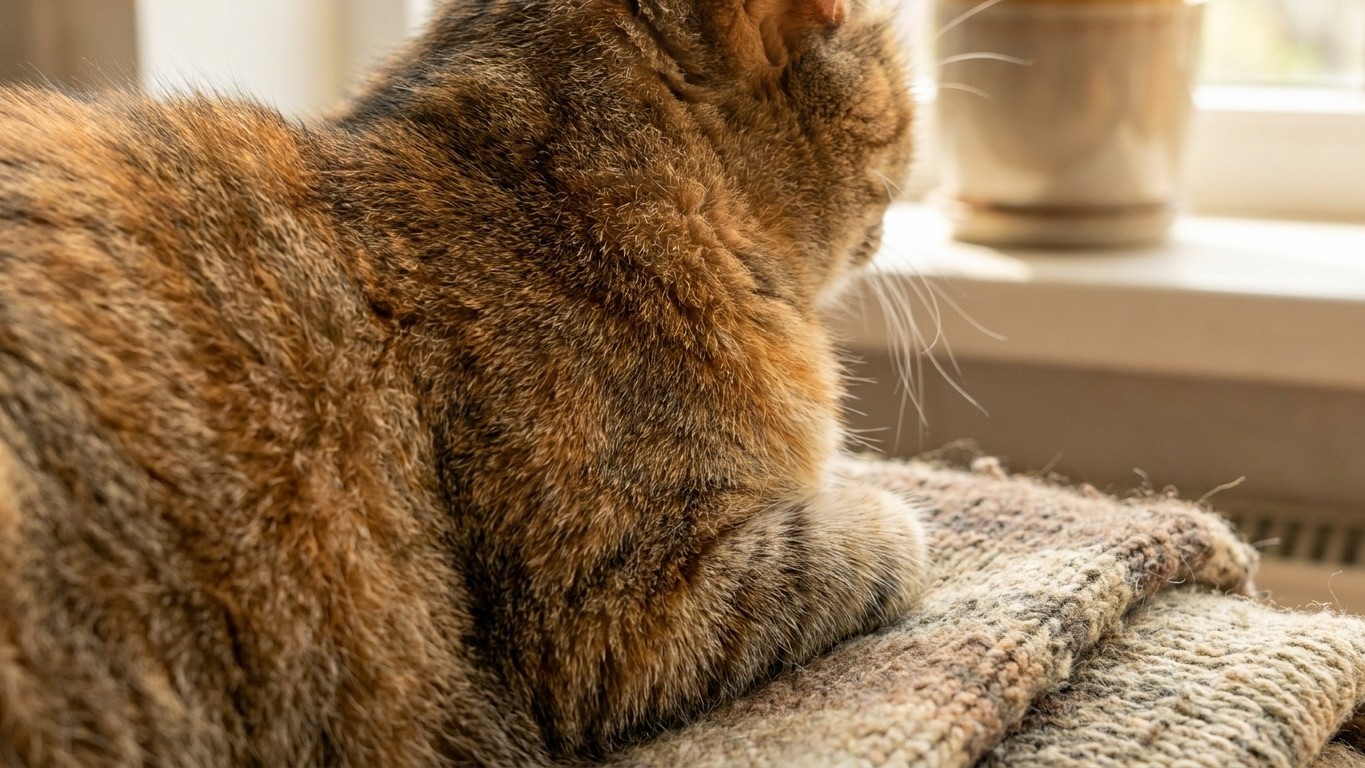
A single missed patch under the shoulder blades put my 16-year-old tabby, Mabel, on an intravenous drip for three days. I’d brushed her every week for years, convinced I was doing right by her. But arthritis had quietly stopped her twisting round to reach that one spot, and the mat that formed there hid a raw, infected wound I never saw until it was oozing and she’d stopped eating.
Vets see this pattern constantly in older cats, and it rarely announces itself the way you’d expect. Cats quietly stop doing things that hurt, and grooming the hard-to-reach parts of their body is one of the first activities to go. Mabel never yelped when I touched that patch. She just went still, which I mistook for contentment rather than the guarded stiffness of pain.
Key takeaways
- An untreated mat between shoulder blades led to a life-threatening bacterial infection requiring three days of IV treatment
- Arthritis affects 90% of cats over 12, silently stopping them from grooming hard-to-reach areas while cats hide their pain perfectly
- The real danger: what looks like messy fur is actually a festering wound where bacteria thrive in warm, moist darkness
Why one patch turns into a crisis
Arthritis can make it difficult for cats to groom certain areas of their body, and arthritis in the neck can interfere with the cat’s ability to bend or twist to reach their back. That’s precisely where Mabel’s mat sat, wedged between her shoulder blades, a spot she simply couldn’t twist round to lick anymore. Arthritis affects nearly 90% of cats over 12 years old, so this isn’t a rare fluke, it’s practically the default state for a cat entering her late teens.
What makes mats genuinely dangerous rather than just scruffy is what happens underneath them. Matts are even more painful for cats with less excess muscle or fat, which is common in senior cats, and as cats age, their skin loses elasticity, increasing their discomfort with mats and making them more prone to injuries such as tearing and bruising. A tight mat pulls constantly on thin, fragile skin, and once that skin breaks, the trapped moisture and warmth underneath create exactly the environment bacteria love. Inadequate grooming can leave the skin greasy and dirty and cause matting of the hair, which can also irritate the skin. Vets classify these skin infections as pyoderma, and it can run deep. Deep pyoderma extends into the dermis and subcutaneous tissues, potentially leading to cellulitis or systemic infection. That’s the mechanism behind Mabel’s drip: what looked like a knot of fur was, underneath, a wound that had been quietly festering and spreading infection into her bloodstream.
There’s a grimmer possibility too, one every UK cat owner should know about in warmer months. Flies are drawn to soiled, matted fur and any break in the skin. They may lay the eggs in open wounds or badly soiled, matted fur, and the eggs hatch in 8-72 hours, with larvae growing into large maggots within 2-19 days. Vets call this myiasis, and it’s genuinely urgent. These flies lay their eggs on open wounds or moist skin areas, from which the larvae hatch and penetrate the tissue, feeding on necrotic tissue, leading to further damage. Mabel’s case never reached that stage, thankfully, but the vet who treated her told me she’d seen it happen to cats whose mats went unnoticed for even a week longer in summer.
Why cats hide it so well
The frustrating truth is that a devoted owner can still miss this. Even the most attentive owner may not be able to tell if their cat is feeling uncomfortable or experiencing pain since they are adept at hiding pain. Cats are prey animals by instinct, wired over thousands of years to mask weakness. A limp, a wince, an obvious cry, none of that comes naturally to them even when something is badly wrong. I ran my hand over Mabel’s back every week and felt only fur, never thinking to part it and look at the skin itself.
Obesity compounds the problem for plenty of senior cats, even ones who aren’t overweight in a dramatic way. Overweight and obese cats physically cannot reach large portions of their body, as excess body fat prevents a cat from curling and twisting into the positions needed to groom her back, belly, and hindquarters, so the easy-to-reach areas stay clean while the hard-to-reach areas become matted and greasy. Add in dental pain, thyroid disease, or diabetes, all of which can independently reduce how much a cat grooms, and you have a long list of quiet reasons a once-immaculate coat starts slipping.
What actually catches these problems early
The fix isn’t more brushing, it’s different brushing. Running a comb over the topcoat tells you almost nothing about the skin beneath. What works is parting the fur, section by section, and actually looking at the skin itself, especially in the blind spots a cat can no longer reach alone.
- The base of the tail and lower back, a classic trouble spot even in shorthaired cats
- Between the shoulder blades and along the spine
- The armpits, groin, and belly, where litter and urine cling
- Behind the ears and under the chin
Pay extra attention when brushing around your cat’s hips, underbelly, and hind legs because these areas can be sensitive for older cats, and if you notice any lumps, bumps, or sensitive-to-touch spots call your vet so they can give your kitty a checkup. If you do find a mat, resist the urge to grab scissors. Do not try to cut, pull, or yank mats because you can hurt your kitty, instead try to gently loosen the mat with your fingers or apply a bit of corn starch to the mat and brush it through. For anything tight against the skin, a Professional groomer or your vet has clippers designed to get underneath safely, something scissors simply can’t do without risking the paper-thin skin beneath.
Mabel’s vet also flagged something I hadn’t considered: any senior cat with a sudden change in grooming habits deserves bloodwork, not just a bath. Many common diseases, such as kidney disease, thyroid disorders, and diabetes, can also cause decreased grooming, and it is important to have your veterinarian examine and review blood work for your senior cat every 6 months. Three months after her drip, Mabel’s coat is glossy again, but I now run my fingers right down to the skin every single week, not just over the surface. It takes an extra two minutes. Given what the alternative cost her, that’s the easiest trade I’ve ever made.
Sources : lapinevet.com | fallsroad.com