
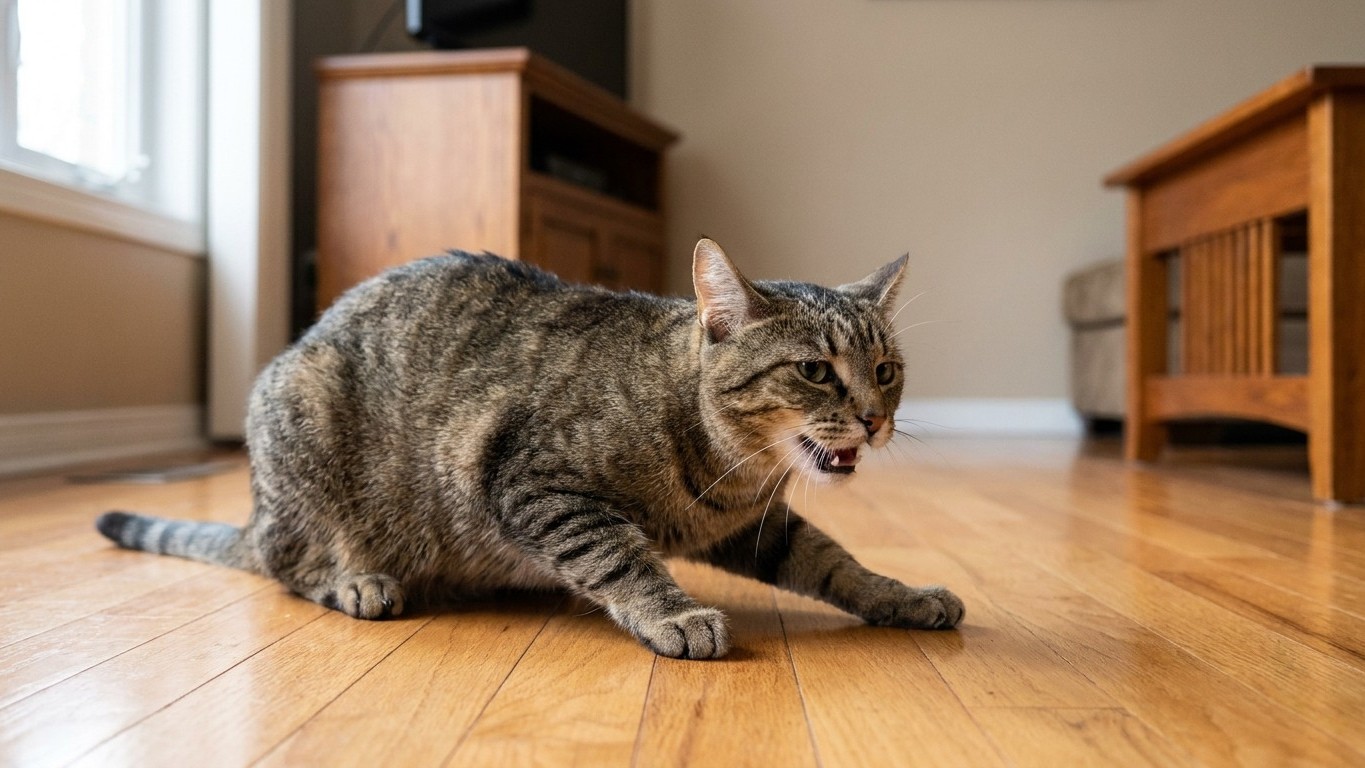
That crouched posture with the neck stretched dead flat and elbows splayed out isn’t your cat gearing up to deposit a hairball on the good rug. When cats with asthma cough, their neck and back are straight and parallel to the floor, and they don’t usually move backward while coughing. Compare that to a genuine hairball moment, where asthma is a disease of the lungs, while hairballs come from the stomach, and when cats with hairballs vomit their back is arched, and they vomit up fluid and hair, often while walking backward. Two completely different mechanisms, two completely different postures, and knowing which one you’re watching could genuinely save your cat’s life.
Feline asthma isn’t some rare curiosity either. It’s a common allergic respiratory disease in cats, affecting at least one percent of all adult cats worldwide, and Cornell puts the figure even higher. She may be among the 1 to 5 percent of cats who develop feline asthma, according to Cornell University College of Veterinary Medicine. Scale that up and it stops sounding niche. More than 80 million cats currently live in American homes, and veterinary epidemiologists estimate that 800,000 or more of these animals suffer from acute or chronic asthma. Translate that ratio to Britain’s roughly 11 million pet cats and you’re looking at a genuinely sizeable population of wheezy kitties, most of whom are probably being dismissed as “just a bit of a hairball problem.”
Key takeaways
- One small postural detail separates a harmless hairball from a potentially fatal asthma attack—but most cat owners miss it entirely
- Feline asthma affects 1-5% of all cats worldwide, yet it’s routinely dismissed as ‘just hairballs’ by unsuspecting owners
- Your cat’s favorite scented litter or your go-to air freshener could be triggering life-threatening attacks without you ever knowing why
Reading the Body, Not Just the Sound
Vets and behaviourists keep coming back to the same visual cue because it’s remarkably reliable. Cats suffering from asthma attacks often assume a characteristic crouched posture and extend the head and neck forward while wheezing or coughing. That’s not a cat winding up for a big retch, it’s a cat trying to physically widen its own airway because the bronchioles inside are clamping shut. An asthmatic cat looks like it’s bracing itself, almost bracing for impact, whereas a hairball cat is actively working something up and out. When a cat is vomiting hairballs or anything else, there is more of a retching sound and vomit is produced.
The sound itself gives clues too, though it’s genuinely tricky to parse in the moment. In addition to a cough that doesn’t produce a hairball or vomit, you may notice your cat crouching down, hunching her shoulders, and extending her neck, her cough may produce foamy mucus, and you may notice that she is breathing quickly and that her breathing seems labored. Interestingly, some cats will swallow after an asthmatic coughing fit, which muddies the water further. A coughing cat will crouch with his elbows out and neck extended, and make a repeated wheezing sound with no fluid produced, though since the cough can loosen some mucous, cats may swallow or have a bubbly sound after a coughing episode. No actual hairball ever appears, though, and that absence is the single biggest tell.
What’s Actually Happening Inside the Chest
The mechanics are worth understanding because they explain why this cough is so much more urgent than a stomach issue. Feline asthma is a respiratory condition affecting the lower airways that is believed to be triggered by inhaling allergens and other irritants, and these irritants trigger an immune response that causes the individual bronchi in the lungs to constrict and the surrounding tissues to swell, sending the cat into respiratory distress. Household culprits are more mundane than you’d expect. Suspected triggers include tobacco smoke, dust mites, pollen, grass, mould, perfume, aerosol sprays, household cleaning products and cat litter. Your favourite scented candle or a fresh bag of clumping litter could genuinely be setting off attacks without you ever connecting the dots.
There’s also a demographic pattern that’s useful to know. Cats can develop asthma at any time during their lives though it’s more common between the ages of two and eight, and there is a slightly higher prevalence in females and in certain breeds of cat such as Burmese and Siamese. If you own a chatty Siamese who’s started making odd throat noises around middle age, that’s not a coincidence worth ignoring.
When This Becomes an Emergency
The frightening part of feline asthma is how fast it can escalate from an odd cough to a genuine crisis. An asthma attack can quickly be life-threatening, and if your cat has difficulty breathing, is taking more than 40 breaths per minute, or has deep chest movements with labored breathing, this is a veterinary emergency, so take your cat to the vet or emergency clinic right away. Blue-tinged gums are the reddest of red flags. The obvious signs that a cat is having a respiratory attack are: coughing, wheezing, blue lips and gums, squatting with shoulders hunched and neck extended, rapid open mouth breathing or gasping for air, gagging up foamy mucus, and overall weakness. Open-mouth breathing in a cat, at any point, outside of a stressful car journey, should send you straight to a vet.
Diagnosis isn’t straightforward, so don’t expect a quick answer at a single appointment. There is no single, specific test that can definitively diagnose feline asthma; instead, veterinarians rely on information gathering and testing to arrive at a diagnosis. Expect a workup that rules out mimics first. Diagnosing asthma involves ruling out other causes of coughing or breathing trouble, like infections, heartworms, parasites, or even tumors, and vets may use blood tests looking for high eosinophils, chest X-rays to spot inflammation, or bronchoscopy procedures to collect samples from inside the lungs. If you can grab even ten seconds of phone footage during an episode, bring it. If you are not sure which symptom your cat has, it is best to video the event to show your veterinarian what is happening.
The genuinely reassuring news is that this condition, while incurable, is manageable, and cats with well-controlled asthma often live long, comfortable lives. While asthma can never be cured, the condition can be managed with appropriate medication and environmental modifications, and limiting potential allergens in the home can provide your cat with many good years of life. Swap the scented litter for an unscented variety, skip the aerosol air fresheners, and keep smokers well away from the house. Small changes, but they add up to fewer terrifying evenings watching your cat crouch low with that flattened neck, waiting for a hairball that was never coming.
Sources : vet.cornell.edu | vet.cornell.edu