
Have I got some good material to write this article now.
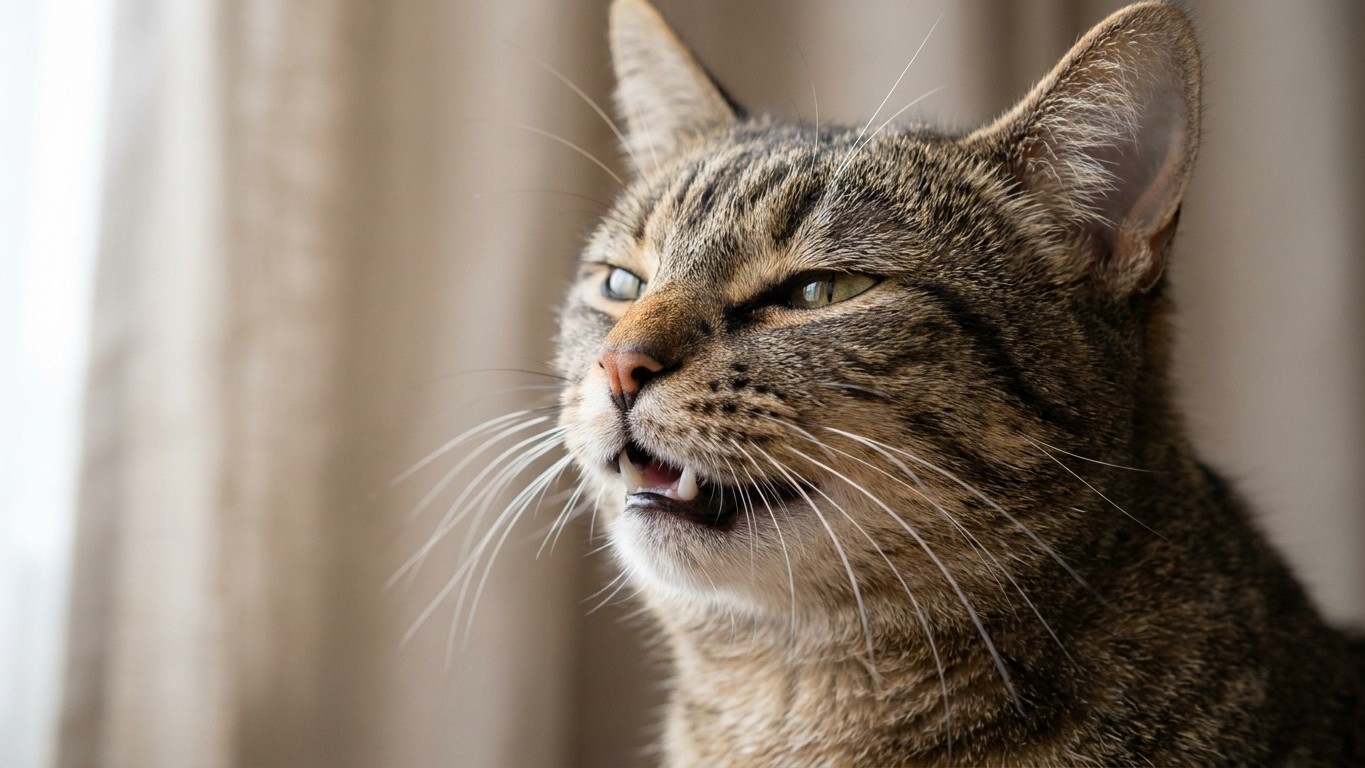
That squished-up “bleurgh” face your cat pulls when it sniffs your shoe or another cat’s favourite spot on the sofa isn’t disgust at all. It’s called the flehmen response, and it’s your cat’s way of firing up a secret second nose tucked into the roof of its mouth. The flehmen response in cats is used to analyze scents and pheromones by directing them from the mouth to their specialized vomeronasal organ. Far from being grossed out, your cat is essentially running a full chemical scan on whatever it’s just encountered.
Key takeaways
- Your cat’s lip-curling ‘bleurgh’ face isn’t a sign of disgust—what is it really analyzing?
- Cats possess a hidden sensory organ humans have but no longer use—here’s what it detects
- Multi-cat households rely on this bizarre behavior to maintain peace—discover how
What’s actually going on behind that grimace
Cats demonstrating the flehmen response often look like they are sneering or grimacing as they open their mouth and curl their upper lips. Behind those bared front teeth sits a small fleshy bump called the incisive papilla, and the flehmen response encourages scents to move towards the vomeronasal organ via the incisive papilla, a small fleshy structure you can see behind the upper incisor teeth on the roof of the mouth in cats. The vomeronasal organ itself, also known as Jacobson’s organ, sits just above that, in soft tissue tucked between the hard palate and the nasal septum.
Structurally, it’s rather clever. Cat mouths contain two tiny, fluid-filled sacs on the roof of the mouth, and these sacs connect to the nose via narrow ducts. When your cat draws breath in with its lip curled back, it isn’t just sniffing in the ordinary sense. When cats pull a scent-rich breath into their mouth, fluid carries compounds to the VNO sensors. The tongue plays its part too, flicking tiny particles up towards that opening so the organ gets a proper sample rather than just a passing whiff.
What makes this genuinely fascinating is that it’s a completely separate system from your cat’s regular sense of smell. Cats already have an extraordinary nose, with more than 200 million scent receptors in their noses, 40 times more than us humans, but the vomeronasal organ does a different job entirely. This organ is separate from the regular sense of smell. While the nose handles airborne scents, the vomeronasal organ specializes in detecting pheromones, the chemical signals animals release through urine, feces, saliva, and glandular secretions to communicate with members of the same species. the nose reads the newspaper headlines, while Jacobson’s organ reads the small print.
Why cats do it (and why we don’t)
The scientific groundwork for this behaviour goes back further than you might expect. A study in the journal Zeitschrift für Tierpsychologie examined the link directly, finding that urine of oestrous female cats positively influences the frequency of flehmen in tomcats, and crucially, these results, combined with the effect of experimental blocking of the entrance of Jacobson’s organ on this behaviour, supported both ideas about the organ’s function in detecting non-volatile chemicals and sexual pheromones. That’s proper evidence, not just a hunch based on funny faces.
It’s tempting to assume this is all about romance, and reproduction certainly plays a starring role. Male cats often perform the flehmen curl after sniffing a female in estrus, assessing her reproductive status before deciding to court. But the behaviour is far broader than a feline dating app. Females do it too, and not just around potential mates. Females also flehmen outside of sex, for example, when they find new food bowls or toys. I find that particularly endearing: your cat treating a new scratching post with the same forensic seriousness as a rival’s scent mark.
Multi-cat households get a practical benefit from all this sniffing too. Cats mark areas by rubbing and scratching, and those markings carry chemical notes about ownership. By studying these scent marks with a lip curl, cats gauge potential rivals, and in multi-cat households, that check helps maintain group peace. So next time your cat gapes at the cushion your visiting friend’s cat sat on, it’s essentially reading a very detailed identity card.
Curiously, we humans carry a vestige of this same equipment and never use it. Humans have a vomeronasal organ, or at least the remnant of one, and anatomical studies find it present in the nasal septum of almost all adults, but the scientific consensus is that it’s vestigial, a leftover from an evolutionary ancestor that no longer serves a sensory function. The neural connections that would relay signals from the organ to the brain appear to be absent or nonfunctional, and surgeons operating on the nasal septum don’t need to take any special care to avoid it. Cats got to keep the working model; we’re stuck with a redundant part.
Should you ever worry about it?
Almost never. This is a completely normal, healthy behaviour, and one shared surprisingly widely across the animal kingdom. The behavior has also been observed in wild cats such as lions and tigers, along with other animals including horses, goats, and sheep. A lion curling its lip at a scent mark on the savannah is running exactly the same biological software as your tabby investigating the postman’s boots.
The one thing worth keeping an eye on is context. If your cat’s mouth is hanging open for reasons that have nothing to do with an interesting smell, if it looks laboured, painful, or is accompanied by drooling, pawing at the face, or reluctance to eat, that’s not flehmen. That warrants a trip to the vet, since genuine breathing difficulty or dental pain can sometimes be mistaken for a funny face by an anxious owner. But the classic scenario, a brief lip curl, a slightly open mouth, a faraway look, usually lasting just a few seconds after your cat has had a good nose (and mouth) full of something intriguing, is nothing more than curiosity in action.
One last titbit worth knowing: the word itself has nothing to do with cats originally. “Flehmen” is a German word that means “to bare the upper teeth.” It comes from “flemmen”, an Upper Saxon German word meaning “to look spiteful.” Ironic, really, given that the expression your cat pulls has absolutely nothing to do with spite, and everything to do with quietly gathering intelligence on the world one scent molecule at a time.
Sources : pubmed.ncbi.nlm.nih.gov | pet.goldsupplier.com