
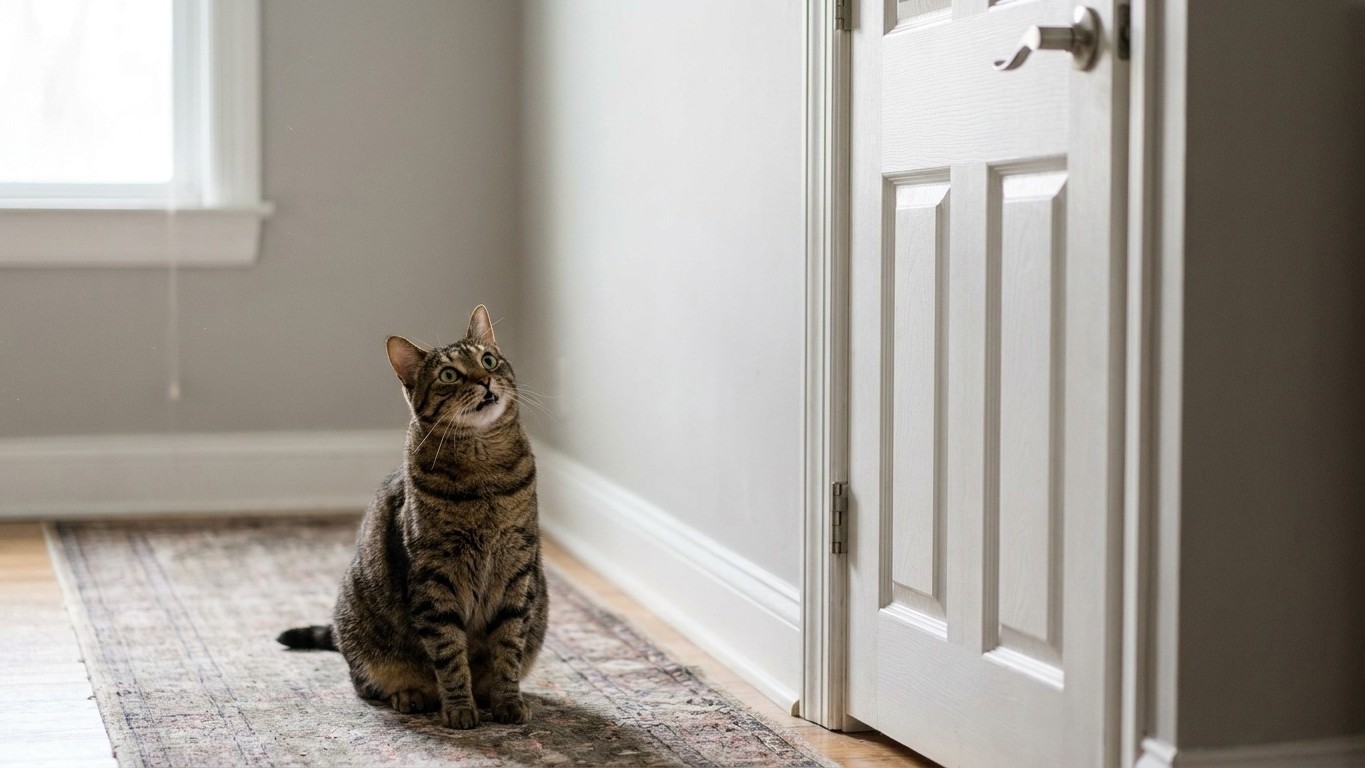
A cat parked in front of a closed door, meowing over and over, isn’t simply saying “I love you and want to be near you.” According to Veterinary behaviour specialists, that insistent crying can point to genuine separation distress, territorial frustration, or, in older cats, an underlying medical problem that needs a vet’s attention rather than a fuss and a cuddle.
Most cat owners assume the meowing is just a bid for company. Sometimes it is. But the cat’s meow is her way of communicating with people, and cats meow for many reasons, to say hello, to ask for things, and to tell us when something’s wrong. The trouble is that all these messages sound remarkably similar to human ears, which is exactly why so many owners miss the signs until the behaviour has escalated into something harder to manage.
Key takeaways
- A closed door isn’t just blocking your cat—it’s cutting off their sense of territory and mental map of the home
- Sudden or intense door-meowing paired with other changes can signal separation anxiety, a genuine medical condition in cats
- Older cats wailing at doors might have cognitive decline or painful conditions like hyperthyroidism, not behavioral issues
Why your cat treats a shut door as a personal insult
Cats are territorial creatures, and a closed door interrupts something they take rather seriously: patrolling their patch. Cats are inherently territorial animals; in the wild, their survival depends on knowing every inch of their environment, and even domesticated cats retain this instinctual need to map and control their space. Shut them out of a room and you’re not just blocking a doorway, you’re cutting off part of their mental map of the house.
Scent plays a bigger role here than most people realise. Cats mark their space with scent glands on their paws and face, and closed doors stop them from refreshing these scent markers, which can be unsettling. Add to that the fact that a shut door blocks sight and smell entirely, and you get what one behaviour writer rather nicely calls a sensory void. A closed door represents an unknown zone, disrupting a cat’s sense of environmental mastery; when a door is shut, it blocks visual and olfactory access, and since cats rely heavily on scent and sight to monitor their surroundings, a sealed room becomes an unpredictable gap in their mental map. No wonder they kick off.
None of this is dramatic on its own. A cat meowing occasionally at the bathroom door because it wants to know what you’re up to is perfectly ordinary feline nosiness. What changes the picture is frequency, intensity, and whether the meowing continues long after you’ve reappeared.
The point where “affection” becomes anxiety
This is where things get more serious. Persistent crying at doors, especially paired with other changes, can be a textbook sign of separation-related distress rather than simple curiosity. Cat separation anxiety is a stress-related condition where cats show behavioural changes when left alone, and common signs include excessive vocalisation, inappropriate elimination, destructive behaviour, and overgrooming. If your cat only cries at the door when you’re on the other side of it, and settles the moment you’re back in the room, that’s a pattern worth noting, not ignoring.
Timing matters enormously for working out what’s going on. The actions can vary greatly, from excessive meowing to inappropriate elimination, but if it happens most often just before you leave the house, it is likely a sign of anxiety about being alone. Some cats even pick up on the earliest departure cues, long before the actual door closes. Your cat’s stress may start when he picks up on your departure cues, such as putting on your shoes or packing a suitcase, and he may show his distress by vocalising and clinging to you or by withdrawing and hiding.
It’s worth saying plainly: cats absolutely can suffer separation anxiety, and it isn’t a myth invented for dog owners. Research backs this up, and vets increasingly treat it as a genuine, diagnosable welfare issue rather than quirky behaviour to be laughed off.
When the crying is actually a medical red flag
Here’s the bit that too many owners skip past. A cat who suddenly starts howling at doors, especially an older cat, may not be anxious or bored at all. They might be unwell, confused, or in pain. Elderly cats suffering from mental confusion, or cognitive dysfunction, may meow if they become disoriented, a frequent symptom of this feline version of Alzheimer’s disease. A cat with cognitive decline can genuinely forget what’s behind a familiar door or lose track of the time of day, which explains the confused, almost distressed quality some owners describe hearing in older cats’ cries at night.
Vets also flag a shortlist of physical conditions that mimic anxious meowing almost perfectly. For some cats, especially those that are middle aged or elderly, veterinary examination is recommended to rule out potential medical causes of vocalisation such as pain, endocrine dysfunction and hypertension. Hyperthyroidism in particular is notorious for turning a placid cat into a restless, vocal one almost overnight. As one veterinary resource puts it plainly, if you notice a sudden increase in frequency, degree, volume, or type of vocalisation, it may be an indication of a more serious condition.
The golden rule from behaviourists is to treat any sudden change as suspicious rather than sentimental. It is important to use your cat’s previous level of vocalisation as a meter stick against which to measure vocalisation; a cat who has always been vocal will likely remain that way, and there is only cause for concern if your cat has recently become vocal compared to previous behaviour. A naturally chatty Siamese howling at the airing cupboard is nothing new. A normally silent moggy suddenly wailing at every door in the house is a different story entirely.
What to actually do about it
Start with a vet visit if the behaviour is new, sudden, or paired with other symptoms such as appetite changes, litter tray accidents, or weight loss. Once medical causes are ruled out, gentle desensitisation works far better than scolding: reward calm behaviour near closed doors with treats, install a cat flap between rooms where practical, and avoid the trap of rushing to open the door the second the meowing starts, since that simply teaches persistence pays off. Cats never punished for vocalising, and given consistent routines plus proper enrichment, generally settle within weeks.
One small, often overlooked-garden-mistake-putting-thousands-of-cats-at-risk/”>Overlooked detail: female cats in heat also become more vocal and clingy around closed doors, rubbing and rolling as much as crying, so if your unspayed cat’s door-meowing comes in cycles rather than constantly, that reproductive drive, not distress, might be the real culprit behind the noise.
Sources : felinefam.com | thevetdesk.com