
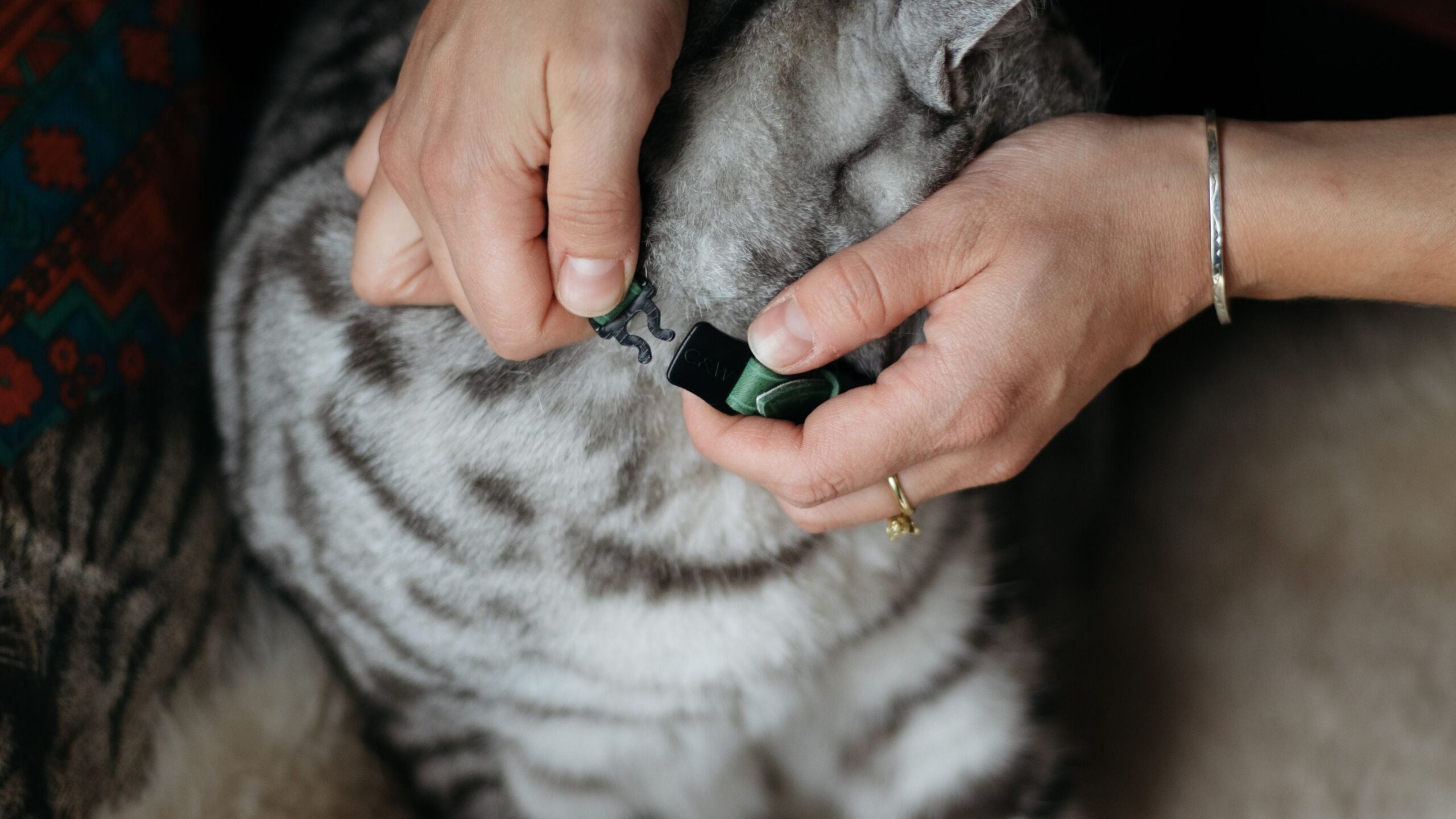
A cat’s breakaway collar buckle looks almost identical to a standard plastic clasp. Same shape, similar colour, a satisfying click when it fastens. No wonder so many owners assume it’s just a slightly sturdier version of the same thing. It isn’t. That small piece of moulded plastic is, quite literally, the difference between a cat that wriggles free from a fence post and one that doesn’t come home at all.
Key takeaways
- Most cat owners don’t realize their collar’s safety clip works completely differently from a standard buckle—and the difference can be fatal
- Cats get trapped by collars in shocking ways: tree branches, fence posts, even getting their own legs caught—but one type of clip prevents all of it
- There’s a right way and a wrong way to fit a breakaway collar, and most people are doing it incorrectly without knowing it
What actually happens when a collar catches
Collar strangulation occurs when a pet’s collar gets caught on an object and, while the animal attempts to get free, the collar tightens around the neck and restricts airflow. For cats, the trigger points are everywhere: fence panels, tree branches, gate latches, even the springs underneath a sofa. Cats who enjoy climbing can get their collar caught on a branch, or an opponent’s teeth may get stuck in it during a fight, both scenarios can lead to injury or, worse, strangulation.
There’s a less visible danger that catches many owners off guard. Axillary wounds caused by a forepaw getting trapped in the collar are well described in the veterinary literature. Cats with this type of injury often went missing for several weeks before returning home with a characteristic, severe wound under the foreleg. The mechanics are grim: the cat scratches at the collar, slips a leg through it, and then cannot get free. Over time, the collar cuts into the skin, becomes embedded, and causes infection. Surgery is sometimes required to repair the damage. The RSPCA has issued warnings to cat owners after witnessing over 100 cats getting injured by their own collars across the UK.
The collar most owners picture as “safe”, the elasticated one — has its own record of harm. Some retailers refer to elasticated cat collars as “cat safety collars,” but animal welfare organisations including Cats Protection and the RSPCA are clear that elasticated cat collars are not safe. The elastic can trap a leg just as effectively as a rigid collar, sometimes more so, because it stretches to accommodate the limb before locking it in place.
How the breakaway mechanism actually works
Breakaway-style safety buckles open under pressure when force is applied to them. You can open them by pulling the strap apart on either side of the safety catch. The catch opens automatically if your cat gets caught or entangled, because force applied to the collar strap causes the clip to break open. No human intervention needed. The cat provides the force itself simply by pulling away from the obstruction.
Standard plastic buckles, which are opened by pressing the sides inwards, are not safe because they require human intervention to open them. That’s the fundamental flaw in an ordinary collar: it works perfectly well, every time, except in the one moment it matters most, when there’s nobody there to press the sides.
The release threshold matters too. For adult cats, a collar that requires at least 2.5 kg to release is standard, while specialist kitten collars are designed to open at a lighter weight of around 1 kg. This is worth paying attention to, because a kitten wearing an adult collar may not be heavy enough to trigger the release mechanism. It’s generally not a great idea to leave kittens unattended with a collar on, they’re often not heavy enough to trigger a breakaway buckle, and their adventurous spirit can lead them into difficult situations.
Fitting it right: the two-finger rule
A breakaway collar can only do its job when it fits correctly. Too loose and the mechanism is almost irrelevant, because the cat (or its leg) slips through the collar before the buckle ever gets a chance to release. A collar that’s too tight could be uncomfortable or lead to skin problems, while a collar that’s too loose could mean a cat gets their leg or jaw trapped through it.
When fitting a new collar, size it to sit comfortably around your cat’s neck, you should be able to fit two fingers between the collar and your cat’s skin. That’s it. Two fingers. Not a fist, not a single fingertip. If you’re unsure whether a collar is quick-release, check it breaks apart easily before putting it on your cat by pulling on the sides with your hands.
Fit isn’t a one-time task. Check the collar every few days to make sure it hasn’t become loose or tight, and that it doesn’t have any damage or loose threads that could hurt your cat. Cats change weight across the seasons, fur density shifts between summer and winter coats, and a collar that fitted perfectly in April may be too tight by November. Check fit every one to two weeks in growing cats, and reassess after grooming visits or seasonal changes in coat thickness.
One further caveat from the science: even “safety collars” with a breakaway clip do not fully prevent severe incidents, albeit rarely reported. Nevertheless, the use of breakaway collars is considered vital. No piece of kit is entirely foolproof, but the breakaway collar is unambiguously the right choice compared to the alternative. This feature is designed to prevent injury or strangulation if the collar gets caught on something like a tree branch or fence, and breakaway buckles can even protect indoor cats who jump on ledges or shelving.
The collar and the microchip are not the same thing
A collar, however well designed, can come off, by design. That’s the whole point. Which means identification needs a backup that stays put. A collar is not a replacement for a microchip. All cats in the UK must be microchipped by law. In England, the requirement has been in force since June 2024, with owners found breaking the rules facing a £500 fine if they do not comply within 21 days. Scotland, Wales, and Northern Ireland each have their own regulations, so it’s worth checking the rules for your nation if you’re unsure.
Cats Protection recommends microchipping as the safest permanent method of identification for cats, and it’s easy to understand why. Unlike collars, microchips don’t come off or put cats at risk of collar-related injuries. The ideal setup is both: a well-fitted breakaway collar for visible identification and an immediate point of contact for whoever finds your cat, and a microchip as the permanent, indestructible record underneath. One works in the moment, the other works forever.
There is one scenario where the breakaway collar quietly earns its keep even indoors. Research has highlighted that breakaway buckles can protect indoor cats who jump on ledges or shelving, the gap between a bookcase and a wall, the back of a washing machine, a kitchen drawer left ajar. Cats treat domestic interiors as obstacle courses, and a standard buckle collar catches on things inside just as readily as it does on a fence post in the garden. The small click of a breakaway buckle is a feature worth understanding, not just a fancier clasp. Always speak to your vet if you have any concerns about collar fit, skin irritation, or whether a collar is appropriate for your individual cat’s health and behaviour.
Sources : outdoorbengal.com | oreateai.com