
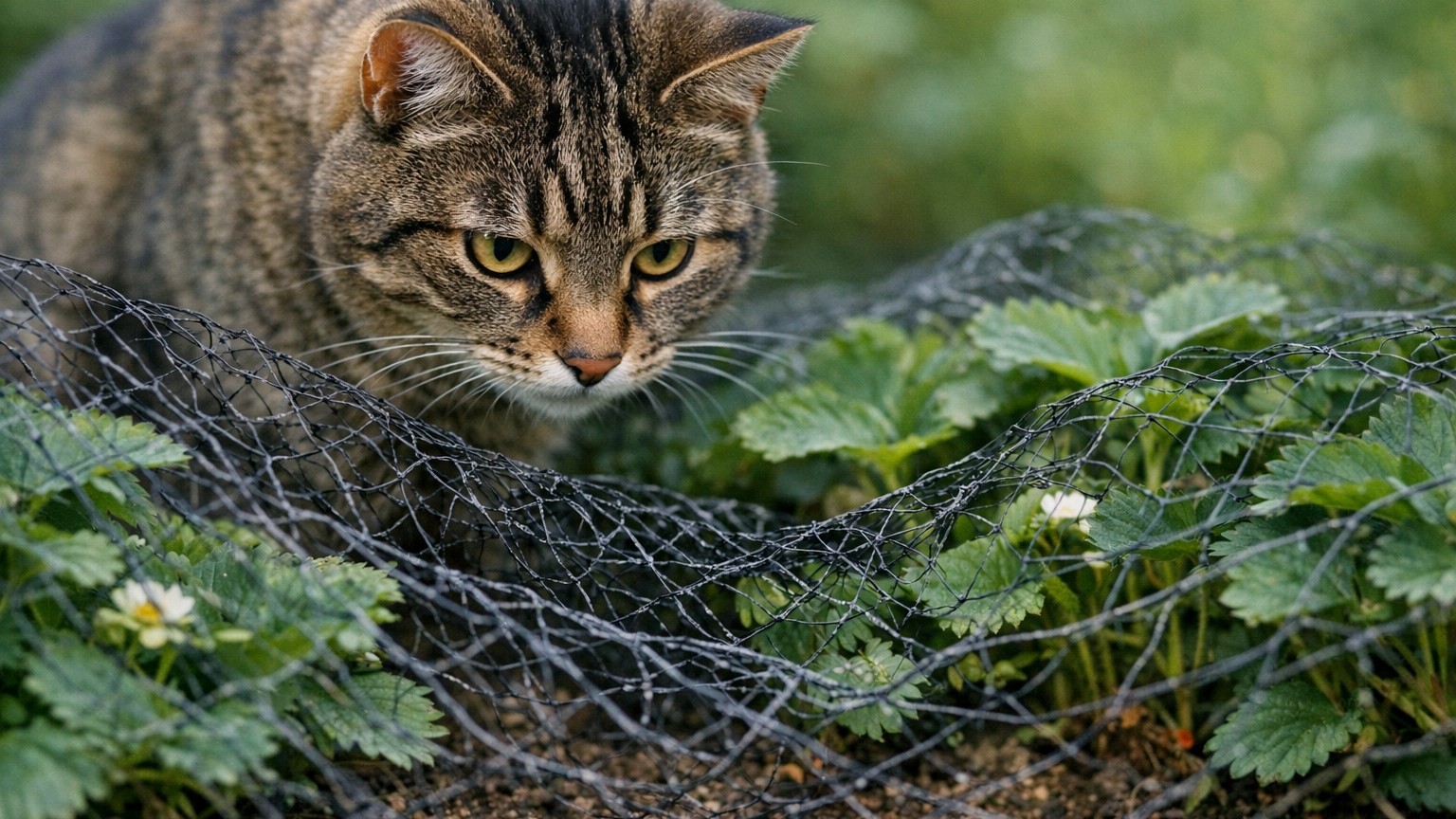
Every June, blackbirds eye up strawberry beds with the focus of a seasoned professional. The reaction of most gardeners? Grab the cheapest roll of plastic bird netting from the shed, drape it loosely over the plants, and call it done. The problem is that this split-second, low-effort decision can become genuinely dangerous, for wild birds, for hedgehogs, and, in ways many owners never anticipate, for their own cat.
Key takeaways
- Loose netting over strawberry plants becomes a lethal snare during June nesting season—with consequences nobody anticipates
- When trapped birds panic and thrash, plastic mesh fragments can wind around your cat’s throat or be swallowed entirely
- Hedgehogs are especially vulnerable to ground-level netting, often found dead after midnight tangling that goes unheard
Why loose netting in June is a particular trap
June is peak strawberry season, but it also falls squarely within nesting time for many of Britain’s garden birds. Under the Wildlife and Countryside Act 1981, wild birds in the UK are legally protected, and it is an offence to intentionally kill, injure, or take any wild bird, or to damage a nest in use or being built. Draping loose netting over plants doesn’t just create an obstacle for birds, it creates a snare. Problems arise when netting is incorrectly installed or not properly maintained, resulting in birds and other wildlife getting tangled or entering via gaps and becoming trapped.
The physics of it are grim and simple. A blackbird or robin dives in low, drawn by the scent and colour of ripe fruit. A wing catches a loop in the mesh. The more it panics and thrashes, the tighter the net pulls. The RSPCA has described this type of netting as “potentially lethal to wild animals and birds,” noting that animals “can end up with life-threatening injuries by getting their legs, wings or beaks tangled in the netting or, if not spotted by anyone who can help free them, they can eventually starve to death.” The distress call from that trapped bird, a frantic, repeated alarm, carries across the garden. If you have a cat, it absolutely hears it too.
This is exactly where the secondary danger arrives. A cat responding to panicked thrashing in netting doesn’t just hunt: it bites, pulls, and chews. Sections of loose plastic mesh can tear free easily, and a cat that bites through thin plastic netting risks ingesting pieces of it. Thin strands can also wind around a cat’s jaw or throat during the frenzy. Plastic netting not only causes harm to birds, it also releases plastic into the environment if not maintained correctly, which can then be ingested by other animals including hedgehogs and small mammals. Cats add themselves to that list without much difficulty. If your cat has swallowed netting material or is showing signs of choking or distress, contact your vet immediately.
Hedgehogs are in the picture too
Most gardeners think about birds when they buy netting, almost never about hedgehogs. But a net draped close to ground level, which is exactly what happens when you toss it loosely over low strawberry plants — is a hedgehog trap waiting to be sprung. The RSPCA advises that any netting or wire in the garden should be kept at least a foot above ground level, that fruit nets and goal nets should be packed away when not in use, and that netting should ideally be replaced with solid metal mesh, which is far less likely to entangle hedgehogs.
Hundreds of thousands of animals die from being trapped in netting each year. Net entanglement leads to injuries, restricted movement, and in severe cases, fatalities, animals that struggle to free themselves are often found with severe wounds and significant stress affecting their overall health. A hedgehog caught in plastic netting in your strawberry bed will typically be found dead rather than alive, because they tend to get tangled around midnight and no one is there to hear the struggle.
How to do it safely, if you still want to net
The good news is that protecting your strawberries without turning your garden into a wildlife hazard is genuinely straightforward, it just requires thinking about structure before you reach for the net roll.
The RHS specifically warns that wildlife can be at risk from poorly erected and managed garden netting, and recommends very fine mesh such as insect-proof mesh or horticultural fleece as one of the safer options, provided the edges are secured by burying under the soil or anchoring to a board at ground level. Birds in particular can become entangled in loose netting, which may result in their death or injury. The key difference between safe and dangerous netting is always tautness and structure: a properly supported frame, with netting pulled tight and edges pinned down, behaves nothing like a floppy sheet thrown directly over plants.
Mesh size also matters significantly: smaller mesh sizes such as 19mm are suitable for deterring smaller birds like sparrows, and choosing the correct size both ensures effectiveness and reduces the risk of entanglement. A rigid fruit cage, essentially a box frame draped in mesh, removes almost all entanglement risk because there are no sagging pockets for wings or paws to catch in. Regularly inspecting netting for wear, damage, or sagging and promptly repairing any holes or weak areas is just as important as the initial installation.
For those who would rather skip the netting entirely, the alternatives are surprisingly effective. Painting fruit-sized rocks strawberry-red and placing them around plants early in the season draws birds in to investigate, but by the time real fruit appears, they’ve grown frustrated and largely leave the actual crop alone. Wildlife gardening experts also recommend using cloches in light colours rather than green (which birds can’t see well and get caught in), and hanging reflective items such as old CDs, wind-socks, or wind-chimes from stakes as a deterrent.
If a bird is already trapped
Speed matters. If you find a bird caught in netting, first assess the situation from a distance to see whether it can free itself, then, if it’s safe to do so, gently cut the netting using scissors, wearing gloves both to protect yourself and to minimise stress to the bird. If you need further help, the RSPCA’s emergency line in England and Wales is 0300 1234 999, the SSPCA in Scotland can be reached on 03000 999 999, and the USPCA in Northern Ireland on 028 3025 1000. Do not attempt to pull the net free by force, this usually makes the tangle worse and can snap fragile wing bones.
One detail worth knowing: once a wild bird becomes trapped, it receives legal protection under the Animal Welfare Act, which means the netting owner is legally responsible for ensuring the animal is freed from unnecessary suffering. That changes the calculus from “it’s just a bird” to something with actual legal weight, particularly relevant if you have left netting unattended for days.
There is a certain irony in the fact that the same garden that attracts wildlife with bird feeders and log piles can quietly kill it with a £3 roll of loose plastic netting. The strawberries are worth protecting. So is everything else that visits your patch after dark.
Sources : strawberryplants.org | wmjames.co.uk