
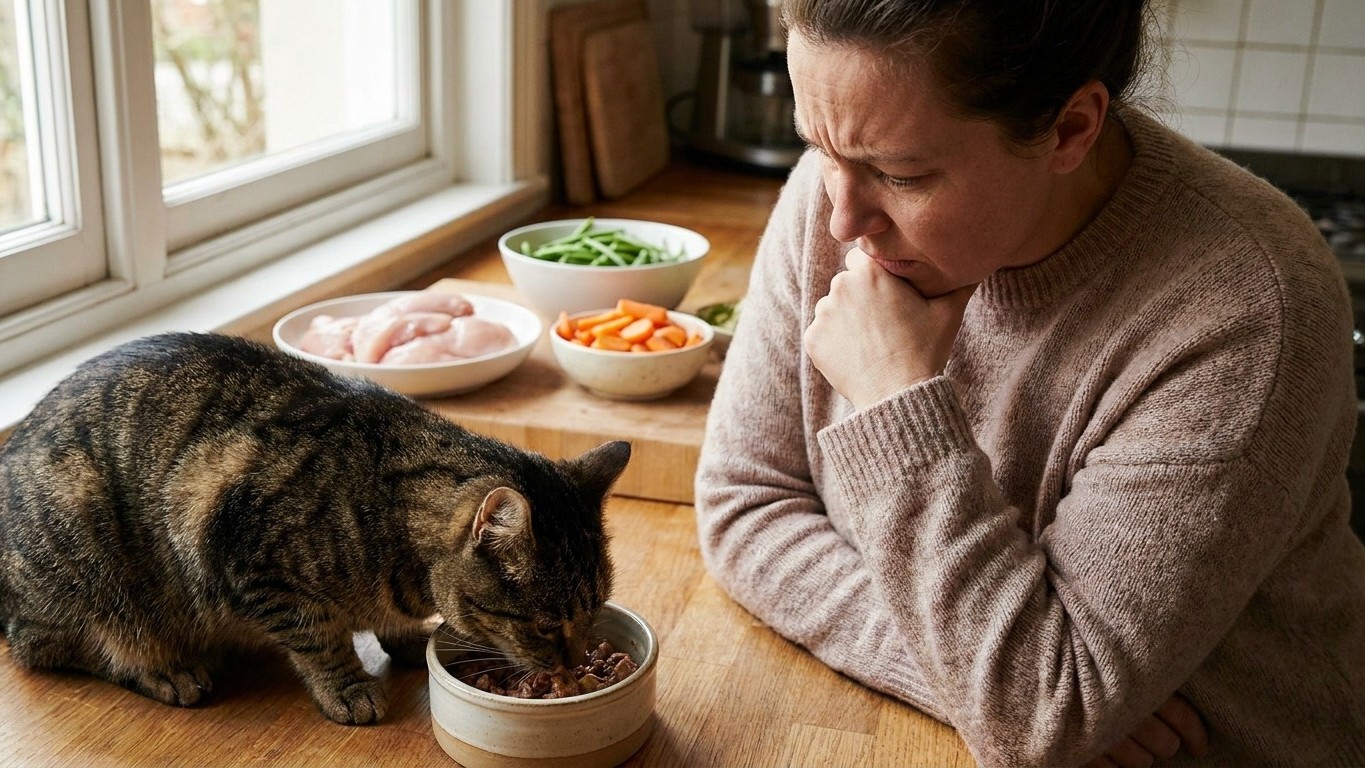
A cat’s heart can start failing silently, weeks or even months before any obvious symptom shows up, and by the time laboured breathing or lethargy sets in, the damage is often already severe. This is the harsh reality behind taurine-deficient dilated cardiomyopathy (DCM), a condition that has resurfaced in cats fed exclusively on well-meaning homemade diets, despite being largely stamped out by the pet food industry decades ago.
Taurine is an amino acid that cats cannot manufacture in sufficient quantities themselves. Cats can make some taurine, but the enzyme required to make it out of cysteine is in short supply and needed in other physiologic pathways, so without an adequate dietary supply of taurine, cats eventually become taurine deficient. Unlike dogs or humans, felines depend almost entirely on their food to supply this nutrient, which is why the species is so uniquely vulnerable when a diet falls short. Cats are very sensitive to DCM caused by taurine deficiency, as this species is unique in requiring this amino acid in their diets (compared to dogs, humans, and most other species).
Key takeaways
- A silent heart condition is spreading among cats fed homemade diets—and owners don’t know until it’s too late
- 95% of home-cooked cat recipes fail basic nutritional standards, even those written by veterinarians
- One missing nutrient can mean the difference between a healthy cat and permanent heart failure
Why a home-cooked bowl isn’t automatically a safer one
The link between taurine and heart disease isn’t new science. In the 1980s, taurine deficiency was linked to dilated cardiomyopathy, and it’s thought that taurine within heart muscle cells helps maintain appropriate concentrations of calcium and other charged particles on either side of the cell membrane, so without enough taurine, the heart muscle cannot contract normally, which eventually leads to congestive heart failure. Once manufacturers cottoned on, the fix was straightforward. Since the link between taurine deficiency and DCM was discovered in the 1980s, all cat food manufacturers have added taurine to their food. That single change meant DCM today accounts for less than 10% of feline heart disease, a genuine success story for pet nutrition science.
But that success only applies to commercial food. Cats who do not eat commercially produced cat food are at risk of taurine-related DCM. A 2019 UC Davis study, published in the Journal of the American Veterinary Medical Association, looked hard at what home cooks are actually feeding their cats and found the results genuinely alarming. Researchers evaluated 114 recipes from online sources and books, written by nonveterinarians and veterinarians, and of the 94 recipes with enough information for computer nutritional analysis, none of them provided all the essential nutrients to meet the National Research Council’s recommended allowances for adult cats.
Even having letters after your name didn’t guarantee a safe recipe. Recipes lacked nutrients regardless of the source or whether they were written by veterinarians, although those authored by veterinarians had fewer deficiencies in essential nutrients. Out of all 114 recipes examined, researchers found just five recipes, all from veterinarian authors, that met all but one of the essential nutrients. That’s roughly a 4% success rate, from a pool that included professional input. Nutritionist Jennifer Larsen, who led the research, has been blunt about the practical implications for anyone determined to cook from scratch, recommending a consult with a board-certified veterinary nutritionist for a customised formulation rather than relying on a recipe found online or in a book.
The deficiencies weren’t limited to taurine either, which makes the whole picture more troubling. Most recipes were lacking concentrations of three or more nutrients, with some deficient in up to 19 essential nutrients, and many had severe deficiencies, offering less than 50% of the recommended amount of choline, iron, zinc, thiamin, vitamin E and manganese. Some recipes went further into genuinely dangerous territory. Seven percent of the recipes called for ingredients that are potentially toxic to cats, including garlic or garlic powder, onions and leeks. Anyone chopping garlic into a “healthier” home-cooked meal for their cat, thinking they’re doing right by them, could unknowingly be poisoning the animal they’re trying to protect.
What taurine deficiency actually does to a cat’s body
The heart isn’t the only organ taurine protects, though it’s the one that tends to kill first. Deficiency in taurine can lead to dilated cardiomyopathy, a weakening and dilation of the heart wall muscles leading to poor cardiac output, and retinal degeneration, a progressive loss of vision cells in the retina resulting in gradual vision loss and eventual blindness. Taurine deficiency can also lead to reproductive failure, poor growth in kittens born to taurine-deficient queens, and gastrointestinal disturbances.
The trouble with DCM specifically is how quietly it develops. A cat’s heart muscle can be thinning and struggling for months while the animal still eats, plays and purrs as normal, because cats are notoriously good at masking discomfort. By the time visible symptoms appear, the disease has often already progressed a long way. As one veterinary source puts it, “the first clue that a cat might have taurine deficiency often comes from reviewing its diet, since most cases are linked to unconventional or nutritionally incomplete feeding practices,” with suboptimal diets ideally identified and corrected before clinical signs develop. That timing is everything. Catch it early, through routine bloodwork or a heart scan before symptoms hit, and there’s real hope. Dietary supplementation, usually 250 mg taurine given by mouth twice daily, can reverse dilated cardiomyopathy caused by taurine deficiency, as long as the condition is caught early enough. Miss that window, and the heart damage can become permanent, even with correct supplementation afterwards.
Feeding your cat well without gambling on their heart
None of this means every cat owner should feel guilty for wanting better food than what comes out of a tin. The impulse is a good one; the execution just needs proper backup. Simply combining common human food ingredients will not provide adequate nutrition and could pose a risk of nutritional imbalances if not properly formulated, which is why multiple nutrient supplement products containing essential minerals, vitamins, fatty acids and amino acids are typically added to formulate a complete and balanced cat diet. Anyone genuinely committed to home cooking should work with a board-certified veterinary nutritionist rather than a recipe pulled from a forum, however well-intentioned the author.
For the vast majority of us, though, the simplest safeguard sits on the supermarket shelf. Providing any high-quality commercial cat food is sufficient to meet a cat’s taurine needs, precisely because manufacturers are legally required to formulate to nutritional adequacy standards. If a homemade diet still feels right for your cat, whether through allergy, fussiness, or simple preference, ask your vet about periodic taurine blood testing alongside routine check-ups. It’s a five-minute conversation that could catch a silent problem long before a scan ever reveals it’s too late.
Sources : ncbi.nlm.nih.gov | lawndalevets.com