
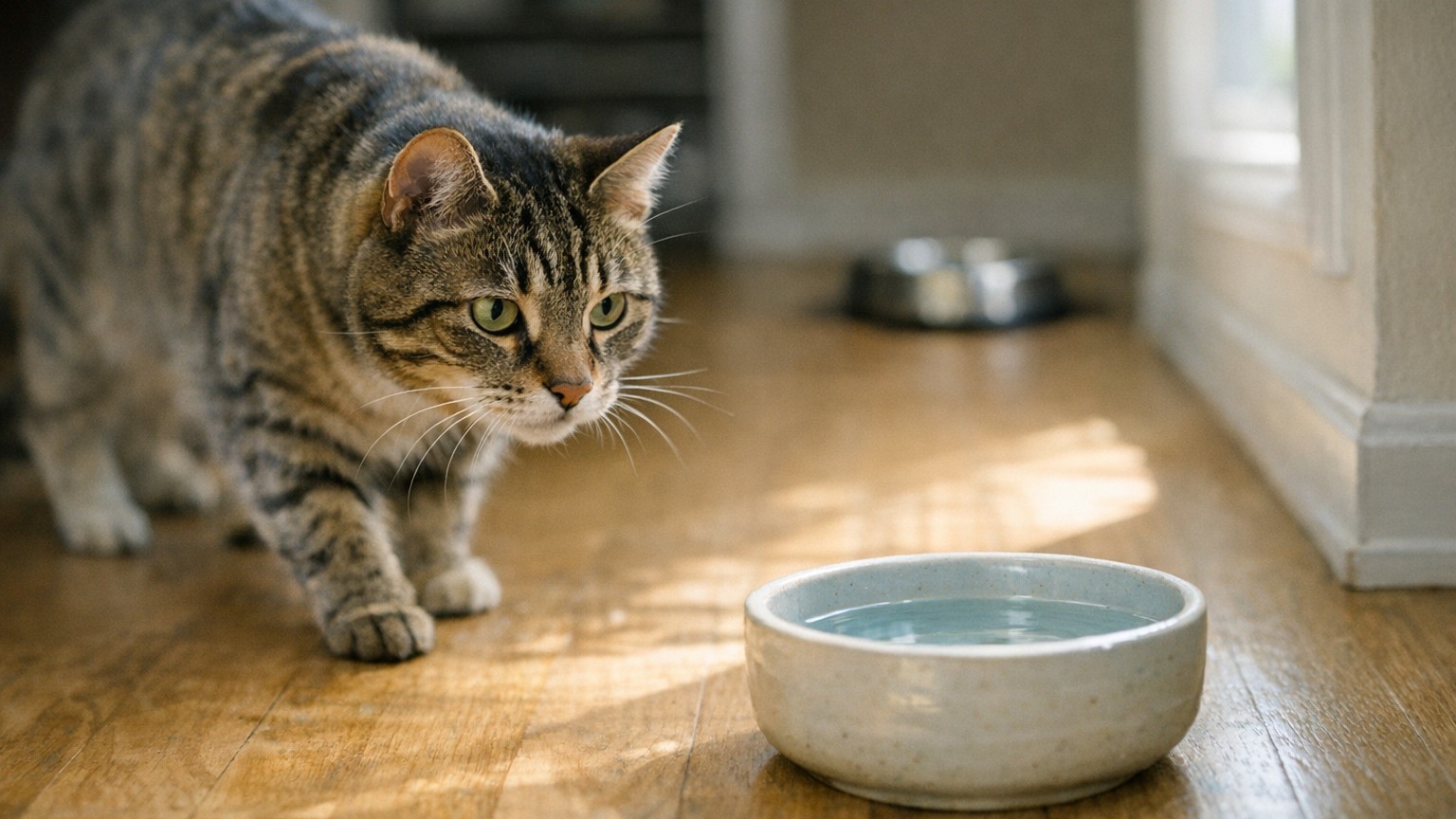
For twelve years, every summer, the same ritual: top up the water bowl, watch it go untouched for hours, top it up again. Conscientious cat ownership, right? Then a vet appointment changed everything. Watching my cat approach the bowl, hesitate, sniff, and walk away, the vet said four words: “She doesn’t like this.” Not the water. Not the bowl itself. Everything about the setup was wrong.
Turns out, I’m far from alone. Many cat owners make common mistakes when it comes to providing water for their feline companions, and most of them are completely invisible to us because we’re thinking like humans, not cats.
Key takeaways
- A vet identified the exact reason a cat had been avoiding water for over a decade in just seconds
- Cats have ancient desert instincts that make them resist standing water in ways dog owners never consider
- One simple change in bowl placement can transform a chronically dehydrated cat’s health
Cats and water: a complicated ancestral relationship
As descendants of desert animals, cats get most of their hydration from food in the wild, an adaptation that resulted in a low thirst drive that domestic cats still carry today. That single evolutionary fact explains so much. Your cat isn’t being difficult when she ignores a full bowl. She’s simply not wired to seek out standing water the way a dog would. Their brains are not wired the same way as dogs, who often drink a large amount at one time.
The consequences of that low thirst drive, however, can be serious. Chronic, low-level dehydration in cats can contribute to the development or worsening of several health conditions, including bladder inflammation, bladder stones, and constipation. This isn’t dramatic, sudden illness, it’s the slow, quiet kind that builds over years. Chronic dehydration in cats has been associated with an increased risk of kidney disease and lower urinary tract disorders; according to the Merck Veterinary Manual, cats with insufficient water intake produce more concentrated urine, which can predispose them to urinary tract issues and kidney stress.
So how much water does a cat actually need? A healthy adult cat needs about 44–66ml of water per kilogram of body weight daily, for a house cat weighing approximately 4kg, this corresponds to an amount of 176–264ml. The catch is that much of this can come from food itself. Canned foods contain significantly more moisture than dry food diets, and switching to canned food is the simplest way to ensure higher fluid intake. The moisture content in wet cat food can range from 65% to above 80%, depending on the brand and formula. A cat eating exclusively dry kibble, then, faces a genuine daily hydration deficit — one that a single small bowl of standing water rarely fixes.
The bowl, the location, and every mistake I made
My bowl sat next to the food bowl. Convenient for me, deeply unappealing to my cat. In the wild, cats often eat and drink in separate locations, a recently hunted carcass could spoil and contaminate a fresh water source. That instinct hasn’t gone anywhere. A final reason to place cat water bowls away from food is to prevent food particles from contaminating the water: if bowls are placed side by side, when cats eat, food particles can easily fall into the water bowl, and cats are unlikely to drink from water that has food floating in it.
The bowl itself was also wrong. Deep, plastic, slightly too narrow. If a cat’s whiskers touch the sides of the bowl or fountain frequently, it can lead to “whisker fatigue”, a state of sensory overload that causes the cat to stop drinking prematurely. Plastic, although often cheaper, is more likely to retain unwanted odours, and some cats also develop chin acne when offered plastic bowls due to bacteria growing in the easily damaged material. Typically, cats prefer bowls that are made of glass, ceramic or metal.
There’s also the matter of where in the room the bowl lives. When a cat eats or drinks, they like to see their surroundings to stay alert to potential threats, if their bowl is pressed up against a wall or placed in a corner, they may feel trapped, so you should give your cat some space behind and around the bowl to sit so they can comfortably watch the room while they drink. Try to find somewhere away from the hustle and bustle of daily household activities, and place bowls away from doorways where cats are at risk of getting a fright from a sudden movement. My bowl was wedged between the kitchen door and the fridge. The cat walked past it every time the room got busy — which in summer, with the back door constantly open, was constantly.
What actually works: small changes, real results
The single most impactful change is separating water from food. Not just moving it a few inches, moving it to a different part of the room, or a different room entirely. Provide several water bowls around the home, away from litter trays. Cats can be prompted to increase their water intake by always having fresh water available in places that they can easily access and by assuring that there are no conflicts among cats or other pets that may result in a particular cat being “banned” from the water bowl. That last point matters especially in multi-cat households, where one bold cat can quietly control access to all the water points.
Running water is another lever worth pulling. Cats instinctively avoid standing water for several reasons, the most important being that stagnant water can harbour viruses and bacteria, while running water is usually much cleaner. Some cats increase their intake of water when provided with water fountains, but individual preferences among cats for these vary. Not every cat will take to a fountain immediately, patience matters. Clean your cat’s water bowl daily to prevent bacterial growth and ensure they have access to fresh water. It sounds obvious, but a bowl that hasn’t been properly washed in two days will smell to a cat long before it smells to you.
Diet is where the biggest gains often hide. Kibble, nuggets, biscuits, or whatever you like to call them, are potentially very dehydrating for cats, especially if that’s the only type of food your cat is offered. If switching entirely to wet food feels like a big leap, a partial switch, or even just mixing a little warm water into dry food, can make a meaningful difference. Flavouring the water with a small amount of tuna water or low-sodium chicken broth can also prompt a cat to drink more. Always run this past your vet first, particularly if your cat has any existing health conditions. And if your cat’s drinking habits change noticeably, more or less than usual, that warrants a vet check: a sudden increase in water intake could indicate an underlying medical condition, and it’s worth talking to your veterinarian to rule out any health concerns.
The detail most owners never think about
There is one factor that barely anyone considers: the water itself. The quality and taste of tap water differs geographically and may be affected by local council water regulations; hard water and soft water differ in mineral content, and this may affect taste, and while we often think of water as bland, cats actually taste water. In hard-water areas of the UK, switching to filtered water can make a noticeably quicker drinker of a previously reluctant cat. It costs almost nothing to try.
Twelve summers of refilling the same plastic bowl, in the same spot, next to the food, against the wall. Everything I thought was responsible turned out to be a checklist of exactly what not to do. The vet wasn’t unkind about it, just matter-of-fact. Factors such as water freshness, bowl material, location, and even subtle odours can influence a cat’s willingness to drink — and these preferences are instinct-driven behaviours that owners can work with to improve hydration. The good news is that none of this is expensive or complicated. A ceramic bowl, a different corner of the sitting room, and a clean refill every morning can genuinely change how much your cat drinks. Senior cats especially deserve this kind of attention, old age changes in a cat’s metabolism can mean cats spend more time sleeping, and stiffness or pain associated with arthritis can mean they are more reluctant to get up and seek water regularly enough to meet their daily needs. Sometimes the bowl just needs to come to them.
Sources : petco.com | meowant.com