
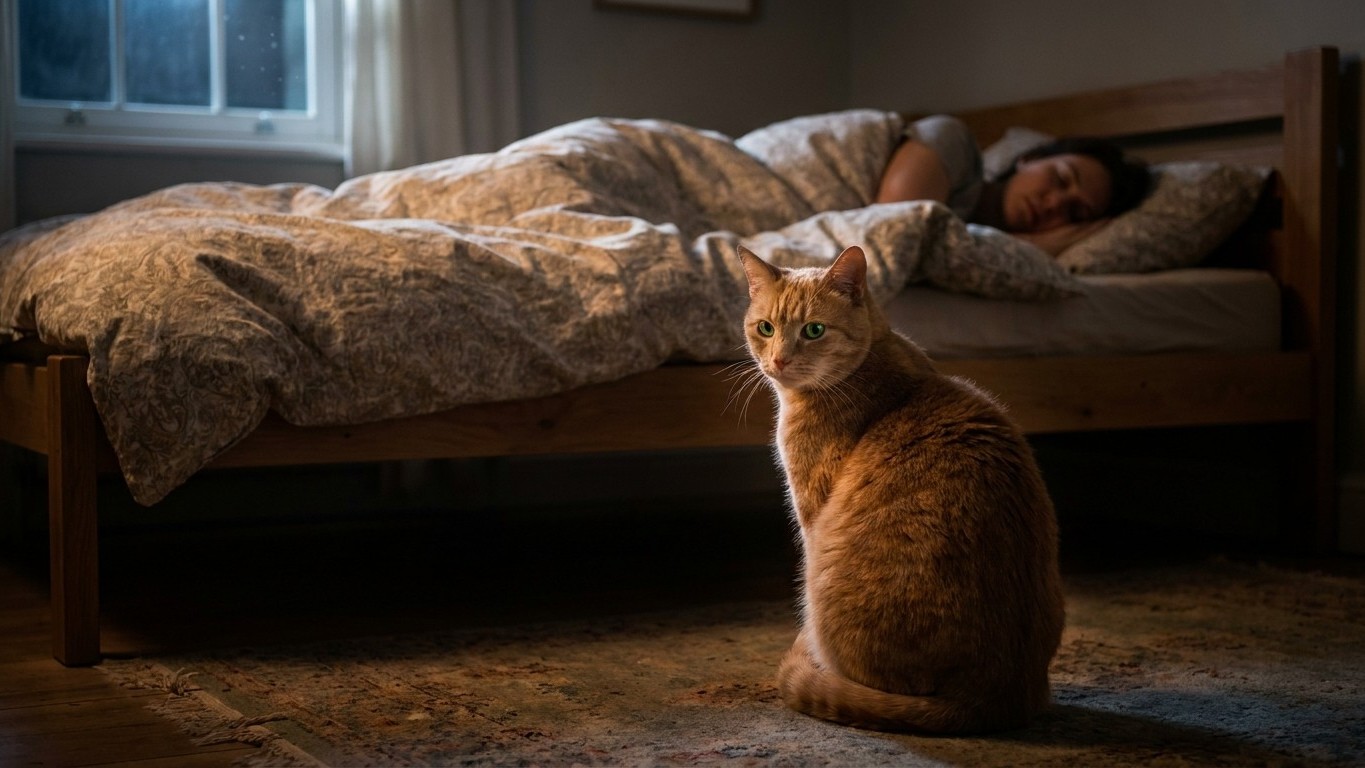
Every cat owner has wondered the same thing at some point: what exactly is that creature doing while you sleep? The thumps, the midnight gallops across the landing, the inexplicable sound of something being knocked off a shelf at 3 AM. Researchers have actually taken this question seriously, fitting cats with collar cameras and infrared night-vision equipment to find out. The answers overturned some very deeply held assumptions, and left owners equal parts charmed and bewildered.
Key takeaways
- Scientists discovered cats aren’t actually nocturnal—and their 3 AM behavior is more deliberate than you think
- 85% of outdoor cats engaged in dangerous nighttime activities, but indoor cats had a very different agenda
- The repeated action that shocked every owner in the study reveals something unexpectedly touching about feline attachment
The studies that changed how we see cats at night
Ever since video cameras became ultraportable, scientists have strapped them onto animals from sheep to sharks to see how they view and interact with the world. Relatively little had been done with cats, perhaps because they are so hard to work with. Two landmark projects changed that.
A behavioural ecologist at the University of Derby placed small cameras on 16 cats and followed them for up to four years as they prowled their neighbourhoods. Infrared recording meant the footage kept rolling long after lights out. Meanwhile, across the Atlantic, researchers monitored 55 cats during a one-year period using KittyCam video cameras in the suburban streets of Athens, Georgia. Between these two projects, scientists accumulated thousands of hours of footage showing exactly what domestic cats do when they believe no one is watching.
The repeated behaviour that most stunned owners? Their cats kept coming back to check on them. When cats were in their homes, they spent a lot of time following their humans around. They liked to be in the same room. Many of the students involved were surprised at how attached cats were to people. One researcher described how her own cat, when left alone, would wander freely around the neighbourhood, but the moment her owner was present in the garden, the cat would settle within two or three metres and not move away. The camera footage confirmed it was deliberate, not coincidental.
Not nocturnal, and not what you think
The single biggest myth the camera studies dismantled is that cats are nocturnal. Many assume cats are nocturnal, but that is a myth. Cats are crepuscular, meaning they are naturally most active at dawn and dusk. The 3 AM zoomies that so many owners film on their pet cameras, the feline racing around the room in a frenzied display of late-night energy, leaping over objects and pouncing on invisible prey — are not the norm for every cat. They are, however, more common in younger cats and those who sleep all day unsupervised.
Carnivores are hard-wired to sleep much more than prey species, and cats are unique in their ability to move from deep sleep to wakefulness without any of that grogginess so familiar to humans. In fact, cats are so adept at falling asleep that they were used as models of REM sleep in early sleep research studies. This is why a cat can appear to be completely spark out, then suddenly tear through the house like something is after it. The biology is genuinely different from ours.
For outdoor cats, the night revealed something more sobering. During their nightly exploits, the cats in the University of Georgia study had a habit of putting themselves in danger. Overall, 85% of the cats did at least one thing the researchers deemed a dangerous behaviour. Road crossings, entering storm drains, eating unknown substances, males were more likely to engage in “risk behaviour” than females, and about a quarter of the cats were eating or drinking substances away from home, potentially ingesting harmful substances. The hunting picture was equally striking: the monitored cats left behind about half of the animals they hunted, only ate about 28%, and brought home about 23%. Owners who assumed their cat was simply “having a little wander” were largely mistaken.
What the cameras revealed about your cat’s inner life
Beyond the hunting and the midnight sprints, the collar camera footage exposed something genuinely moving about the bond between cats and humans. Cats may have “attachment styles” that resemble those of people, and contrary to cats’ aloof reputation, most felines form deep, secure bonds with their owners. Research from Oregon State University found that 64 percent of felines were identified as secure in their attachment, roughly 30 percent were ambivalent, and the rest were mostly avoidant.
The cameras showed this playing out at night. Rather than treating the sleeping house as a free-for-all playground, many cats in the studies made repeated trips back to where their owner was resting. When owners were not present, cats behaved very differently, they would happily sleep in the garden when their owner was around, but would not do that often when the owner was not there. Presence genuinely changes their behaviour. That is not indifference wearing a fluffy coat. That is attachment.
One major change in behaviour researchers noticed in the initial research was that cats vocalised less outside than they did in the house, and the pitch of their voice was different. This was backed up by the wider study. The low, quiet version of your cat you rarely see is the outdoor version, more cautious, less chatty, entirely different from the demanding creature who wakes you at 6 AM for breakfast.
What to do if your cat is genuinely disruptive at night
Understanding the biology helps, but it does not magic away the sleep deprivation. Cats are crepuscular, which means they are most active at dawn and dusk, the best times for hunting in the wild. Although today’s cats are domesticated, that instinct remains strong. Young cats often have bursts of playful energy just when you are ready for bed. The practical fix is to work with that instinct rather than against it.
A solid play session roughly 30 minutes before you go to bed, followed by their main evening meal, can make a real difference. Since nighttime activity may be a form of social play and attention-seeking behaviour, the first consideration is whether the cat is getting sufficient amounts of social interaction and play during the daytime. Food-dispensing puzzle toys during the day also help: they mimic a hunt and keep cats mentally and physically active, meaning they have less pent-up predatory energy to burn at midnight.
The one rule every behavioural source agrees on: many people reinforce boisterous nighttime activity without meaning to. They might get up to feed, play with, or simply chase the cat out of the room. All of these responses teach the cat that disturbing you gets attention. Even a cross word counts as a reward in a cat’s social calculus. If a behaviour is new, sudden, or accompanied by other changes, always consult your vet, hunger, boredom, stress, and lack of daytime activity can make cats more active overnight, but new nighttime behaviour, yowling, or restlessness should be discussed with your veterinarian, as conditions like hyperthyroidism can be a driving factor.
One last thing the cameras confirmed, and it is rather lovely: senior cats may be restless at night for different reasons. Changes in their sleep cycles, hearing loss, anxiety, or the onset of cognitive dysfunction can lead to vocalising and increased wakefulness. An older cat who suddenly starts pacing or calling out at night deserves a vet visit, not just a closed bedroom door. That 3 AM check-in they keep making on you? For most cats, it turns out, that is love, expressed in the only language they know.
Sources : science.org | youtube.com