
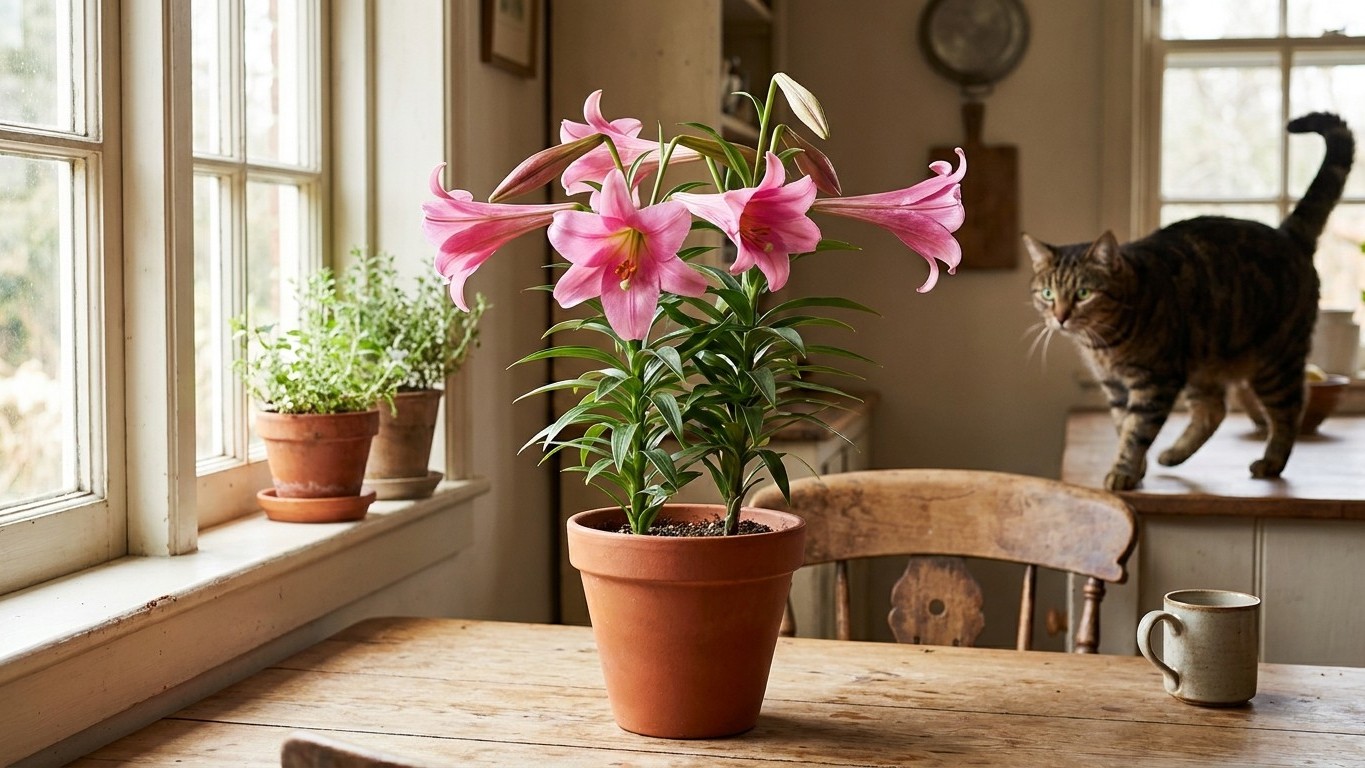
Every April, without fail, UK vets brace themselves. Emergency rooms fill up with stricken cats, distraught owners, and the same story repeated over and over: there were flowers in the house, beautiful spring flowers, and nobody thought twice about it. The culprit is lilies. Specifically, the habit of bringing bouquets containing lilies indoors during the spring season, around Easter and Mother’s Day, when florists sell them by the thousands and most cat owners have no idea they’re placing a lethal object on their kitchen table.
Key takeaways
- A mysterious toxin in lilies causes irreversible kidney damage in cats within 18 hours—but most owners don’t know they’re at risk
- The cruelest part: cats seem to recover after vomiting, making owners wait too long before seeking emergency care
- Even ‘pollen-free’ lilies marketed as safe are completely false reassurance—every part of the plant is lethal to felines
A toxin that scientists still haven’t fully identified
According to Cats Protection’s CATS Report 2024, over half of all cat owners are not aware that lilies are a danger to their cat. Lilies in the “daylily” (Hemerocallis) and “true lily” (Lilium) families are poisonous to cats, and cause kidney failure. That statistic alone explains the spring surge. Lilies contain an unknown toxin that makes eating even the smallest amount of any part of the plant, including flowers, leaves, stem or pollen, extremely dangerous to cats. Scientists have studied this for decades and still cannot fully identify the exact compound responsible. What they do know is the outcome.
The entire lily plant is toxic: the stem, leaves, flowers, pollen, and even the water in a vase. Eating just a small amount of a leaf or flower petal, licking a few pollen grains off its fur while grooming, or drinking the water from the vase can cause a cat to develop fatal kidney failure in less than three days. Dogs, for comparison, get at most an upset stomach. It is believed that when cats digest lilies their bodies create a toxic metabolite which results in severe kidney injury. This is why cats are the only animal susceptible to life-threatening lily toxicity.
The most dangerous lilies for cats include the Tiger lily, Easter lily and Stargazer lily, as well as Asiatic and Oriental lilies, the most common types of lilies we see used in bouquets. These are exactly the varieties that end up in Mother’s Day arrangements and Easter table decorations. A common way for lily poisoning to develop is when a cat brushes past a lily, causing pollen to fall onto their fur (which they later lick off and ingest). The cat doesn’t even need to nibble the flower directly. A casual brush in passing, followed by a grooming session on the sofa, is enough.
The timeline: faster than most owners realise
The effects of lily toxicity are rapid. Within one to three hours of ingestion, cats become nauseous, leading to a decreased appetite, drooling, and vomiting, as well as signs of depression and lethargy. Vomiting is typically self-limiting and resolves within two to six hours, which is the cruelest part of this whole picture. The cat seems to improve. Owners assume it was something minor. They wait.
Within 12 hours of ingesting the lily, symptoms begin to appear, including appetite loss, vomiting, lethargy, and drooling. After twelve hours, the toxin begins to damage the kidneys, and after about eighteen hours, that damage becomes irreversible. If a cat stops urinating about 24 hours after ingestion, it is unlikely they will survive. The window between exposure and permanent damage is brutally short, which is why vets urge owners not to wait for things to get worse before picking up the phone. If you even suspect contact, call your vet immediately.
There is also no antidote. Cats that have been affected by lily poisoning require intensive treatment, and it is likely that they will need to be admitted to the vet clinic for treatment. Sadly there is no antidote to lily poisoning, so the vet will focus on supportive care. This may include emptying the stomach (by making the cat vomit), giving activated charcoal to prevent further absorption of toxins, cleaning any lily pollen off the coat, and placing the cat on a drip to flush out the toxins in the bloodstream and support the kidneys. Treatment for a cat with lily poisoning can be very expensive; hospitalisation can cost hundreds of pounds.
The pollen-free lily myth and other false reassurances
One particularly dangerous misconception circulating among cat owners is that pollen-free lilies, marketed by some florists as a safer option, solve the problem. They don’t. Pollen-free lilies are often marketed as a “safe” option for cat owners. However, as all parts of the lily are toxic, not just the pollen, a pollen-free lily will not be safe for cats, and the advice for cat owners to avoid lilies remains the same.
Another trap: the gifted bouquet. Most lilies were obtained from grocery or other stores, and were purchased by the owners or as gifts to the cat owners. A well-meaning friend sends flowers for Mother’s Day, the recipient is a cat owner, and nobody thinks to check the contents. A YouGov survey commissioned by Cats Protection revealed that around six in 10 UK adults were not aware lilies are fatal to cats if they ingest them, and when choosing to buy flowers, nine in 10 people said they would not consider whether they’re toxic to pets. That combination of ignorance and gifting culture is precisely what fills emergency clinics every spring.
As lily flowers age, they start dropping leaves and pollen, potentially adding access for a cat when the plant or bouquet was originally out of reach. Placing a vase on a high shelf is not a reliable safeguard. Cats can be very adventurous, finding the way even to the top of a cupboard or refrigerator. Cats that show zero interest in plants can change behaviour entirely when presented with something new and fragrant in their environment.
What to do if you think your cat has been exposed
Contact your vet immediately if you think your cat has eaten or licked any part of a lily plant, and never wait for symptoms to develop. Take a photograph of the plant if you can. Try to bring the lily plant with you to the veterinary clinic (or take a picture of it on your phone). This will help your veterinarian determine if it’s one of the highly toxic ones. For out-of-hours emergencies, this content has been reviewed by the Veterinary Poisons Information Service (VPIS), whose Animal PoisonLine provides 24-hour specialist telephone advice to UK pet owners who are worried their pet may have been poisoned.
One study showed that most cats who are treated aggressively within 48 hours of ingesting lilies can survive. The difference between a cat that makes a full recovery and one that doesn’t is almost entirely down to how fast the owner acts. Sometimes cats that have recovered from lily poisoning are left with long-term kidney damage. This can cause symptoms later in life, and will need to be monitored by the vet at regular intervals.
For cat owners who love having fresh flowers in the home, all is not lost. There are lots of beautiful, pet-friendly petals to use, including freesias, roses, and snapdragons. Orchids and sunflowers are also safe alternatives. The spring floral season doesn’t have to be a threat to your cat. It just requires checking before buying, and telling anyone who might send you flowers that a bouquet with lilies in it is, quite simply, not welcome.
Sources : petnation.care | vethelpdirect.com