
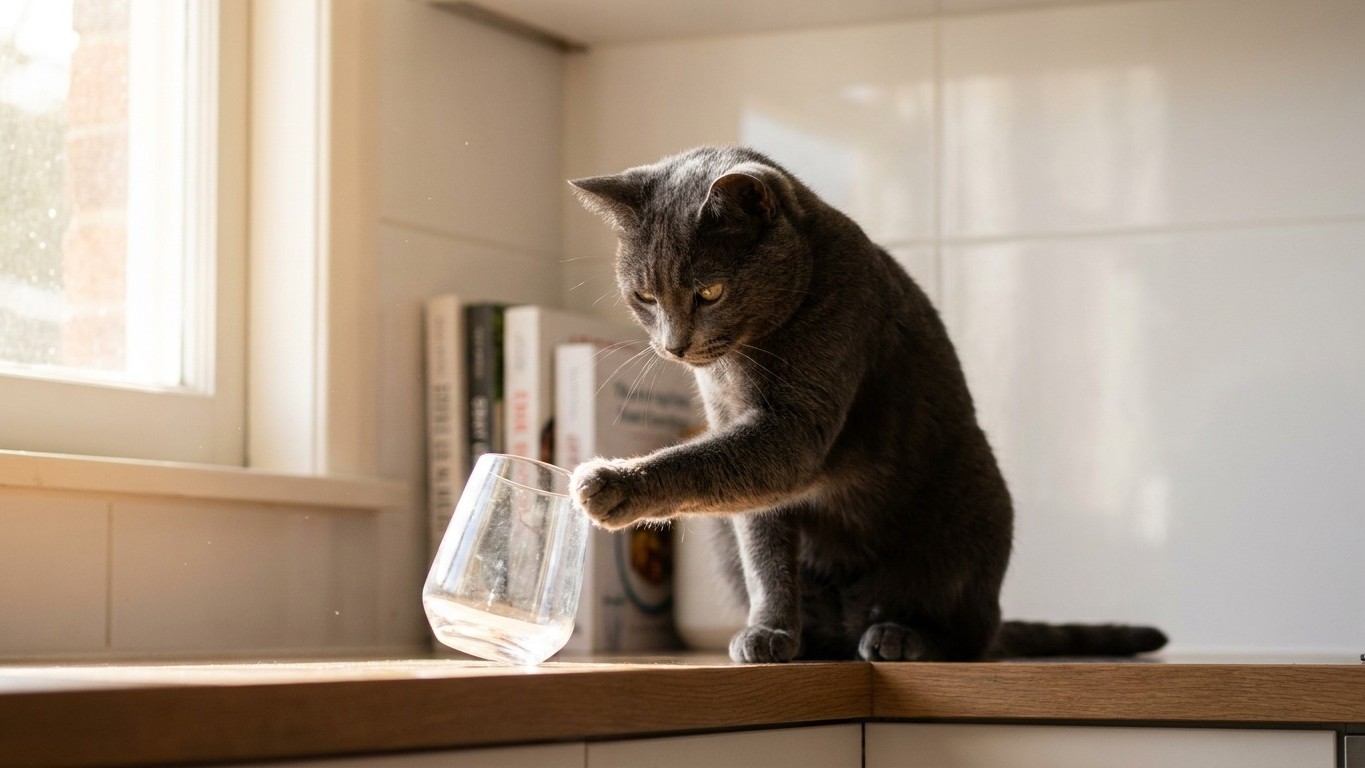
Your cat locks eyes with you, extends one deliberate paw, and — crash — your glass hits the floor. The look on their face afterwards? Pure serenity. You call it destruction. Science calls it data collection. The truth is that what looks like gleeful sabotage is, at its core, a sophisticated piece of feline behaviour rooted in millions of years of evolution, and once you Understand what’s actually going on, the whole thing becomes considerably less infuriating.
Key takeaways
- Cats aren’t being destructive—they’re running experiments that their hunter brains are hardwired to conduct
- Every object pushed off a counter is intelligence gathering, territorial marking, and gravity research rolled into one deliberate paw swipe
- Your dramatic reaction is exactly the reward your cat was hoping for, and they’ve figured this out far better than you have
A Hunter’s Brain in a Domestic Body
When your cat bats at your phone or pushes your keys across the counter, they’re doing exactly what millions of years of evolution programmed them to do. Cats are ambush predators with lightning-fast reflexes designed to pounce on small, moving prey. The problem, if you can call it that, is that your kitchen worktop is now standing in for the African savannah. Domestic cats share over 95% of their DNA with wild species like the African wildcat, and their play styles mirror the behaviours needed in the wild.
Wild cats use their paws to test potential prey, batting at things to see if they’re alive or worth chasing. Your house cat’s brain works exactly the same way, when they see your pen, their instincts treat it like prey. This is why you may observe them batting or pushing items around. When an object rolls or moves in response to their touch, cats may perceive it as prey trying to escape, triggering their instinct to chase. Your coffee mug, then, is essentially a very disappointing mouse.
The paw itself is a key part of this story. A cat’s paws and toe pads are incredibly sensitive. Just like their whiskers, their paws contain many nerve receptors. Cats experience the world primarily through their paws and whiskers. When they encounter objects on elevated surfaces, they’re conducting important research about their environment. The act of pushing objects with their paws provides crucial sensory information. Hard objects feel different from soft ones, light items move differently than heavy ones, and the various sounds created by different materials all contribute to their understanding of their surroundings. So yes, gathering intelligence. Quite literally.
There’s also an element of territorial logic at play. Knocking items over might also be a way for your cat to mark their territory. All cats have scent glands on their paw pads that release special hormones called pheromones, which they can use to communicate with other cats. Every swipe of the paw across your sideboard is, from their perspective, a small act of ownership.
The Gravity Experiment (And the Audience It Requires)
Cats seem genuinely intrigued by the fact that things fall when pushed. The trajectory of a pen rolling off a desk, the bounce of a rubber ball, or the satisfying crash of something breakable all provide entertainment and mental stimulation. This fascination with cause and effect isn’t unique to cats, but their particular combination of curiosity, precision paws, and access to elevated surfaces makes them excellent gravity experimenters.
But here’s where it gets cleverer, or more manipulative, depending on your patience levels. Pet owners might be unknowingly reinforcing that behaviour by talking to their cat or picking them up when they go up to bat. Cats are quick learners; it doesn’t take long for them to figure out that when they begin pushing a glass closer to the table’s edge, their favourite people respond and give them attention. The smartest cats might become the biggest troublemakers because they figure out the cause-effect relationship faster and exploit it more consistently. They’re the ones who’ll test different objects to see which gets the strongest reaction.
Many cats discover that positive attention and negative attention both satisfy their need for interaction. Whether you’re praising them, scolding them, or simply engaging with them after they’ve knocked something over, you’re reinforcing the behaviour. From their perspective, mission accomplished. : your dramatic sprint across the room to catch the falling glass is the reward, not the deterrent.
There’s also the boredom factor, which shouldn’t be underestimated. Indoor cats, particularly those without adequate mental and physical stimulation, may turn to table-clearing as a way to create their own entertainment and release pent-up energy. Certain high-energy breeds, like the overly curious Siamese, might be more curious than others and seek mental stimulation through knocking things over. Highly social breeds, like the Sphynx or Abyssinian, knock things over just to remind you that they are there.
What You Can Actually Do About It
The good news: this behaviour isn’t a character flaw, and it absolutely can be redirected. The bad news: you’ll need to stop reacting so dramatically. Ignoring the undesired behaviour, rather than responding with a lot of excitement, will help diminish it if your cat is attention-seeking. If they do knock something over, clean it up silently without acknowledging them at all. Cold as it sounds, that’s the most effective move you can make.
Enrichment is the other half of the equation. Interactive toys, play sessions, cat trees, puzzle feeders, and more can help keep their big brains busy. Rotating what is available will keep their attention as new toys periodically show up. Food-release toys can be particularly intriguing and offer good mental stimulation since they have to puzzle out the way to get the food treat. Wand toys, in particular, mimic the erratic movement of prey in a way that batting a pen off a shelf simply cannot compete with.
For the practical side of protecting your home, instead of placing breakables in spots that are irresistible for your little feline, stash them in cupboards, cabinets, and areas they can’t reach. One surprisingly clever hack from the world of museum curators: using museum wax (little dots of sticky stuff) to hold items that you don’t want to get knocked over but that you want to keep on display. Cat-proofing and museum preservation techniques turn out to have a Surprising amount of overlap.
For cats who knock things off counters specifically to wake you up for breakfast, consider getting an automatic feeder that dispenses food on schedule. When they realise the table-clearing trick no longer produces food, they’ll abandon the strategy. And if the behaviour intensifies suddenly or seems out of character, that’s worth a conversation with your vet, sometimes destructive behaviours escalate when cats feel stressed, anxious, or understimulated, and a cat who suddenly begins knocking over more objects than usual might be expressing frustration about changes in their routine, environment, or social situation.
One final thing worth knowing: a cat might, of course, also accidentally knock something over. It might not be intentional at all. Cat breeds with long or fluffy tails might be more prone to sweeping things off counters, such as Norwegian Forest Cats. So before attributing Machiavellian motives to your cat, consider the possibility that sometimes a broken vase is just a broken vase, and the tail is the real culprit.
Sources : creative.science | purina.com