
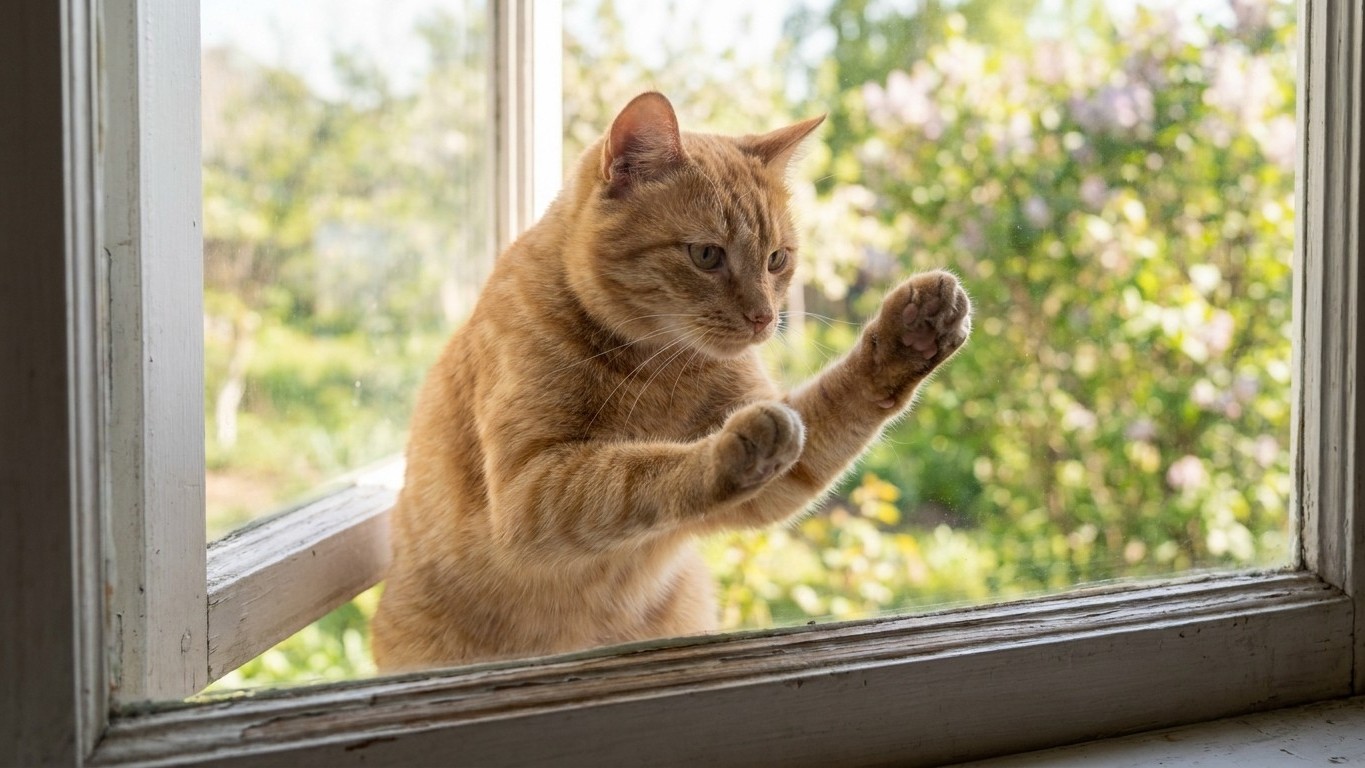
The first warm week of April is, for many cat owners, a simple pleasure: push up the sash, feel the breeze, watch the world wake up. For vets working in urban and suburban practices across the UK, that same week marks the start of something they dread every year — high-rise syndrome season. The emergency calls start coming in, the X-ray queues lengthen, and the waiting rooms fill with cats who tumbled from windows their owners never thought to secure. This is not a rare or fringe event. It is predictable, seasonal, and largely preventable.
Key takeaways
- Veterinarians report a dramatic spike in cat falls every April when windows open—but most owners don’t realize the danger exists
- A shocking truth: falls from lower floors can be more dangerous than falls from higher ones, and cats may appear fine while suffering life-threatening internal injuries
- Simple, affordable prevention methods exist that vets say could eliminate most of these tragic incidents entirely
What “High-Rise Syndrome” Actually Means
High-rise syndrome is a veterinary term for injuries sustained by a cat falling from a building, typically higher than two storeys (roughly 7 to 9 metres). The phrase was coined by veterinarians in New York City in the 1980s, when emergency clinics began noticing a very specific cluster of injuries arriving through their doors once windows opened in spring and summer. High-rise cats suffer from a common triad of injuries: chest trauma, head and facial injuries, and limb fractures.
About half of the cats who experience high-rise syndrome have respiratory distress, with bruising of the lungs (pulmonary contusions) and a collapsed lung (pneumothorax) being common injuries. Due to their natural instinct to land on their feet, cats often experience facial injuries upon landing, broken teeth, jaw fractures, and eye trauma are common, particularly if they hit a hard surface face-first. These are not minor scrapes. Some of these animals need intensive care, oxygen chambers, and weeks of surgical recovery.
The seasonal pattern is stark. Out of 1,125 recorded cases analysed in one of the largest studies on the subject, 867, that’s 77%, occurred during the summer months of April to September. April alone is when the spike begins. High-rise syndrome is consistently more frequent during the warmer period of the year. The link to open windows is direct: warm weather, curious cats, and unscreened window frames form a combination that plays out in vet surgeries week after week.
Why Cats Fall, and Why It’s Not What You Think
There is a common belief that cats always land safely, that their famous agility makes window falls a non-event. Many people assume that because cats can survive falls from high places, they will always walk away unharmed. This simply isn’t the case. While cats have a unique ability to often land on their feet, they are still at risk of serious injuries from falls, and cats can and do die from them.
During a fall from a high place, a cat can reflexively twist its body and right itself using its acute sense of balance and flexibility, this is known as the cat’s “righting reflex”. Cats that fall from greater than seven storeys actually suffer fewer injuries than those falling shorter distances, because the average-sized cat reaches terminal velocity after about seven storeys and can then relax its body, resulting in less injury on impact. A fall from the second floor, can be more dangerous than one from the sixth. That’s a counterintuitive truth that trips up a lot of owners.
The cause of the fall in most cases is related to play, the animal jumps from a window or over a balcony while chasing a bird or insect, or slips whilst walking on the edge of a balcony railing or windowsill. Cats have a tendency to hyperfocus on anything that interests them; a bird or bug flying just beyond their reach can distract them enough that a loud noise or strong breeze startles them into a fall. The cat isn’t being reckless. It’s just being a cat, doing exactly what millions of years of evolution designed it to do — and the urban flat is not a forgiving hunting ground.
Young cats and kittens are more likely to be curious, active, and adventurous, pushing their boundaries. They also lack the experience with hazards found in older cats and thus make up a larger percentage of high-rise syndrome victims. In one study, 59.6% of cats with high-rise syndrome were younger than one year old. That’s kittens and young cats, the animals most likely to be kept indoors, in flats, by owners who may not yet know the risk.
Survival Is Possible : But Only With Immediate Veterinary Care
While 90% of cats will survive falling from a high-rise building, about a third of those cats won’t survive without veterinary help. That statistic deserves to sit in the mind for a moment. Survival is not guaranteed by the fall alone, it depends entirely on how quickly a cat reaches a vet. Even if a cat appears fine externally, internal injuries can be life-threatening. Blunt force trauma can lead to organ damage, internal bleeding, and shock — conditions that require immediate veterinary intervention.
The physiology here is particularly unforgiving. Sometimes pulmonary contusions (bruising on the lungs) can worsen over 48 hours following trauma. A cat that walks away from a third-floor fall and seems bright-eyed may be quietly deteriorating inside. If your cat falls on concrete and loses consciousness, don’t assume they haven’t survived, immediately bring them to an emergency animal hospital. If there’s any doubt, any doubt at all, contact your vet straight away. This is not a wait-and-see situation.
Most incidents take place at night, specifically, 62.1% of falls occur mainly at night. That’s when cats are most active, most alert to passing prey, and least likely to be watched. Many owners leave windows cracked open overnight in warm weather without a second thought. Their cat, meanwhile, is perched on the sill in the dark, utterly captivated by something only it can hear.
What You Can Do Before the Next Warm Day
Prevention here is genuinely simple. If you want windows open, always install sturdy, snug screens, these will keep your cat from falling in the first place. If you don’t have screens, keep windows closed. Childproof window guards are not an adequate replacement; though the gaps are too small for children, cats can squeeze through just fine. That’s a detail that catches people out every year.
For balconies, one of the most effective preventive measures is installing window screens, safety netting, or enclosed cat patios, sometimes called catios. These let cats enjoy fresh air and stimulation without any risk. Rather than keeping windows ajar all day, ventilate more frequently throughout the day instead — and be mindful of keeping them closed at night when your cat is most likely to be awake.
One detail that tends to surprise people: the tilted or “turn and tilt” window position, common in many UK and European flats, carries its own particular danger. Cats can become wedged in these openings, leading to serious injuries from sustained pressure on the spine and abdomen. If you have tilt-and-turn windows, treating them as open windows, and securing them accordingly, is just as important.
The numbers tell the story plainly. Falls from height are among the most frequent accidents affecting cats, accounting for nearly 14% of such incidents in urban areas with high-rise buildings. April is not just the start of spring. For cats in flats across the UK, it’s statistically the start of the most dangerous months of the year, and the only thing standing between a safe cat and a heartbreaking emergency is a well-fitted screen and the knowledge that this matters.
Sources : tractive.com | webmd.com