
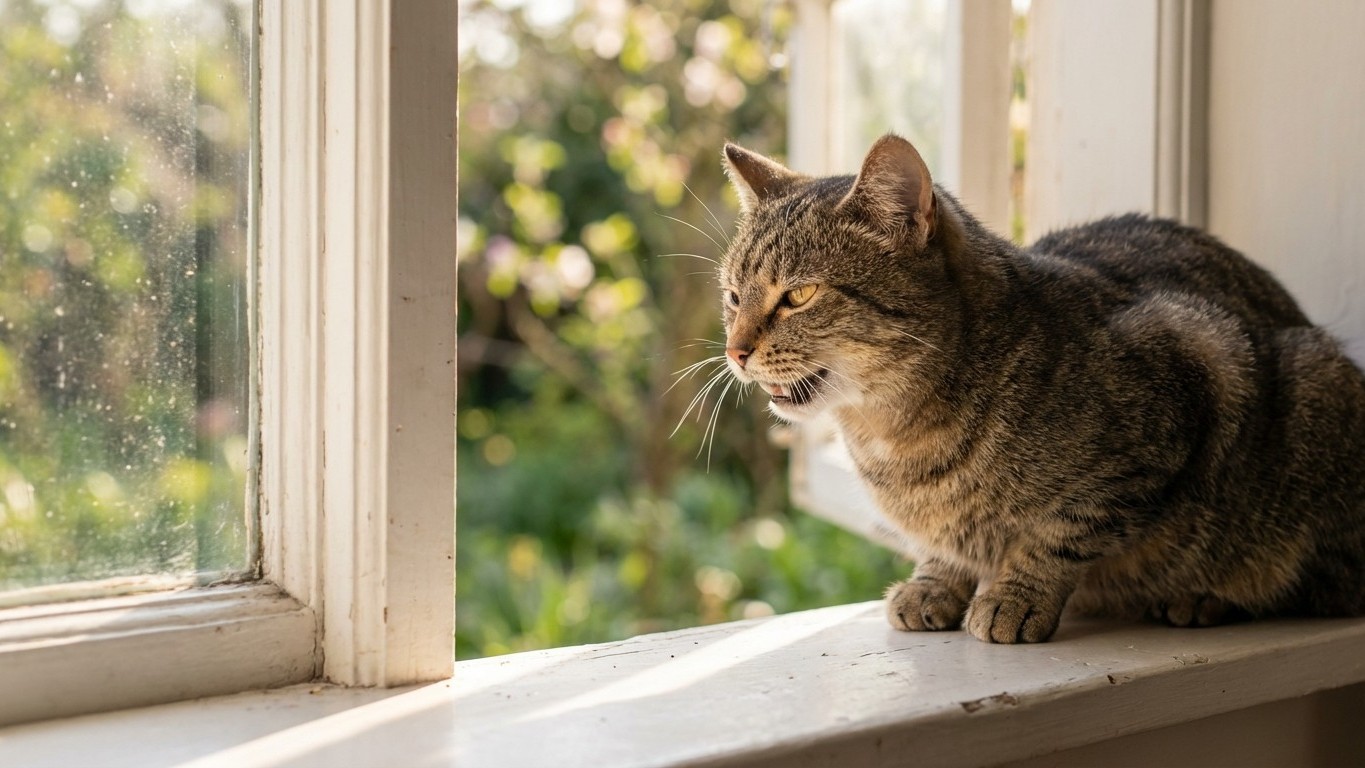
Every spring, something shifts in the indoor cat. You know the scene: your tabby, who spent most of January draped across the radiator like a fur stole, is suddenly pacing the windowsill, yowling at nothing, and launching herself off the sofa at 2am. You assume it’s the birdsong. Maybe the breeze. But the birds and the fresh air are only part of the story, and the smaller part. The real culprit is invisible, odourless to you, and yet lands on your cat’s sensory system like a thunderclap. It’s pheromones, drifting in on the spring air from other cats outside, and Your Indoor Cat is receiving every single chemical message in vivid detail.
Key takeaways
- Cats possess a hidden ‘second nose’ in the roof of their mouth that humans completely lack
- Spring pheromones carry territorial claims, mating signals, and rival warnings—all arriving at once through your window
- Your spayed or neutered indoor cat still experiences the full neurological cascade, triggering ancient instincts they cannot act on
A nose built for a different world
Cats have an estimated 45 to 200 million odour-sensitive cells in their noses, whereas humans only have around 10 million. That alone would make them acutely sensitive to spring’s chemical chorus. But here’s where it gets genuinely extraordinary: cats also have a secondary scent-processing system that we lack entirely. They have a second “nose” hidden in the roof of their mouth called the vomeronasal organ, also known as Jacobson’s organ. The receptors in this organ pick up things that the scent receptors in a cat’s nose simply can’t, scientists think the information processed by this special organ serves as a combined sense of smell and taste.
Humans may have physical remnants of a vomeronasal organ, but it is vestigial and non-functional. We are, completely deaf to this chemical frequency. Your cat, however, is tuned in perfectly. The flehmen response, that amusing moment when cats curl their lips, wrinkle their noses, and hold their mouths open — results in maximal delivery of scent chemicals (pheromones) to this specialised olfactory analyser in the roof of their mouths. If you’ve seen your cat do this frozen, slightly daft grimace by an open window in April, you weren’t imagining that something was going on. You were watching a biological radio antenna at full reception.
Researchers have found that while humans have only two V1R scent-discrimination receptors, cats have around 30. So not only do they detect more scent molecules than we do, they distinguish between them with far greater precision. The difference isn’t just quantitative. It is a fundamentally different relationship with the olfactory world.
What’s actually coming through the window
Semiochemicals that carry messages between members of the same species are called pheromones. For cats, pheromones are used to mark territorial boundaries, advertise that a cat is ready to mate, or send greetings. In spring, all three of those messages arrive at once, carried by air currents drifting through your barely-cracked sash window. The tom from number 47 has been rubbing his chin on the fence post. A female further down the street is in oestrus. A rival has sprayed the front gate. Male cats use urine spraying to mark their territory and communicate with other cats. Male cat pheromones communicate to female cats that a potential mate is nearby, and send messages to other male cats that a potential competitor has been around.
Your Indoor Cat is receiving all of this. Unlike sensory neurons from the main olfactory epithelium, the vomeronasal organ sends neuronal signals directly to the amygdala and ultimately the hypothalamus. Since the hypothalamus is a major neuroendocrine centre affecting aspects of reproductive physiology and behaviour, this may explain how scents influence aggressive and mating behaviour. This is not casual sniffing. This is a direct line from the spring air outside straight into the part of your cat’s brain that governs instinct, hormones, and territory. Spring is mating season for many animals, and while your cat may be spayed or neutered, their instinct to mark their territory can still kick in.
The light switch your cat can’t ignore
Pheromones are the hidden driver, but they don’t act in isolation. As the days grow longer, a cat’s internal clock responds. Increased light affects hormones like melatonin and serotonin, which influence mood, alertness, and activity levels. So by the time those outdoor pheromone signals are flooding through the window, your cat’s brain is already primed, hormonally restless, alert, and operating on something closer to its ancestral timetable. Cats are crepuscular animals, meaning they’re most active at dawn and dusk. As spring brings earlier sunrises and later sunsets, those active periods often become more noticeable to their human companions.
The practical result is a cascade of behaviours that can feel baffling or disruptive. Some cats become chatty during the spring, expressing their excitement or restlessness through meowing or chirping sounds, this can be especially noticeable in indoor cats yearning for outdoor experiences. When these behaviours occur around doors, windows, door frames, or other areas with access physically or visually to the outdoors, it is most often due to a stress response from your indoor cat. Spraying, scratching near exits, or obsessive window-watching can all be symptoms of a cat trying to respond to a social and territorial world it can smell but cannot reach.
Spayed and neutered cats may experience fewer hormonal influences associated with certain behaviours, like marking behaviour, eating, and vocalising, but this doesn’t mean they’re completely immune. The olfactory input is still arriving, the brain is still processing it, and some degree of restlessness remains, particularly in cats with any feral background or previous outdoor experience.
What you can actually do about it
The first practical step is enrichment, and the key is making it olfactory as well as physical. Giving your cat interesting new things to smell is a form of enrichment that may be as interesting as a new toy. Rotating stimulating scents, catnip, silver vine, or even a piece of cloth briefly rubbed on garden soil — can offer an indoor cat a scent narrative to engage with, rather than leaving their nose fixated on the frustrating signals from outside. Interactive toys, climbing trees, puzzle feeders, and play sessions help satisfy hunting instincts without turning your living room into a launchpad toward the outdoors.
For cats displaying stress-related behaviours like scratching furniture or toileting outside the litter tray, synthetic pheromone products are worth discussing with your vet. Synthetic pheromones are lab recreations that mimic natural pheromones to help promote a sense of calm and security in stressful situations, with the idea of building confidence and preventing or alleviating fear, anxiety, and stress-related behaviours such as spraying, scratching, and inter-cat aggression. However, they aren’t a one-size-fits-all solution. Some cats may be more receptive to the pheromones and alter their behaviour, but the underlying cause of the stress must also be identified and resolved. Always consult your vet before assuming any behaviour change is purely seasonal, there are medical causes for many of the same symptoms.
Window safety matters too. Ensure all windows latch safely so your cat can’t slip outside, and install window screens as an extra layer of security to protect your cat from falls. A cat deep in a pheromone-triggered trance at a fourth-floor window is not thinking clearly about gravity.
One detail that surprises most owners: cat pheromones are not detectable by humans and do not have any effect on human behaviour. You are sharing a flat with a creature experiencing a completely parallel sensory reality, one full of territorial dispatches, mating announcements, and chemical social drama that plays out entirely without your knowledge. Spring doesn’t just wake your cat up. It hands them a season’s worth of neighbourhood gossip, all at once, through the gap in the window.
Sources : slate.com | pmc.ncbi.nlm.nih.gov