
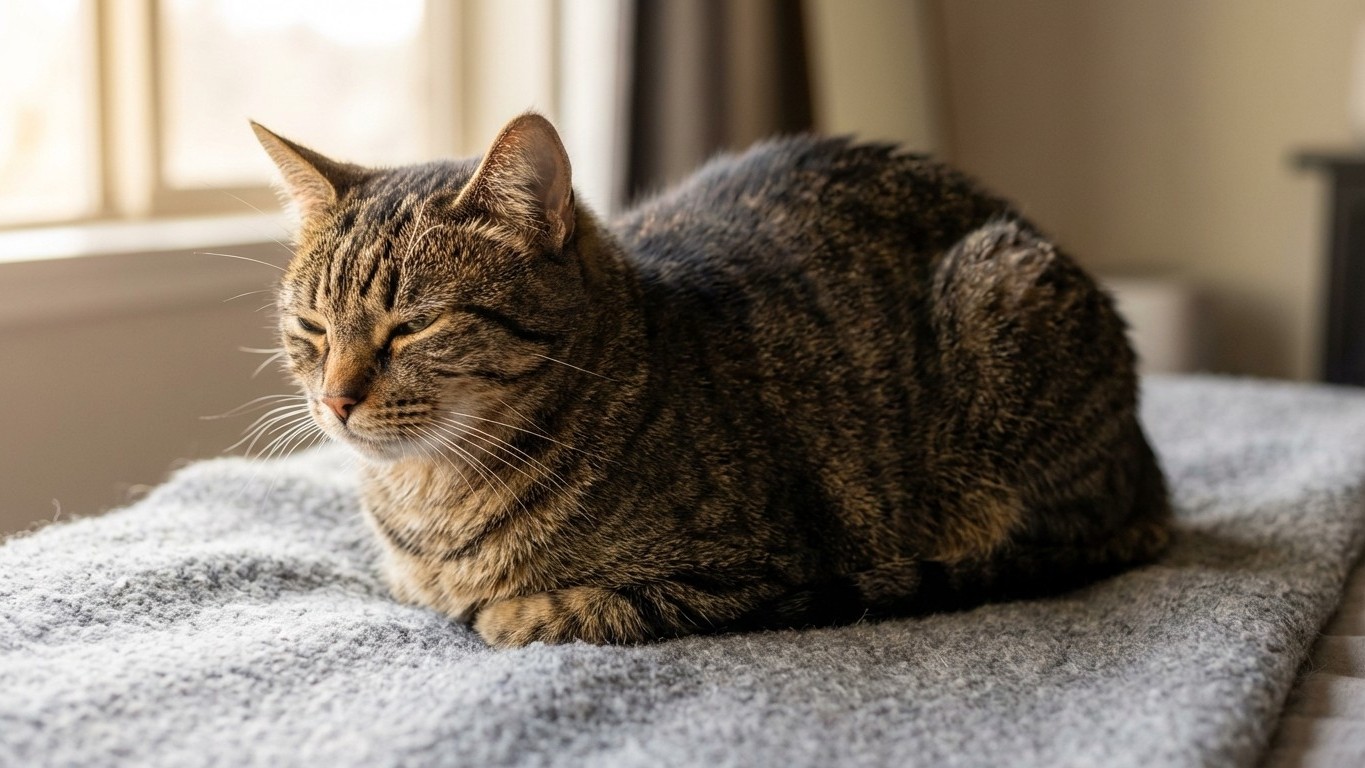
Your cat settles into a neat little bundle on the sofa, paws tucked under, looking for all the world like a small loaf of bread. You take a photo for Instagram. Perfectly reasonable. But what if that adorable pose has been quietly telling you something else entirely?
While the loaf position usually Signals-pain/”>Signals comfort, it can sometimes mask pain or illness. The problem is that cats are, by evolutionary design, extraordinarily good at looking fine when they aren’t. Cats are masters at hiding their pain, a survival Instinct that prevents them from seeming vulnerable and becoming prey in the wild, and even if your cat never steps a paw outdoors, they have an innate drive to conceal discomfort.
Key takeaways
- Cats are experts at hiding pain through pure survival instinct—what looks adorable might be something far more concerning
- The subtle difference between a cosy loaf and a pain loaf could mean the difference between early detection and chronic illness
- One simple tool used by vets can help you spot pain in your cat’s face—and there’s even a free app for it
The loaf, the meatloaf, and the difference that matters
Cats sleeping in the classic loaf position keep their front paws curled underneath their body with their head up. This position preserves body heat and protects vital organs, and cats in this pose may be relaxed but are also poised to spring into action if they sense danger. Think of it as a comfortable “standby” mode, calm, but not entirely switched off.
The trouble begins when the loaf quietly morphs into something else. In the meatloaf position, the cat’s front paws and neck may Stretch outward, the face or head gently rests downwards, and the back is arched, and this position is potentially concerning. The meatloaf is a variation of the loaf where the cat hunches forward with the back arched upwards, paws underneath, leaning forward with the chin on the floor. It looks, frankly, uncomfortable — because it usually is.
Vets note that cats frequently adopt a hunched position when they’re in pain, and tucking the limbs this way may help ease lower back pressure or soothe abdominal discomfort. Cats with heart or lung diseases may sit hunched with their elbows extended outward and their heads lowered to make breathing easier, while cats with abdominal pain from conditions such as liver disease or chronic kidney disease may sit in the loaf position to take pressure off internal organs.
If your cat is in the meatloaf pose, they almost certainly need medical attention, as it is a position often associated with serious illness, including feline chronic kidney disease (CKD), in which the kidneys stop functioning as they should. According to International Society of Feline Medicine guidelines, CKD affects 30–40% of cats over ten years of age — which makes this worth Knowing about if you share your home with an older cat.
How to tell a cosy loaf from a pain loaf
The distinction is genuinely subtle, and that’s what makes it so easy to miss. In a true bread-loaf position, the cat is pretty relaxed with no evidence of tenseness or rigidity, but if the body seems stiff, the back looks arched, or the cat appears to be holding tension, it could indicate discomfort or illness.
A cat that consistently sleeps in a tight, hunched loaf with eyes partially open may be experiencing pain. Compare that to a healthy loafer: head upright, ears gently forward, eyes soft and slow-blinking, face relaxed. The painful version tends to show a slightly lowered head, squinted or half-closed eyes, and a body that seems somehow braced rather than melted into the surface beneath it.
Context counts for a great deal here. Cats love variety and will swap and change how they sleep, so if your cat is in one sleeping position at all times, it can suggest they are unwell. A cat who used to sprawl across the entire sofa but now only ever adopts a tight, compact crouch is telling you something has changed. A cat that suddenly starts sleeping in a hunched, tense position, hides in dark or enclosed spaces more than usual, or stops stretching out entirely may be in pain, and combined with changes in appetite, grooming, or litter box habits, altered sleeping behaviour is a good reason to schedule a vet visit.
Pay close attention to where your cat chooses to loaf. If your cat is repeatedly found randomly loafing in the middle of the floor or on a cold, uncomfortable surface, it’s time to investigate further. A healthy cat seeks warmth and comfort; one that is hurting may simply stop somewhere without any apparent logic.
Reading the whole cat, not just the body
Posture alone will only get you so far. The real picture emerges when you look at the whole animal. A common sign of pain is the hunched or crouched position, where your cat tucks its paws tightly underneath and makes itself compact, sometimes with a stiff body, a pose that may suggest discomfort or an attempt to protect sensitive areas. But watch the face, too.
The Feline Grimace Scale (FGS) is a validated tool for acute pain assessment in cats based on changes in facial expressions. It assesses five action units: ear position, orbital tightening (how squinted the eyes are), muzzle tension, whisker position, and head position, each scored from 0 to 2. Developed by the Veterinary Teaching Hospital of the Faculty of Veterinary Medicine at the Université de Montréal, the team’s aim was to analyse facial expressions in cats and identify pain in a way that was easy to interpret by the veterinary professional. Owners can use it too, there’s even a free app.
A sick cat might be tense and exhibit a hunched body posture with its head tilted down, and their ears may be rolled out, their whiskers straight, and their coat dull and matted. If you see your cat constantly resting in this position, consider taking them to the vet. Other red flags to watch alongside posture include: a sudden reduction in grooming, reluctance to jump onto furniture they previously scaled without hesitation, withdrawal from social interaction, and unusual aggression when touched in a particular spot.
If a cat is in discomfort, they will often move less, sleep more, and groom less too, resulting in a dull or lacklustre coat. The pain could be dental, or anywhere else in the body, such as osteoarthritis or abdominal pain, preventing them from adopting the usual flexible postures we’re used to seeing.
One thing absolutely worth knowing: never try to treat your cat with pain medications meant for people. Cats metabolise medication differently and can die from ingesting something like acetaminophen (paracetamol). If you suspect your cat is in pain, the only right move is a call to your vet.
When to act, and why sooner is always better
Most cats actually do show symptoms of pain early on, albeit signs that are very subtle and inconsistent. Sometimes these symptoms resolve somewhat, or they might remain subtle and intermittent until the pain worsens and progresses. Unfortunately, when signs of discomfort finally become consistent and noticeable to owners, it’s often at the point where pain has become chronic and has progressed significantly.
This is the uncomfortable truth of living with cats: their stoicism works against them. So many of their behaviours have evaded being domesticated, and unfortunately showing us that they are in pain is one of those innate behaviours they frequently hide. To show pain is to show weakness, and for anxious creatures who instinctively think that everything is out to get them, that’s a very bad idea, so they suffer in silence.
Taking pictures or videos of any behaviour that seems strange to you can be genuinely useful. Many cats hide their symptoms at the vet’s office due to stress, so having visual documentation can help your veterinarian make a more accurate assessment. That phone you picked up to photograph the cute loaf pose? It might turn out to be the most useful diagnostic tool in the house.
The next time your cat settles into that compact little bundle, take a second look. Is the head up, the eyes soft, the muscles loose? Then yes, enjoy the moment, and perhaps take the photo. But if something seems off, if the body looks braced, the face tense, the head drooping toward the floor, trust that instinct. Cats have spent thousands of years perfecting the art of not letting on. The question is whether we’re paying close enough attention to notice.