
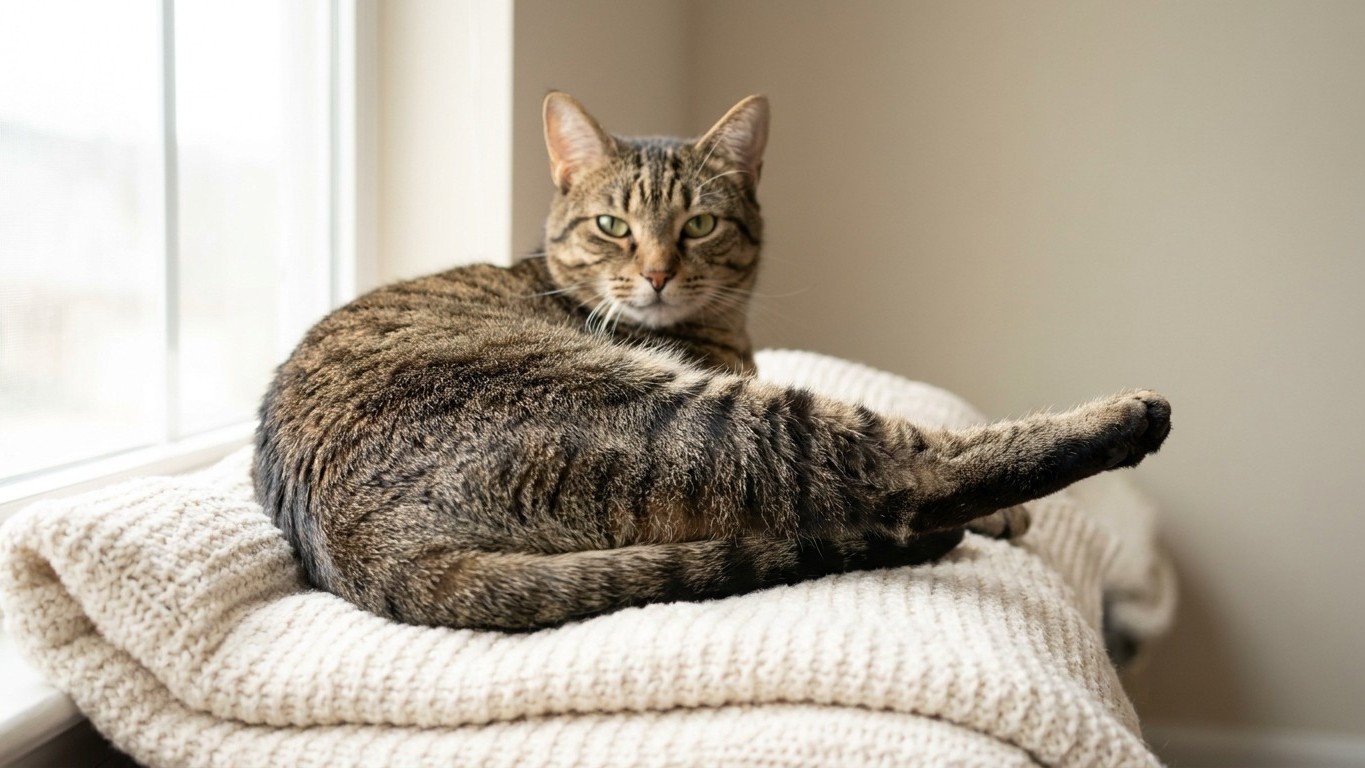
Night screaming in a newly rescued cat gets blamed on stress nine times out of ten. Moving house, new smells, a strange sofa to hide under: all reasonable explanations. But when this particular cat, pulled from a police seizure and handed over to me a few weeks later, kept crying out at 3am for reasons that had nothing to do with settling in, a routine X-ray told a very different story. His hip had been broken once, long before we ever met, and it had healed crooked, on its own, without a single vet ever seeing it.
That detail changes everything about how you read a “vocal” rescue cat.
Key takeaways
- A cat’s night screaming seemed like adjustment stress until an X-ray exposed an old fracture healed without veterinary care
- Cats are evolutionarily wired to hide pain—vets warn that dismissed vocalisation often masks serious chronic conditions
- RSPCA data shows cats are the second most abused pet in the UK, meaning many rescue animals carry invisible injuries
Why the night screaming wasn’t really about the move
Cats are notoriously good at hiding pain, a trait that goes back to their wild ancestry as both hunters and prey. Predators target animals who are easy to catch, such as those who are hurt or ill, so hiding signs of an illness is an evolutionarily sound survival strategy. That’s precisely why vets warn against assuming vocalisation is “just” stress. As one continuing education resource for veterinary professionals puts it, too often unless cats are vocalising or visibly shaking, pain signs are missed, even though cats are silent yet still exhibit signs of pain.
Researchers at the University of Calgary and Université de Montréal developed the Feline Grimace Scale precisely to catch what owners and even vets routinely miss. The scale measures the absence or presence of signs of pain including ears flattened and rotated outward, squinted eyes, whiskers bunched together, and a tense muzzle with a lowered head, each scored from zero to two. The tool has limits, though. It’s designed to evaluate acute pain, so it isn’t appropriate for understanding how cats with chronic conditions are feeling, which is exactly the trap I fell into. A years-old fracture doesn’t produce dramatic facial cues. It produces something quieter and more insidious: a cat who yowls in the dark when a stiff joint finally protests after a day of trying to act normal.
What the X-ray actually showed
The radiograph didn’t reveal a fresh injury. It showed bone that had knitted back together on its own, in a shape it was never meant to take. This happens more often than people assume. Some cats with a hip dislocation will naturally create a pseudo joint and may only be first diagnosed when they’re X-rayed for another reason entirely. Left unaddressed, this false joint means permanent lameness and potentially chronic pain, exactly the picture painted by his stiff, jerky gait once you knew to look for it.
Vets I’ve spoken to over the years describe the same pattern with old fractures that were never treated: the body does its best to compensate, but the result is rarely pain-free. One veterinary clinic’s case notes describe a cat that did not get diagnosed at the time of the injury and lived with the fractures for several years, with the femoral necks rotating out of correct alignment on X-ray. Left this way, these hips go on to become severely arthritic. That’s the mechanism behind so much of what looks like “just an old cat being grumpy” or, in this case, a rescue cat who “just needs time.” Sometimes he does need time. Sometimes he needs an anti-inflammatory and a proper pain plan.
The silver lining, if there is one, is that this type of injury is often manageable rather than dangerous. Surgical options like a femoral head ostectomy exist for cats whose hips have degenerated this way, removing the damaged ball of the joint so the body forms a workable, pain-free pseudo-joint instead. Over time, scar tissue forms a pseudo-joint, allowing for mobility with reduced or eliminated pain, though not every case needs surgery. In milder, well-compensated fractures, careful pain management and weight control can be enough.
How many rescue cats are carrying secrets like this
This isn’t a one-off sob story. RSPCA figures paint a genuinely troubling picture of what cats in the UK go through before they land on someone’s sofa. In 2024, the charity’s cruelty line received 907,797 calls from members of the public, the equivalent of receiving a call every 32 seconds. The trend has only worsened since. There has been a 22% annual increase in cruelty calls, with 21,117 in 2025 compared to 17,260 in 2024.
Cats specifically bear a heavy share of this. According to the RSPCA’s own figures from recent years, cats are one of the most popular pets in the UK with an estimated 11 million pet cats in UK homes, but they are the second most abused pet, after dogs. Nationally, intentional harm incidents against cats, including attempted killings, poisonings and beatings, rose 25% in one recent year alone. Every seized or surrendered cat carries a history nobody hands over with the paperwork. Sometimes that history is written on an X-ray plate rather than in a case file.
What to actually do if your rescue cat won’t stop crying
Give a new cat time, absolutely, cats can take weeks to settle into a strange home and vocalisation from anxiety is completely real. But if the crying is happening specifically at night, worsens with movement, or comes with stiffness getting up from a nap, don’t let “he just needs to adjust” be the final word. A full physical exam, and ideally a set of X-rays covering the hips and spine, costs a fraction of what months of unmanaged pain does to a cat’s quality of life and your own sleep. Ask your vet directly whether the vocalisation could be pain-related rather than behavioural. Rescue and rehoming charities in the UK increasingly flag this exact scenario: a cat presumed “vocal” or “difficult” turns out to be stoically living with an old injury nobody bothered to check. Getting that answer early is, quite simply, the kindest thing you can do for an animal who spent who knows how long unable to tell anyone what actually hurt.
Sources : vetgirlontherun.com | abc.net.au