
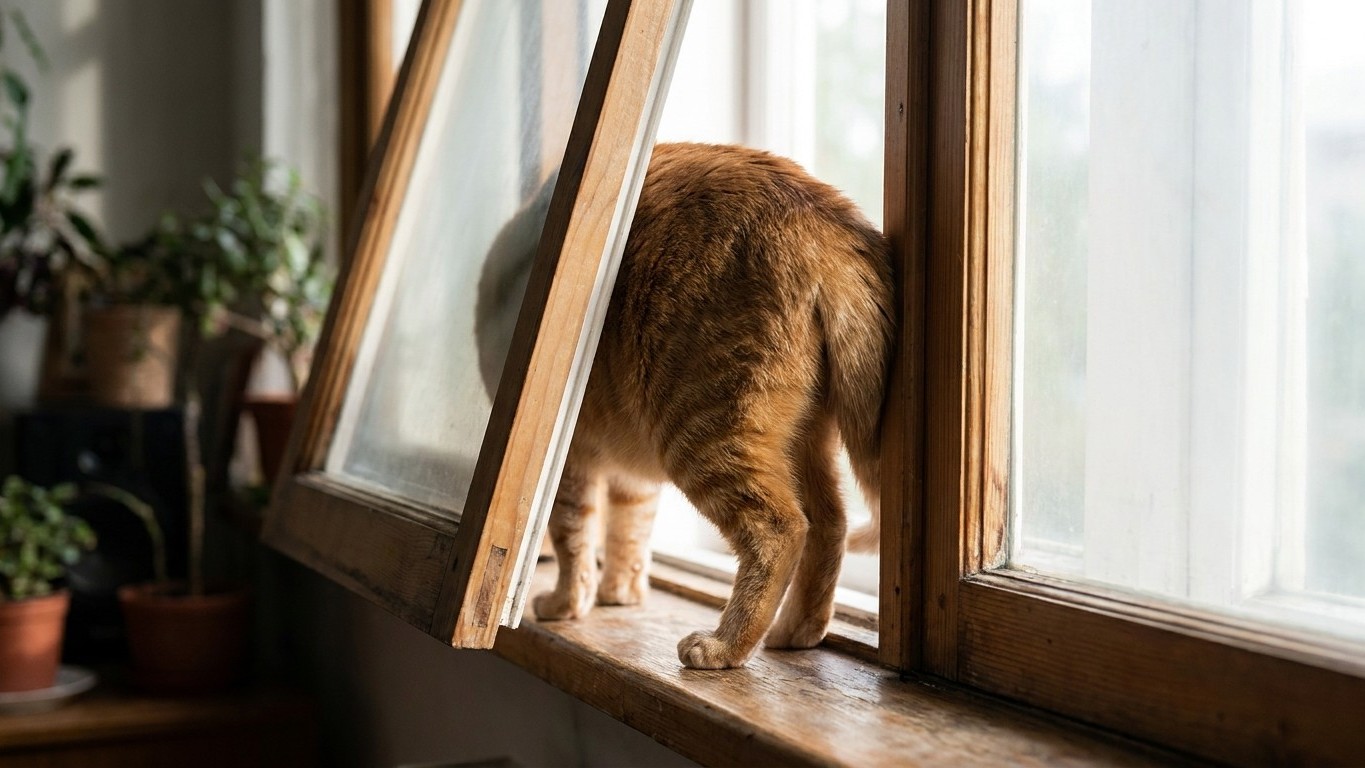
That narrow triangular gap at the top of a tilt-and-turn window looks harmless enough for letting a bit of air into a stuffy room. For a curious cat, though, it’s an invitation with a nasty catch: this trauma syndrome occurs when cats try to escape through the small V-shaped opening at the top of bottom-hung windows, but instead become trapped. The head and shoulders slip through easily. The hips don’t. What follows is a slow, crushing entrapment that vets across Europe now recognise as one of the more grim and preventable causes of feline emergency admissions.
The mechanics of it are almost cruelly simple. In most cases, cats manage to squeeze their head and upper body through the window but then get stuck with their hindquarters in the slanted gap, and attempts to free them only make the situation worse, causing the cat to slide further down into the gap and become trapped. Panic does the rest. The more a cat struggles, the tighter the wedge becomes, and the tilted frame acts like a slow vice on the lower spine and pelvis.
Key takeaways
- Cats can squeeze their heads through tilted windows but become fatally wedged by the hips in a slowly tightening vice
- The crushing pressure cuts off blood supply to the spine and back legs, often causing permanent paralysis even after rescue
- A 70-cat study found a 10% death rate during hospitalization, but survival depends entirely on how quickly the cat reaches a veterinarian
Why the hips take the hit
Vets sometimes call this “Kippfenster-Syndrom”, a German term that’s crept into veterinary literature because bottom-hung windows are so common across Germany, Austria and Switzerland, though the same window design is increasingly fitted in British homes too. Window entrapment presents a notable risk of injury and even death for cats living in areas where bottom-hung windows are common, and these windows, often referred to as ’tilt’ or ‘hopper’ windows, have a vertical opening that tilts inward.
What makes this particular trap so dangerous isn’t a fall or an impact. It’s sustained pressure on one specific point of the body. The trauma occurs when cats become accidentally trapped, often around the thoracolumbar area, leading to varying degrees of organic hypoperfusion that can affect various structures, including the spinal cord, muscles, nerves and kidneys, depending on the severity of the trauma. Put another way, the pinch doesn’t just bruise, it cuts off blood supply to the back half of the body. Nerve damage follows before any bone even breaks.
The pattern of injury bears this out. The abdominal aorta, the main artery located below the spine, is often squeezed so severely that it causes circulatory problems in the parts of the body behind it. That’s why vets talk about hindlimb paralysis rather than a simple sprain. Neurological abnormalities resulting from this condition can range from mild deficits to complete paralysis, and typically both pelvic limbs are affected, though deficits in a single limb or all four limbs are also possible. A cat that seemed perfectly bouncy an hour earlier can end up dragging its back legs.
The numbers behind the syndrome
This isn’t a rare curiosity dredged up from an obscure case file. A multicentre study spanning 2005 to 2022 looked specifically at cats trapped in bottom-hung windows and found the outcome, while serious, is often survivable with prompt treatment: of the 70 cats that met the inclusion criteria, only seven (10%) died or were euthanased during hospitalisation. Survival, though, hinges heavily on how the cat presents at the vet’s door. Researchers found evidence of an association between clinical and neurological status and survival, with tail function being the strongest association, and cats lacking tail sensation, motor function and/or tonus were more likely to die than cats with normal tail function. A drooping, unresponsive tail is a red flag that shouldn’t be shrugged off as “just a bit shocked.”
An earlier study of 71 cats with this specific bilateral hindlimb injury put the overall survival rate at 65%, though mortality rate was influenced by the severity of Neurological grade upon admission, resulting in a mortality rate of 55% with neurological status grade 5. Vets also flag a nastier complication that can appear once a cat seems to be recovering. Owners should be aware of sudden respiratory distress syndrome as one of the main causes of death with bottom-hung window trauma. the danger doesn’t necessarily end the moment the cat is freed and carried inside. Depending on how long the cat was trapped, life-threatening shock can occur several hours or even days after the injury.
Wider fall-related figures give some sense of scale too. One Austrian veterinary teaching hospital alone reported treating about 70 to 80 cats that suffer from bone fractures or internal injuries after such accidents every single year, with a clear seasonal spike: the summer months are dangerous for indoor cats, as a large number of cats have accidents every year when they fall out of open windows or from balconies. Warm weather means more open windows, more flies and birds to chase, and more chances for a moment’s curiosity to turn into a crisis.
What actually protects a cat
The fix here isn’t complicated, it’s just easy to forget on a hot evening. Restrictor stays, mesh screens fitted specifically to prevent the tilt gap from being accessible, or window locks that cap how far the frame opens all remove the hazard entirely while still letting air circulate. Balconies deserve the same scrutiny; even a gap between railings that looks too narrow for a cat’s body can be squeezed through, hips and all, by an animal built to compress itself for exactly this sort of manoeuvre.
If the worst does happen and a cat is found wedged in a tilted window, resist the urge to yank it free by the visible half of its body. Support the trapped area, widen the gap if you safely can, and get to a vet immediately even if the cat trots off looking fine afterwards, because the internal damage from this kind of crush injury often doesn’t announce itself until hours later. A five-minute check at the surgery is a far better outcome than a phone call at 2am when the hind legs have stopped working.
Sources : researchgate.net | pmc.ncbi.nlm.nih.gov