
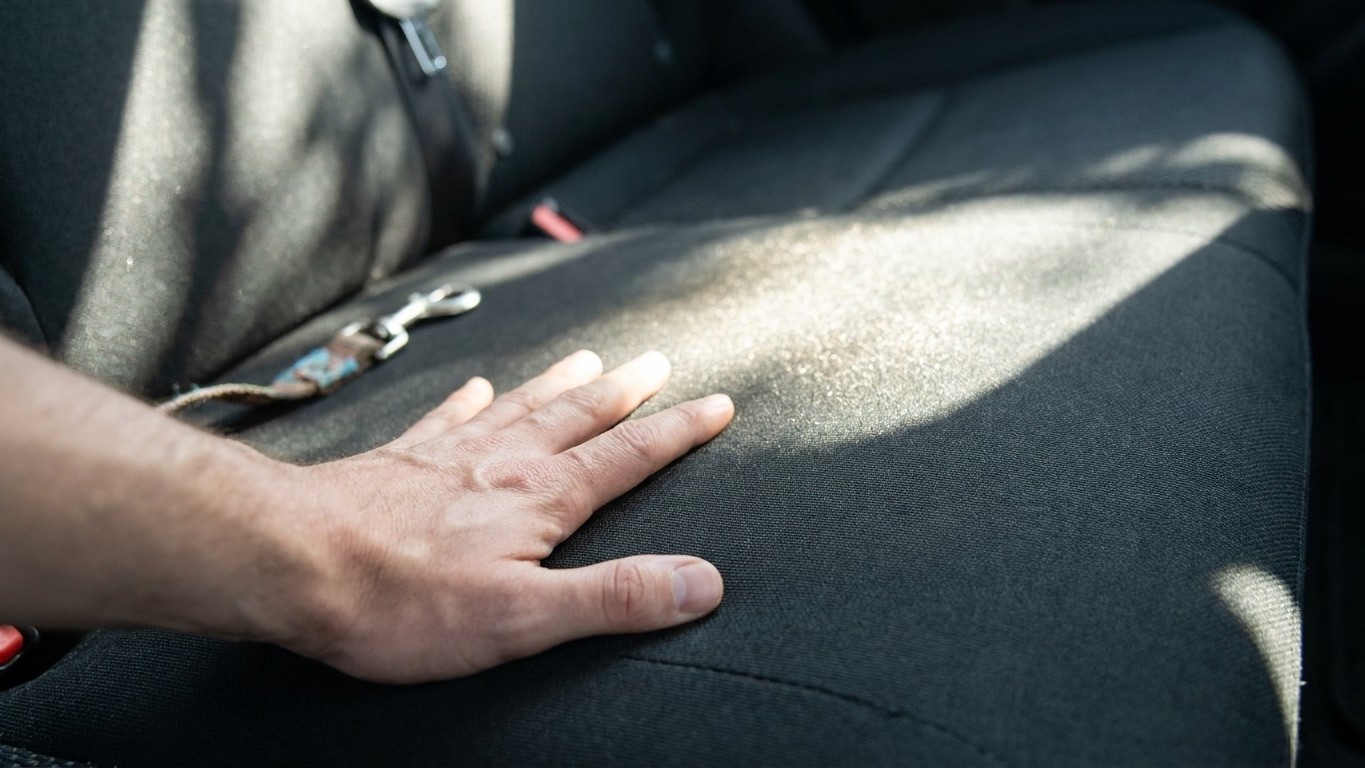
Slide your hand onto the back seat where the carrier will sit, count to ten, and if you can’t keep it there comfortably, neither can your dog or cat. This is the single habit vets say would prevent a chunk of the heatstroke cases that flood into surgeries every August, and yet almost nobody does it before loading their pet into the car.
The reason it matters comes down to basic physics that most drivers never think about. Glass acts like a magnifying lens, and upholstery, especially dark fabric or leather, absorbs and holds that heat long after the air conditioning has cooled the cabin air itself. Although most cars have great air conditioning for the front seats, the back seat or boot can heat up very quickly and become dangerously warm for your pet, especially if they are in a carrier with less airflow. You might feel perfectly comfortable up front while your dog sits on a seat that’s baking at a completely different temperature just a metre behind you.
Key takeaways
- A single habit could eliminate a significant portion of summer heatstroke cases that flood vets’ surgeries in August
- Car interiors heat up to dangerous temperatures far faster than owners realize—even on mild-looking days
- Pets cool differently than humans, making them dangerously vulnerable to heat in vehicles with restricted airflow
Why ten seconds tells you everything
The palm test works because human skin is a decent proxy for a paw pad or a dog’s exposed belly. If a seat is too hot to rest your hand on for a slow count of ten, it’s too hot for an animal to lie against for the length of a journey. This isn’t paranoia dressed up as advice. Research from the University of Leicester, in partnership with Admiral, found that the surface temperature of tarmac is much higher than the air temperature, reaching 50°C, more than double the air temperature. Car interiors behave the same way, and a carrier sitting directly on a sun-warmed seat traps that heat around the animal inside it with almost no airflow to dissipate it.
The speed of the change is what catches owners out. Even on days that don’t feel particularly hot, when outside temperatures reach just 24°C, the interior of a parked car can climb to 38°C within ten minutes. Leave the car sitting for longer and the numbers get properly alarming. When it’s 22°C outside, within an hour the temperature can reach 47°C inside a vehicle, which can result in death. An RSPCA officer once locked himself in a car during a heatwave to demonstrate exactly this, and when he got in it was 23°C but within half an hour the temperature had shot up to 57.1°C. He wasn’t even a dog wearing a fur coat.
That distinction matters enormously. Dogs and cats cool off primarily by panting, not by sweating, and their systems can become overwhelmed quickly. A human trapped in a hot car can at least sweat and shed clothing. A Labrador can’t unzip its coat. Flat-faced breeds have it worse still, since their narrower airways already restrict airflow before you add heat and panic into the mix, which is why French Bulldogs, Pugs and English Bulldogs turn up disproportionately often in heatstroke statistics.
The numbers vets wish weren’t true
This isn’t a niche worry dreamed up by overcautious journalists. The RSPCA’s own emergency line receives thousands of calls every summer about animals struggling in hot vehicles, and one recent year saw almost 8,300 emergency calls made to the RSPCA about this issue, a 5% increase on the previous year and a 15% rise on the year before that. Regional figures tell the same story from a different angle. RSPCA Cymru received 290 reports of animals in hot places, like cars, vans and conservatories, over one six-month period, with 133 of those reports made in a single month, accounting for 46% of calls.
I’ll be honest, that spike pattern doesn’t surprise me at all. It’s not the scorching heatwave days that catch people out, since most owners are already wary by then. It’s the ordinary, mild-looking August afternoon, the “just popping into the shop” moment, when a car parked in what looks like reasonable shade turns into something closer to an oven within the time it takes to queue for a coffee.
There’s also a legal dimension worth knowing. It isn’t illegal to leave your pet in a hot car in the UK, but under the 2006 Animal Welfare Act, a pet owner may be charged with an animal cruelty offence if their pet dies in a hot car while in their care. That’s a sobering thought for anyone tempted to nip into a supermarket “just for five minutes” with the windows cracked.
What to actually do before the journey
The palm test should be the first step, not the only one. Before your pet gets anywhere near the carrier, open every door and let trapped air escape, then run the air conditioning for a few minutes so the cabin, not just the dashboard display, has genuinely cooled. Check that the carrier itself hasn’t been sitting in direct sun on the parcel shelf or in the boot, because plastic and wire carriers heat up just as readily as seats do. Once you’re moving, keep an eye on your pet rather than assuming the job’s done:
- Point a fan or air vent towards the back seat, not just the front footwells
- Add a cooling mat or a damp towel to the carrier base on warm days
- Stop regularly so your pet can drink and you can check they’re not panting excessively
- Never leave the vehicle unattended with your pet inside, even for a “quick” errand
If they’re starting to breathe heavily or look warm, stop for a while and let them cool and calm down. Heavy panting, drooling, wobbliness or collapse are signs of heatstroke that need immediate veterinary attention, so if you see any of these, get your pet into shade, offer small sips of room-temperature water, and head straight to a vet rather than waiting to see if things settle.
Here’s a fact that surprises most owners: heat risk in a car doesn’t disappear once you’re driving with the windows down. Moving air feels cooler on human skin, but a carrier tucked in the footwell or wedged against the back seat can still sit in a pocket of still, hot air even at motorway speed, because the airflow simply doesn’t reach that low or that far back. So test the seat before you load your pet in, then check the carrier itself again once you’ve parked at your destination, before you assume it’s safe to leave them there while you unload the shopping.