
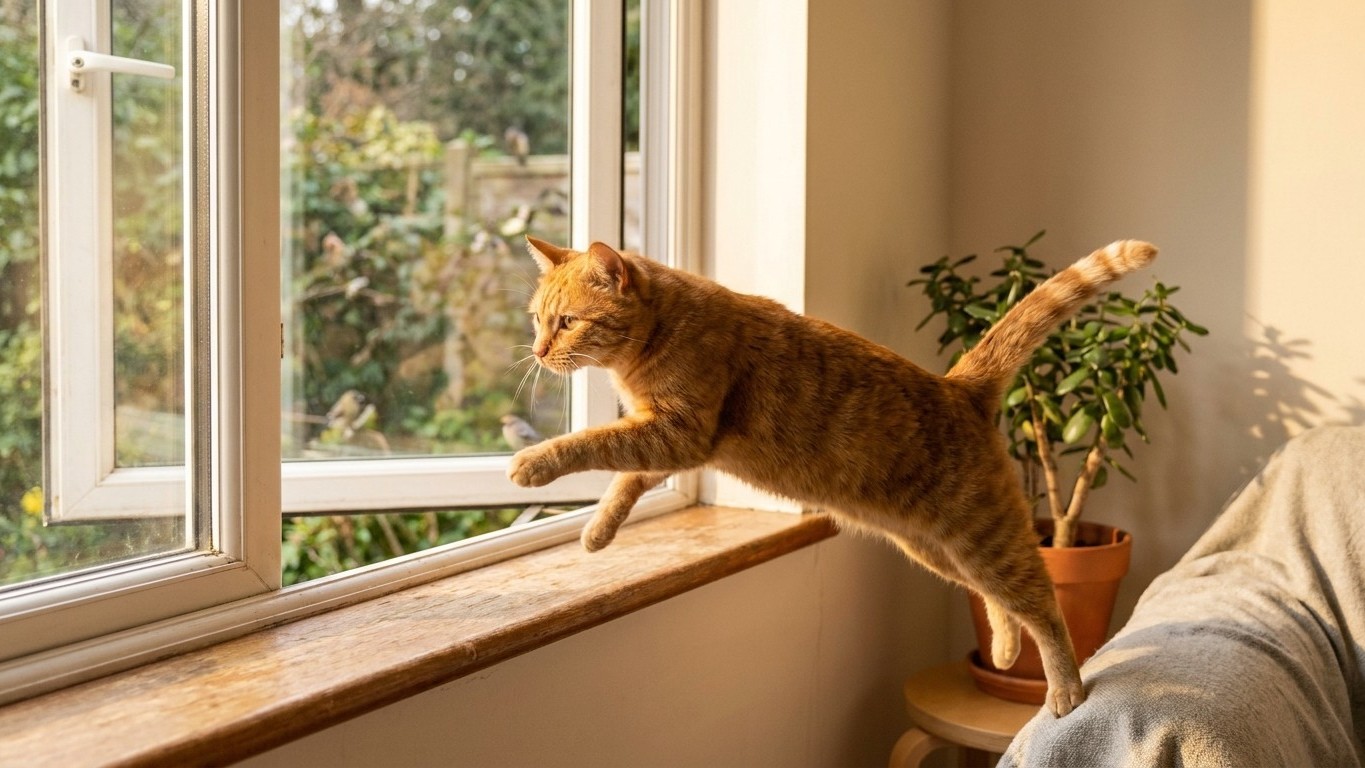
A cat surviving a tumble from a second-floor window sounds like pure luck. Yet vets treating high-rise syndrome cases often see the opposite: cats falling from lower floors frequently arrive with worse fractures and more shattered jaws than those who’ve plummeted from the sixth floor or higher. This isn’t folklore. It’s one of the strangest, most debated patterns in feline emergency medicine, and the explanation involves physics, reflexes and a fair bit of scientific disagreement that’s still being untangled.
Key takeaways
- A cat reaching terminal velocity spreads its body like a parachute—but lower falls don’t give it time to prepare
- The famous 1987 study supporting the ‘high falls are safer’ myth may have been skewed by survivorship bias
- New 2025 research from Berlin challenges everything: greater fall heights correlate with more severe injuries
The physics behind the “safer” long fall
The theory traces back to a 1987 study in the Journal of the American Veterinary Medical Association, which looked at cats brought into a New York clinic after falls from various heights. A well-documented 1987 study examined cats that had fallen from New York City high-rise buildings, and the counterintuitive finding was that cats that fell from higher floors sometimes fared better than those from middle floors. The proposed mechanism sits on two feline superpowers: the righting reflex and terminal velocity.
Cats twist mid-air to land feet-first within the first fraction of a second of falling, using their flexible spine and inner ear balance system. A cat reaches its terminal velocity of 60 mph within five stories of freefall, compared with a person’s terminal velocity of 120 mph. Once a falling cat stops accelerating, something remarkable happens. Once a cat reaches terminal velocity, it reflexively relaxes its body and spreads out, increasing drag and reducing impact forces, whereas cats falling from lower floors had not yet reached this terminal state and landed in a more rigid, injury-prone posture. Picture a cat mid-fall transforming from a tense, curled missile into something closer to a furry parachute, limbs splayed, back arched, spreading the force of landing across a wider area rather than concentrating it on four rigid legs.
A cat plunging from a second-floor window, by contrast, simply doesn’t have enough time. There’s barely a second of freefall before impact, not nearly long enough to fully right itself, let alone relax into that spread-eagled glide position. It lands tense, often at an awkward angle, absorbing shock through stiff limbs rather than a loose, distributed frame. That’s the theory your vet might reach for. But it isn’t the whole story.
What the newest research actually found
Here’s where things get genuinely interesting for anyone who’s read the “long falls are safer” claim online and taken it as gospel. The largest study ever conducted on the subject, published in 2025 by researchers reviewing over a decade of cases at the Freie Universität Berlin, tells a more complicated tale. Researchers analysed medical records and radiographs from 1125 cases of feline high-rise syndrome treated at the clinic between 2004 and 2013, with all cases involving falls from a minimum height of 4 metres.
Rather than confirming the old terminal-velocity theory, this dataset pointed the other way. The frequency of the most common injuries at different fall heights showed a consistent association, suggesting that greater fall height correlates with more severe injury. The study’s authors acknowledge just how messy this field of research has been. Some workers have reported that the relationship between the height of fall and severity of injuries follows a curvilinear pattern, while others argue that severity increases linearly with fall height.
One explanation for why the classic 1987 study found lower floors more dangerous might have nothing to do with physics at all. Cats who die in falls are less likely to be brought to a veterinarian than injured cats, meaning many cats killed in falls from higher buildings may simply never appear in these studies, a statistical trap known as survivorship bias. A cat that doesn’t survive a tenth-floor fall never makes it into the clinic’s records, quietly skewing the data towards “high falls look survivable” when really it’s just that the fatal ones vanish from the sample.
The injuries a fall actually causes
Regardless of which floor your cat fell from, the injury pattern tends to follow a recognisable script. In the Berlin study, the numbers paint a vivid picture of what “high-rise syndrome” really involves: circulatory shock was observed in 48.6% of cases, thoracic trauma in 58.3%, orofacial lesions in 51.1%, blunt abdominal trauma in 14.6%, limb fractures in 47.2% and pelvic fractures in 11.1%. The classic jawbone fracture happens because a falling cat’s chin so often takes the brunt of the landing.
Age and landing surface matter enormously too. European Shorthair cats accounted for 82% of cases in the study, with an average age of just 2.3 years and an average weight of 4.1 kg, a reminder that it’s overwhelmingly young, curious, adventurous cats leaping after a bird or a moth who end up airborne by accident. Seasonal peaks occurred in summer, when 77% of falls happened, and the majority of cats landed on hard surfaces. Encouragingly, despite the severity of injuries described, the overall survival rate in the study was 87%, while 13.3% of cats died or were euthanised as a result of trauma severity or poor prognosis.
What this means if it happens to your cat
Never assume a short fall is automatically the lucky outcome, and never assume a cat walking around afterwards is fine. Internal injuries, particularly to the lungs and abdomen, often show no obvious external sign for hours. A vet should examine any cat that has fallen from height, however calm or unruffled it seems trotting away from the scene.
The genuinely useful takeaway isn’t about which floor is “safer”. It’s that open windows without secure screens are the real hazard, at any height above ground level. Fitting snug window screens, particularly during summer when cats spend more time perched on sills chasing insects with their eyes, removes the gamble entirely. No amount of righting reflex or terminal velocity physics beats simply never falling in the first place.
Sources : journals.sagepub.com | researchgate.net