
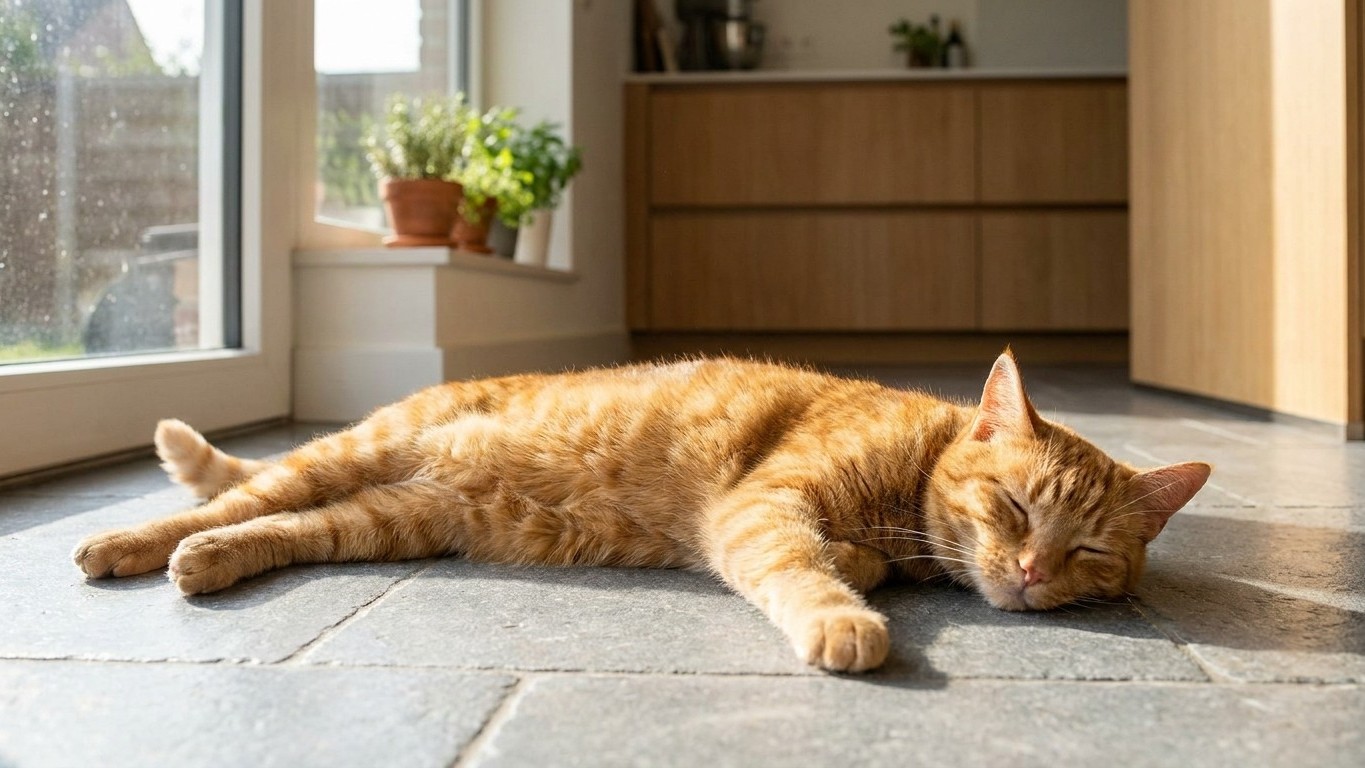
Every summer, the same scene. The cat draped completely flat across the kitchen tiles, limbs splayed in all four directions, looking less like a pet and more like a small fur rug someone forgot to hang up. Most owners assume it’s laziness or some quirky personality trait. A single conversation with a vet changes that assumption entirely, and turns an apparently baffling pose into a perfectly logical piece of animal biology.
Key takeaways
- That flat-on-the-tiles pose serves a biological purpose most cat owners never realize
- The same position can signal either total contentment or a hidden health issue—here’s how to tell the difference
- Even senior cats’ ability to do a full sprawl is a secret indicator of their wellbeing
A self-cooling machine in action
Cats naturally regulate temperature through deliberate behaviours: in heat, they seek cool, shaded surfaces, stretch out to maximise surface area, and groom to exploit evaporative cooling; in cold, they curl into a compact ball, seek warm spots and companions, and develop a thicker winter coat. The flat-on-the-tiles pose, then, is not random. You can identify a cat trying to cool down by the way they sprawl out their bodies, they do that to make as much contact with the floor as possible, which cools them off faster than if they were just sitting or curled up in a “loafing” position.
A normal cat body temperature ranges from 38°C to 39°C, higher than ours, and maintained through a set of mechanisms we rarely think about. Cats are only able to sweat through their footpads, and sweating via the footpads helps cool the surface by producing a moisture layer over the pad. That’s a fairly limited toolkit for a warm British July. So when the body needs more help, the cat turns to its environment. When ambient temperature rises, the body leans on vasodilation (more blood flow to skin) and on behaviour — choosing cooler microclimates, stretching out to increase surface area, and reducing activity that would generate additional heat.
To increase their ability to lose heat, cats often “lick”, applying saliva to the coat to simulate sweating. This is why you might notice your cat grooming far more intensively on a hot afternoon than at any other time. Cats do not experience a home as one temperature; they experience a patchwork of microclimates. Sunlit windows, top-floor rooms, and enclosed cat trees can run much warmer than the hallway floor. When the indoor temperature reaches around 23–25°C, most cats prefer lying on the floor — which, for anyone in the UK sweating through a heatwave with no air conditioning, feels entirely relatable.
What the pose actually tells you about your cat’s emotional state
The tiles behaviour is brilliant thermoregulation. But it also communicates something else, something about trust and wellbeing that body language experts find genuinely telling. The more open your cat’s body position, the less stressed they are. A cat who is lying on their side or their back with their legs stretched out, their tail loose and out, and their belly on show is relaxed. A cat that splays itself flat on a cool surface isn’t just beating the heat — it’s also broadcasting a sense of safety. A cat stretched out on its side with paws loose and body extended feels comfortable and secure. Lying belly-up reflects total trust.
There’s an interesting science side to this, too. Most people performed worse than chance when scientists showed them videos of cats and asked them to say if the felines were feeling positive or negative emotions. Only 13 per cent of people were good at it, and they weren’t your average pet owner; rather, they were people who worked with cats, such as veterinarians, vet techs, and people who work in animal shelters. The flat summer tile pose sits right at this intersection: something that looks worrying to an anxious owner is, most of the time, a postcard of contentment. When a cat is happy, their posture is typically loose, with their limbs and tail stretched out away from their body when lying down. Ears forward, pupils softly narrowed, the tail resting still — all positive signals to read alongside the position itself.
When the same pose becomes a warning sign
Here is where it gets more nuanced, and where the vet conversation becomes genuinely useful. The flat-tiles pose is usually innocent. But the same outward posture can occasionally mask something worth investigating, and the distinction comes down to context rather than position alone.
Cats have evolved to hide signs of illness and pain. In the early stages of illness, often the only thing that a cat owner may notice is that the cat has become quiet and withdrawn. Illness is the second most common reason that a cat suddenly starts sleeping on the floor. They may go in this position to calm their aching body. Cats with arthritis or joint stiffness sometimes avoid soft beds because sinking into a cushion puts pressure on sore areas. A firm floor can feel more supportive and easier to get up from.
The useful rule is this: heat-driven behaviour changes can mimic illness, hiding, reduced appetite, and low activity are shared signals. With illness, the pattern may persist across cooler periods, or additional signs appear, such as vomiting, diarrhoea, coughing, or sustained lethargy. Owners can use a simple rule: if cooling the environment does not bring a noticeable bounce-back within a reasonable window, the problem may not be heat alone. Watch particularly for panting. Open-mouth breathing in cats is more often a red-flag sign of heat stress, pain, anxiety, or respiratory compromise, not a comfortable “cooling mode.” If your cat is flat on the tiles and panting, that warrants prompt veterinary attention rather than a shrug.
While floor-sleeping is usually normal, if accompanied by other changes in behaviour, mobility issues, or signs of pain, it could indicate an underlying health problem that requires veterinary attention. If your cat is also eating less, moving stiffly, or hiding more often, schedule a vet visit to rule out pain or illness. Always consult your vet if you have any concerns, they are the only ones able to give a proper clinical assessment.
How to help your cat through a British summer
Once you Understand what the pose means, you can respond to it properly rather than worrying about it or, worse, ignoring a genuine signal. Because cats rely on behavioural thermoregulation, giving them multiple options is more effective than chasing a perfect thermostat number. A cool zone should include shade, airflow, and a surface that stays cool, such as tile or a cooling mat designed for pets. In a typical UK home, this often means leaving bathroom and kitchen floors accessible, keeping curtains partially drawn on south-facing rooms, and making sure there is always fresh water available. Lack of fresh water on hot days can dehydrate cats, which can cause heat exhaustion.
Any cat with very thick fur is more likely to suffer from heat stroke in the same way that a human wearing excessive layers of clothing is more likely to overheat. The same theory applies to overweight cats, as the extra layers of fat act as extra insulation trapping heat within the body. Flat-faced cats (such as Persians), those that become very stressed in hot temperatures, and very young or old cats are at greater risk. If your cat falls into any of these categories, paying close attention to their summer habits is especially worthwhile.
One thing worth noting about the “sploot” specifically, that full flat stretch with legs extending behind the body. Splooting allows a cat to increase the flexibility between joints and hips. It is simultaneously a cooling strategy, a muscle stretch, and a declaration of ease. This position actually helps them relax their leg muscles and their spine. Older cats sploot less often simply because joint stiffness limits the range of motion — so if your senior cat can still achieve the full sprawl on a July afternoon, it is, oddly, a rather encouraging health indicator.
Sources : pawsclaws.cn | brownvethospital.com