
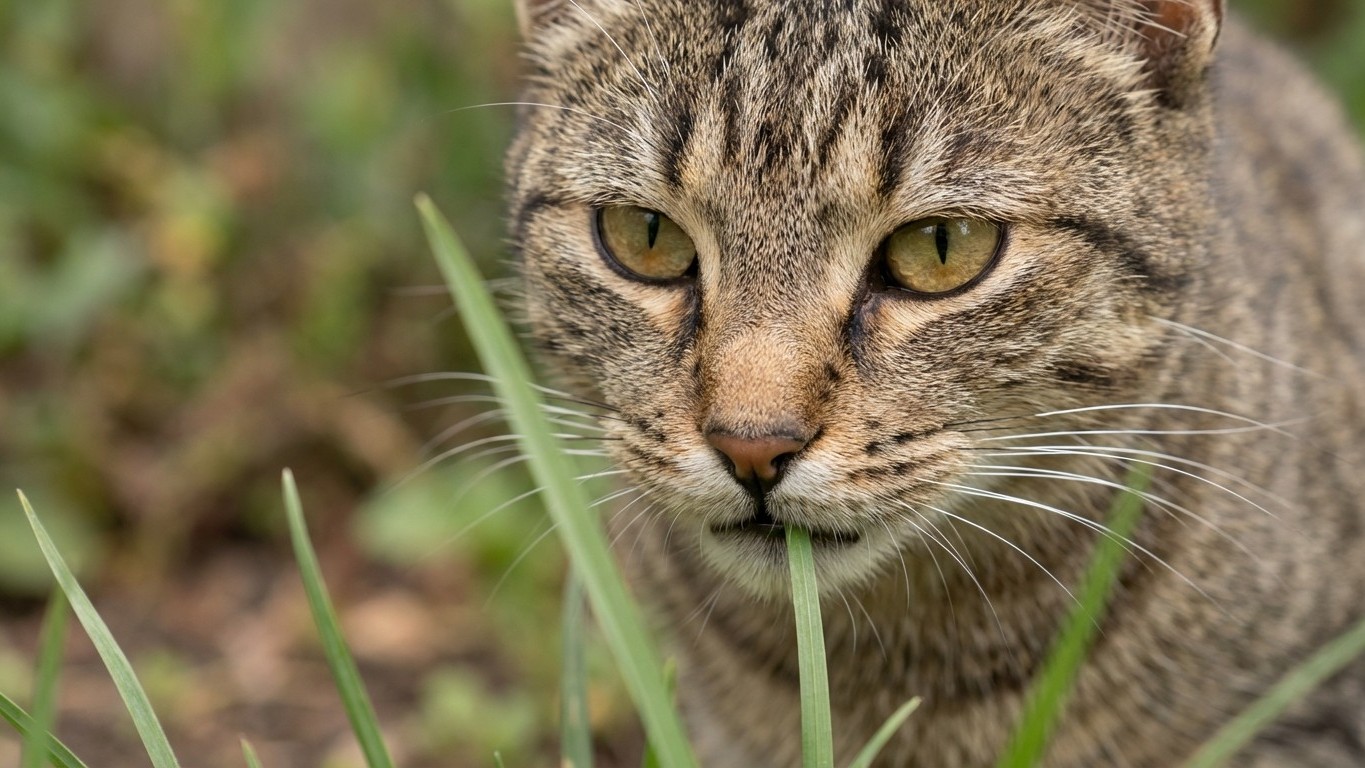
Your cat slinks outside, makes a beeline for the nearest tuft of grass, chews with apparent purpose, and then, sometimes, brings it all back up on your kitchen floor. You’ve probably wondered what on earth is going on inside that enigmatic little body. So have scientists. For over a decade, researchers patiently observed, surveyed, and studied feline behaviour, and the answer they’ve arrived at is both surprising and oddly elegant: grass isn’t an accident or a sign of illness. Your cat is, in all likelihood, doing something deeply, evolutionarily deliberate.
Key takeaways
- Only 6% of grass-eating cats were actually ill beforehand—debunking the most popular myth
- Wild carnivores use grass as a natural parasite purge, and domestic cats may retain this ancient instinct
- Researchers coated hairballs in gold and discovered cats deliberately choose rough plants that work like biological drain snakes
The decade-long investigation you didn’t know was happening
The research trail stretches back to 2006, when a web-based survey was launched under the title “Cats and plants: A scientific study of grass- and plant-eating behaviour in cats.” Two surveys with between 1,000 and 2,000 responses from cat owners were launched over ten years to test different hypotheses regarding plant eating. The lead researchers, based at the University of California, Davis, School of Veterinary Medicine, weren’t working on a hunch, they had specific, testable ideas to knock down or confirm.
Those hypotheses were that plant eating: (1) is a response to the cat feeling ill; (2) induces vomiting; (3) is a means of expelling hairballs from consumed hair, and additionally, that plant eating reflects an innate predisposition acquired from the ancestral cat. Each one, in turn, was put to the test. The results overturned almost everything most cat owners assume.
Analyses revealed that overall, 65 per cent of cats ate plants weekly, yet just 6 per cent appeared ill before eating plants. Read that again. Six per cent. The idea that cats eat grass because they feel sick, then, is far more old wives’ tale than Biological reality. The vomiting, researchers concluded, is merely an occasional byproduct of eating grass — not the objective.
Ancient instinct, modern carpet disaster
Field studies of wild carnivores and primates found that they regularly eat non-digestible grass and other vegetation to purge parasitic worms from their systems. This is where the story gets genuinely strange and rather wonderful. After observing blades of grass wrapped around intestinal worms in wolf scats, one researcher suggested that grass might have a “scouring effect” in removing worms. Similar observations were made in other species: in the faeces of the Chinese lesser civet, whole blades of grass were found in which adult worms were trapped.
Cats, the University of California team believe, regularly eat grass to stimulate muscle activity in their digestive tracts and force parasites from their guts, and “given that virtually all wild carnivores carry an intestinal parasite load, regular, instinctive plant eating would have an adaptive role in maintaining a tolerable intestinal parasite load, whether or not the animal senses the parasites.”
Cats used to eat grass to protect themselves against intestinal parasites. Domesticated cats don’t need this protection any more, but the drive to eat grass might linger. Think of it as evolutionary muscle memory, a behaviour so useful for so many thousands of years that the brain kept encoding it, long after the parasites were gone. Short-haired cats ate plants as frequently as long-haired cats, suggesting that plant eating is not primarily for expelling hairballs — and, intriguingly, the findings also don’t support the hypothesis that young cats learn to eat grass by watching older cats. This is hardwired, not taught.
Cats also appear to eat less grass than dogs, and researchers have a theory for that too. This may be because parasite infections were less prevalent among feline ancestral species, or it may be that cats’ habit of burying and avoiding one another’s faeces slowed the spread of parasites compared with dogs. Even in the realm of worm management, cats were apparently more fastidious.
Then came the gold-covered hairballs
Just when the parasite hypothesis seemed settled, 2025 brought a twist, and one of the more unusual experimental setups in recent veterinary science. Nicole Hughes, a plant biologist at High Point University, focused not on cats but on the greens they eat. “I know what grass looks like — it’s spiky and likely to snag,” she says. Hughes had been saving hairballs from her own two tuxedo cats, Mildred and Merle, for years, waiting for the right research project to come along.
Together with a student researcher, the team clipped apart six homegrown hairballs and coated them in gold, a necessary step for scanning them with an electron microscope. Detailed images revealed both jagged edges and trichomes, spikelike projections that stick out like prongs. Depending on the plant, those microstructures were two to 20 times longer than cat hairs were wide — meaning they were just the right size to snare fur.
Genetic analysis revealed that most of the plant matter came from common backyard grasses and hardy houseplants. All the plants shared one thing in common: rough surfaces at the microscopic level, seemingly suggesting cats deliberately choose the scratchiest plants available. The analogy the researchers reached for was a drain snake, those plastic coils used to yank hair out of bathroom sinks. Cats, it seems, may have evolved to use rough vegetation in much the same way, as a kind of Biological plumbing tool.
The parasite removal theory isn’t dead, though. Cat parasites like roundworms and tapeworms are up to 60 times larger than these plant microstructures, too large to be snared, making parasite removal a less likely reason cats eat grass, according to Hughes. The lead researcher of the earlier study acknowledges these findings hint at how plants could trap cat hair, but doesn’t think the new study proves that is the reason cats eat grass, noting that dogs and other animals that don’t suffer from hairballs eat grass too, and still believes the behaviour is an evolutionary holdover from an ancient ancestor that may have munched grass to expel parasites. Science, doing what science does: two strong, competing, complementary ideas.
What this actually means for your cat (and your garden)
The practical upshot of all this research is reassuring. The consensus among cat experts is that if the feline in your home indulges in the occasional nibble of grass, this should not be discouraged. Whether the driving instinct is parasite purging or hairball management, or both, the behaviour is normal, ancient, and probably serving some purpose your cat’s body understands better than we do.
For indoor cats especially, this matters. “Providing extra enrichment for indoor cats is always a good idea, and cat grass is no exception. Whilst your cat may not opt to use it, it is always beneficial for cats to have lots of choice within their environment”, and indoor cat grass can also help those with outdoor access avoid eating grass that has been treated with chemical fertilisers or pesticides.
It’s fine for cats to eat grass in moderation, as long as it hasn’t been treated with pesticides or herbicides, and if only small amounts have been consumed, and if it hasn’t been near a poisonous plant like a lily or a daffodil. Those last two are worth remembering: both are common in British gardens and both are toxic to cats. Certain popular houseplants can be toxic to cats, including poinsettias and lilies, these and several others are poisonous and can cause a mild or even severe reaction. If you’re ever unsure whether a plant your cat has eaten is safe, always consult your vet promptly.
What strikes me most about this whole line of research is how it reframes the relationship between cats and their environment. They’re not confused carnivores stumbling into the vegetable garden. They’re performing a behaviour refined over millions of years, one that may have saved their wild ancestors from very real, very unpleasant gut residents. The findings suggest that cats may be repurposing a plant’s natural defence features for their own benefit — yet another example of how animals use plants in ways that go far beyond calories or nutrition. Whether the grass on your lawn is a parasite purge, a hairball hook, or both, your cat knows something we’re only just beginning to understand. And researchers are still saving their pets’ poop to find out what else we’ve been missing.
Sources : english.pravda.ru | smithsonianmag.com