
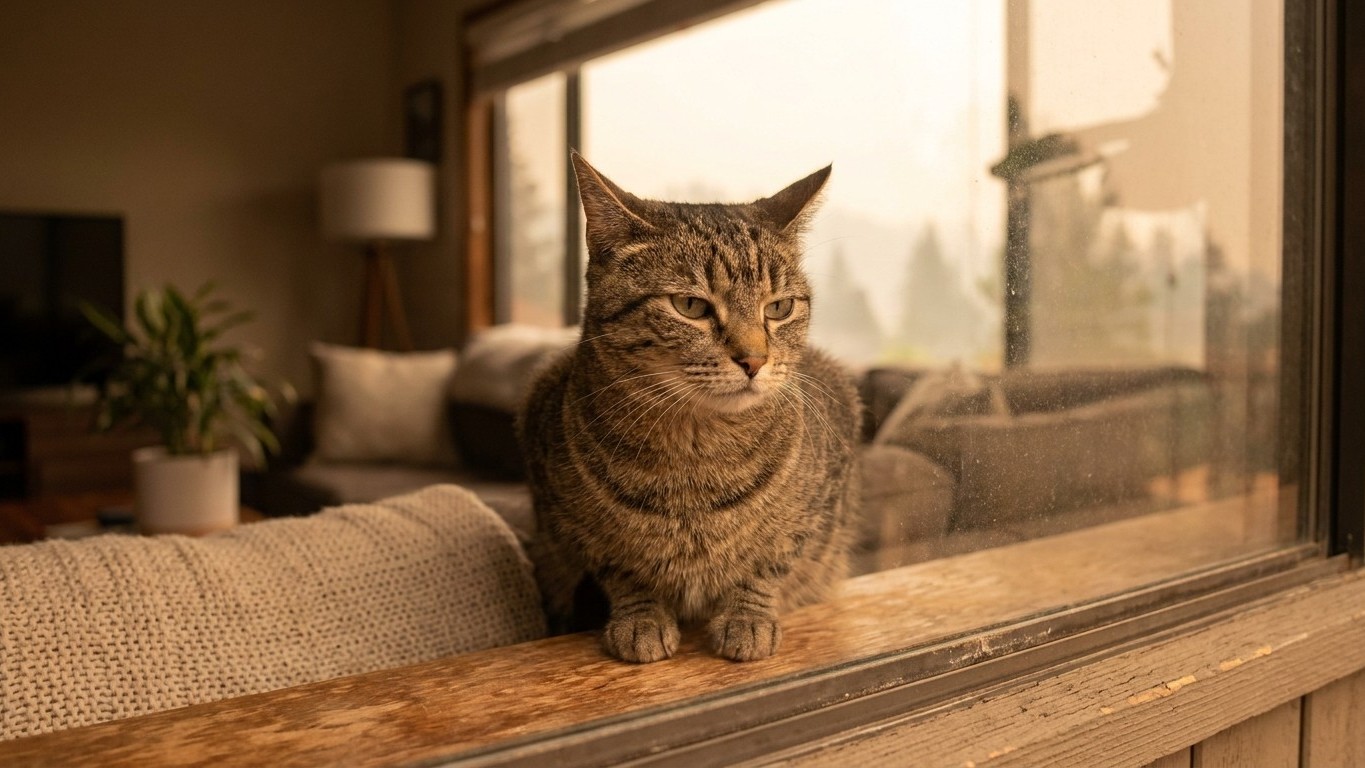
That low crouch, stretched-out neck and retching sound is exactly what a hairball looks like. But during wildfire smoke, it’s often something far more sinister: a cat struggling to breathe. The posture is classic feline asthma, and vets say it’s one of the most commonly missed emergencies of smoke season, precisely because it mimics something so ordinary.
Cats are notoriously good at hiding illness. “Cats are a little bit different in that they tend to hide illness, and they literally hide under the bed,” one veterinarian noted, adding that this makes them harder to properly assess since if they’re not feeling well, they’re often not out where owners can see it. That’s precisely why a cough that looks like a hairball episode deserves a second glance rather than a shrug.
Key takeaways
- A cough that looks exactly like a hairball could actually be feline asthma triggered by wildfire smoke—and it can become life-threatening within minutes
- Open-mouth breathing or panting in cats is almost never normal and should trigger an emergency vet call, unlike in dogs
- Smoke complications can strike 24-48 hours after exposure, meaning a cat that seemed fine yesterday could deteriorate tonight
Why smoke turns a cough into an emergency
Wildfire smoke isn’t just unpleasant, it’s a cocktail of fine particulates and gases that inflame the airways of any mammal unlucky enough to breathe it in. Wildfire smoke poses significant health risks to pets, mirroring its effects on humans, with one veterinarian warning that smoke irritates eyes and airways, inflames lungs, and worsens existing health conditions in dogs and cats. For a cat with feline asthma (a surprisingly common condition), that inflammation can tip a manageable airway into a genuine crisis within minutes.
What makes cats especially tricky is a single behaviour that vets flag again and again: open-mouth breathing. Open mouth breathing or panting in a cat is almost never normal and should be treated as an emergency, in stark contrast to dogs, for whom panting is a completely normal activity. If your cat is sitting with its mouth open, gulping air, that’s not a cat cooling down. That’s a 999 call to your vet, full stop.
Location matters too, in a way most owners never consider. Pets can be even more affected because they’re so little and they breathe fast and low to the ground where the pollutants are more concentrated, according to one emergency vet who has seen the pattern firsthand during smoke events. Your cat isn’t experiencing the same air quality reading on the news app on your phone; down at skirting-board height, the smoke can be thicker still.
Reading the difference between a hairball and a crisis
A genuine hairball retch is usually quick: a few forceful heaves, maybe some noise, then it’s over and your cat trots off looking mildly affronted. An asthma attack triggered by smoke looks similar at first glance, crouched body, extended neck, but it doesn’t resolve the same way. If a cat is coughing a little bit but it resolves quickly, it’s not a big deal, but if there’s a persistent cough, obvious difficulty breathing, unusual lethargy, or no improvement after the smoke exposure has stopped, it’s time to call your veterinarian.
Watch for the tell-tale signs alongside the cough itself:
- Rapid, shallow breathing that doesn’t settle after a minute or two
- Wheezing or a whistling sound on the exhale
- Blue or pale gums, or the cat suddenly collapsing
- Reluctance to move, eat, or groom as normal
Pale or blue gums, or collapse, are certainly reasons to believe there might be a true emergency, one vet explained plainly. There’s no ambiguity there. If you see either of those things, this isn’t a “wait and see how she is in the morning” situation. It’s an emergency vet, tonight.
Timing can be sneaky, too. Complications of smoke inhalation can occur 24 to 48 hours after the incident, which means a cat that seemed to bounce back from a coughing fit can still deteriorate the following day. Vets treating burns and airway injuries also warn that it only takes 48 to 72 hours for ulcers and erosions in the airway to occur, so any suspected smoke inhalation warrants contacting your vet.
Who’s most at risk, and what actually helps
Not every cat faces equal odds. Increased risk is seen in pets with respiratory disease, heart disease, or feline asthma, as well as senior pets, very young animals, and brachycephalic breeds, though healthy pets can also develop serious complications after significant smoke exposure. Flat-faced breeds like Persians deserve particular vigilance; their airways are already narrower before smoke ever enters the equation. Vets at Ontario Veterinary College have specifically flagged Persian cats among the higher-risk facial conformations during poor air quality events, alongside brachycephalic dog breeds like bulldogs and Shih Tzus.
The good news is that prevention isn’t complicated. Keep cats indoors entirely during smoke events rather than allowing even brief outdoor access, since their instinct to hide during a crisis means they might not come back when called. Run air conditioning with the outdoor air intake closed if possible, and a HEPA purifier in the room where your cat spends most time makes a genuine difference to particulate levels. Skip the idea of a pet mask; cats won’t tolerate one, and a poorly fitted mask does more harm than good by adding stress on top of restricted breathing.
One AQI number worth remembering: emergency vets in Minnesota have observed that an AQI over 150 is considered unhealthy for animals, not just the higher thresholds often quoted for humans. Check your local air quality index the same way you’d check the weather, and if it’s creeping into that orange or red zone, that’s your cue to keep the cat flap locked and the windows shut, asthma diagnosis or not. A cough that looks like a hairball might just be a hairball. But during smoke season, it’s worth ten seconds of proper attention rather than a shrug and a “he’ll be fine by morning.”
Sources : chagrinfallspetclinic.com | bbvsh.com