
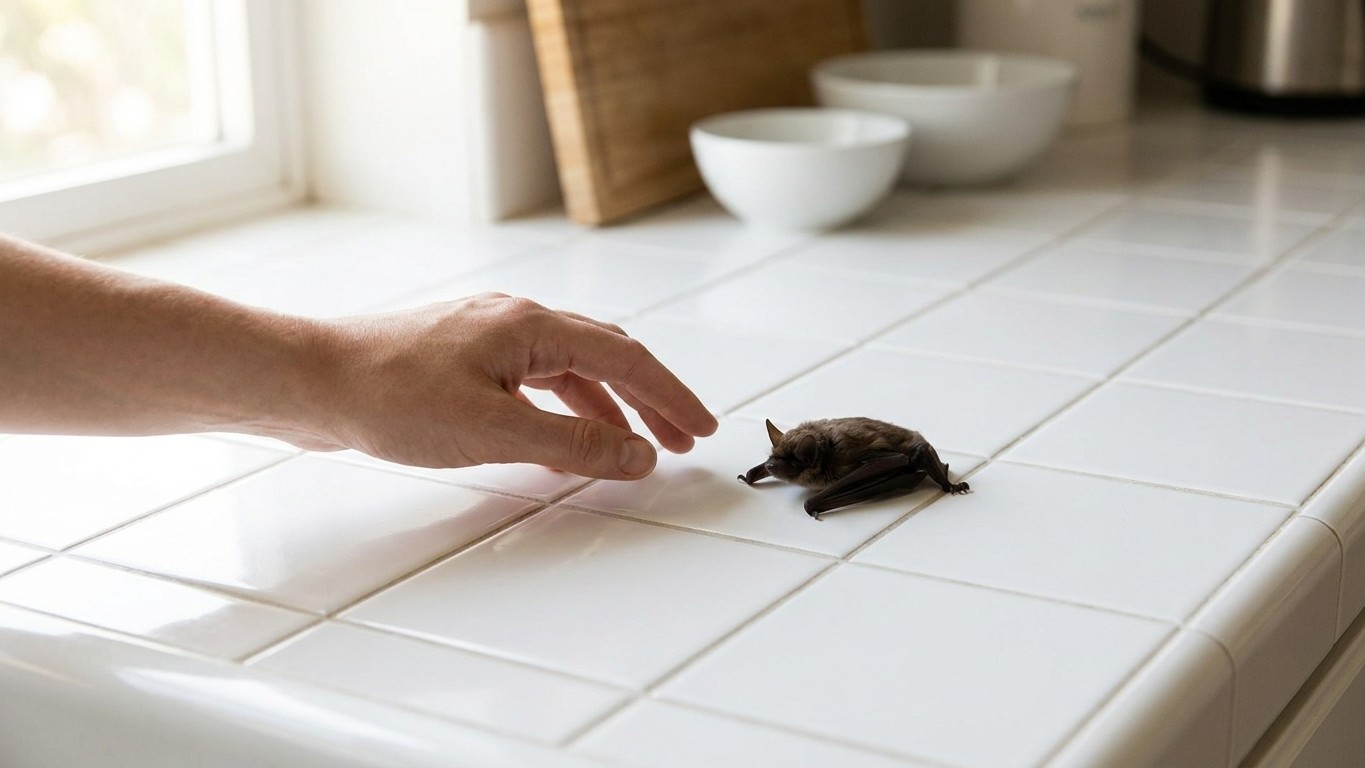
Rabies has been eliminated from British soil for over a century, yet a tiny, twitchy creature no bigger than a 50p coin can still carry a version of it through our gardens and lofts. That’s the reality behind a scenario more common than you’d think: your cat trots in with something small and fluttering, drops it on the lino, and there’s a live bat blinking up at you from the kitchen floor. Scooping it up bare-handed to release it outside feels like the kind, sensible thing to do. It very nearly always is fine. But if that bat so much as nips you, and you don’t feel it happen, you’re suddenly in territory where a GP or vet nurse will ask you one question you might not be able to answer honestly: are you certain it didn’t bite you?
That question matters more than it sounds, because bat teeth are needle-fine and their bites often don’t hurt or bleed. Bat bites are not always obvious and do not tend to leave a mark, therefore they are often felt not seen. You could hold a bat for thirty seconds, put it gently on a windowsill, watch it fly off into the dusk feeling rather pleased with yourself, and have no idea whether its jaws ever closed on your skin. That uncertainty is precisely what turns a heart-warming rescue story into an urgent medical conversation.
Key takeaways
- Bat bites are nearly invisible and painless—you could be bitten without realizing it
- UK bats carry European Bat Lyssavirus, a cousin of rabies with no cure once symptoms appear
- One wrong answer to a doctor’s question launches precautionary post-exposure treatment for 150+ people yearly
Why a bat bite is treated so seriously in a country with no rabies
A small number of UK bats carry European Bat Lyssaviruses, or EBLVs, cousins of the classical rabies virus that circulates in dogs abroad. There are two types present: EBLV-1 found in Serotine bats and EBLV-2 found in Daubenton’s bats. The odds of any individual bat carrying it are genuinely low. Passive surveillance of bats for rabies in the UK since 1986 has found only a small number of EBLV-positive bats (less than 0.5%) from over 19,000 tested. That’s a reassuring statistic, and it’s the reason vets and doctors will tell you, quite rightly, that panic isn’t warranted.
But low probability isn’t zero probability, and once symptoms of EBLV infection appear in a human, there is no cure. Although the risk of catching rabies from a bat in the UK is very low, rabies contracted from bats can be fatal in humans once symptoms appear. The UK’s only confirmed human death happened in November 2002, when a Scottish bat conservationist contracted EBLV-2 from a bite. It remains an isolated tragedy, but it’s the reason every suspected exposure, however trivial it feels, gets taken seriously rather than shrugged off.
What actually happens once you can’t answer “did it bite you?”
This is where the appointment stopped being a formality. Saying “I’m not sure” to that question doesn’t get you sent home with a shrug; it triggers a proper risk assessment, because clinicians have to assume the worst-case scenario when a bite can’t be ruled out. The official health guidance is blunt about this. Any person exposed to any type of bat in the UK should receive a prompt risk assessment and may require post-exposure treatment with rabies vaccine. Even a scratch counts, and so does saliva reaching your eyes, mouth, nose or an existing cut. The virus may also enter the body via open wounds or mucous membranes, however the risk of a pet or a human contracting EBLV from a bat is very low.
The first practical step, and the one everyone should know before they ever pick up a bat, is washing thoroughly and immediately. If you think you have been bitten or scratched by a bat it is important to wash the site of the bite or scratch immediately with soap and water for at least five minutes. After that, medical advice is non-negotiable, whatever your vaccination history. In the event that an individual is bitten or scratched by a bat or exposed to bat saliva or nervous tissue in any other way, they should seek immediate medical advice, regardless of vaccination status. Roughly 150 people a year in England end up going through this precautionary post-exposure treatment, which tells you it’s a well-worn path for NHS staff, not some rare drama.
What to actually do the next time your cat brings one home
Cats are remarkably efficient at catching bats mid-flight, particularly the low-swooping species like Daubenton’s that skim over ponds and gardens for insects, and it’s worth knowing your feline hunter carries its own (very small) risk too. If a cat catches or plays with a bat, the risk of rabies transmission is very low but non-zero, so it’s sensible to keep the exposed pet under close observation for behavioural changes and seek veterinary advice if you’re concerned. For the bat itself, resist the bare-handed instinct even when it feels harmless. If you need to handle a bat, wear bite-proof gloves to protect from any potential risk, or use a thick tea towel and a small box to scoop it up without direct skin contact. Bats are also legally protected in this country, so however you handle the situation, harming one isn’t an option. You cannot kill a bat even if it bites you, as bats are legally protected, and it’s an offence to do so; instead, contain it if possible and contact the Bat Helpline for advice on what to do with it.
One detail that surprised me most while looking into all this: bats are fastidiously clean animals that spend hours each day grooming, and outside of this one bite-transmitted risk, they carry nothing else that threatens us. Bats are clean and sociable animals which spend many hours grooming themselves, and although some share buildings with humans, there are minimal health risks associated with bats living in your property. Gloves, a tea towel, and a moment’s patience are all it takes to turn a kitchen-floor rescue into the good deed it was always meant to be, without the follow-up phone call to your GP surgery.
Sources : pubmed.ncbi.nlm.nih.gov | cem.scot.nhs.uk