
A microchip the size of a grain of rice is precisely what unravels this kind of plan. Leaving a cat behind in an empty flat, however full the bowl looks on day one, is not “buying time”. It’s abandonment under UK law, and the scan that reunites a stray with a vet database is exactly the mechanism that turns a quiet exit into a knock on a new front door three weeks later.
Cases like this land on RSPCA desks more often than most people realise. In Wigan, inspectors found a starving cat left abandoned in a filthy flat for nine days, discovered locked in a rubbish-strewn flat along with another cat. The pair had tried to claw their way out, with one frantically moving its paw through a gap at the bottom of the door before an inspector finally spotted them. Nine days without proper care is bad enough. Three weeks, which is roughly the scenario described here, pushes well past the point where a full bowl on departure day means anything at all. Cats left alone quickly run out of water, and a bowl of dry food doesn’t stretch anywhere near that long once a hungry animal works through it in the first 48 hours.
Key takeaways
- A cat left alone in a flat for three weeks didn’t survive on a single bowl of food—but the microchip scan revealed everything
- Since June 2024, every cat in England must be microchipped by law, and vets can trace owners in minutes
- Abandonment is a criminal offence in the UK; 907,797 calls about animal cruelty came to the RSPCA in 2024 alone
Why “I gave her a full bowl” isn’t a defence
Abandoning an animal in a way likely to cause it suffering is a criminal offence in England and Wales, and Scotland has its own near-identical law under the Animal Health and Welfare (Scotland) Act 2006, where anyone found guilty can expect to be banned from keeping animals for a fixed period or life. RSPCA inspectors don’t treat these as isolated dramas either. The charity’s own figures show the scale of the problem: in 2024, the cruelty line received 907,797 calls from members of the public, the equivalent of receiving a call every 32 seconds. Abandonment in an empty property is one of the more common patterns behind those calls, particularly around house moves, evictions and relationship breakdowns, when a pet suddenly becomes someone’s problem to solve in a hurry.
What tends to surprise people is how often these animals aren’t even hidden well. One RSPCA case in Gloucester saw fourteen abandoned cats and kittens taken in by an animal clinic in the space of six weeks, including a heavily pregnant cat left in a box. Nottinghamshire had its own grim example when a resident found a cat rescued from a communal bin, discovered by a concerned resident in a cat carrier inside a bin. None of these cats had done anything wrong. They were simply inconvenient at the moment someone decided to move on.
How a neck scan finds you at your new address
This is the part that catches people out. Since 10 June 2024, all cat owners in England must ensure their cat is microchipped, as it is a legal requirement under the Microchipping of Cats and Dogs (England) Regulations 2023. Owners who haven’t complied face real consequences: owners found not to have microchipped their cat have 21 days to get one implanted or may face a fine of up to £500. But the more relevant point for our locked-flat scenario is what happens when the cat is already chipped, because that’s precisely how these cases get solved.
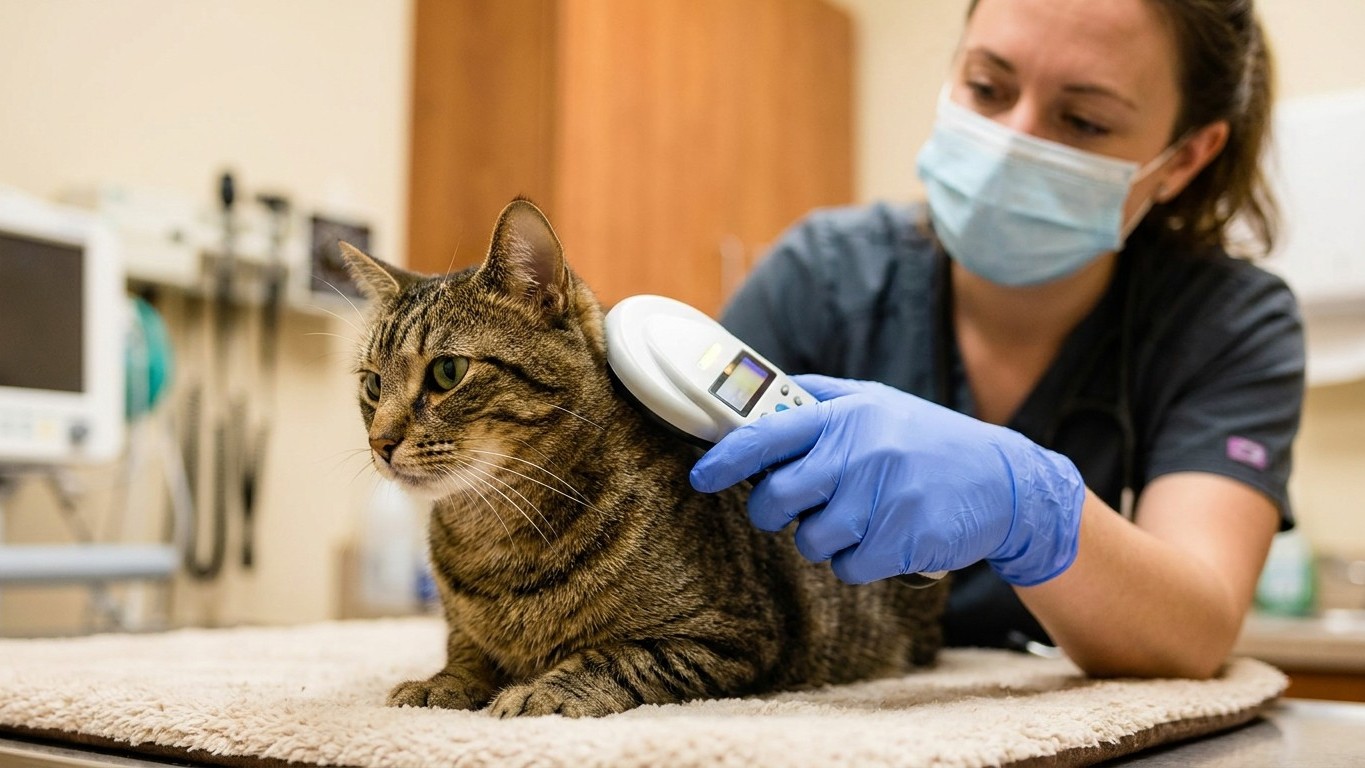
A vet or an RSPCA officer runs a handheld scanner over the back of the neck, the chip beeps back its fifteen-digit number, and that number is checked against a national database. If the registered details are current, the officer has a name and an address within minutes. The RSPCA has been blunt about the one weak link in this system: if an owner moves house or changes their telephone number they must also tell the database they’re registered with, because if the information on that database is old and out-of-date then the chip is useless. In our scenario, someone clearly did update those details, perhaps without thinking it through, and that’s exactly what brought an RSPCA inspector or a concerned vet to a new front door.
It’s worth remembering that a microchip is not a tracking device. Microchips do not have GPS tracking; they provide permanent identification only. Nobody was watching this cat’s movements in real time. The trail was built the old-fashioned way, through a scan, a database query, and a bit of investigative persistence from people whose job is exactly this.
What to actually do if you can’t keep your cat
None of this needed to happen. If a tenancy is ending and a cat can’t come along, contacting a rescue charity before the keys go back changes everything. Organisations like the RSPCA and Cats Protection exist precisely for this situation, and RSPCA guidance for anyone struggling is straightforward: if you’re unable to keep the cat, a local animal rescue charity may be able to help, and you can try contacting your local RSPCA animal centre, Cats Protection or other reputable organisations. It costs nothing to ask, and it spares an animal days of terror behind a locked door.
For anyone currently listing their flat, packing boxes, and privately wondering what to do with a pet in the chaos, the fix takes less time than the panic does. Ring a rescue charity, or ask a friend to foster for a fortnight while things settle. And if your cat is already chipped, log into your provider’s database and check the address sitting behind that fifteen-digit number right now. It’s the detail most owners forget the moment the removal van pulls away, and it’s exactly the detail that decides whether a lost or abandoned cat gets home safely, or ends up as another line in an inspector’s report.
Sources : castlevets.co.uk | mountvets.com