
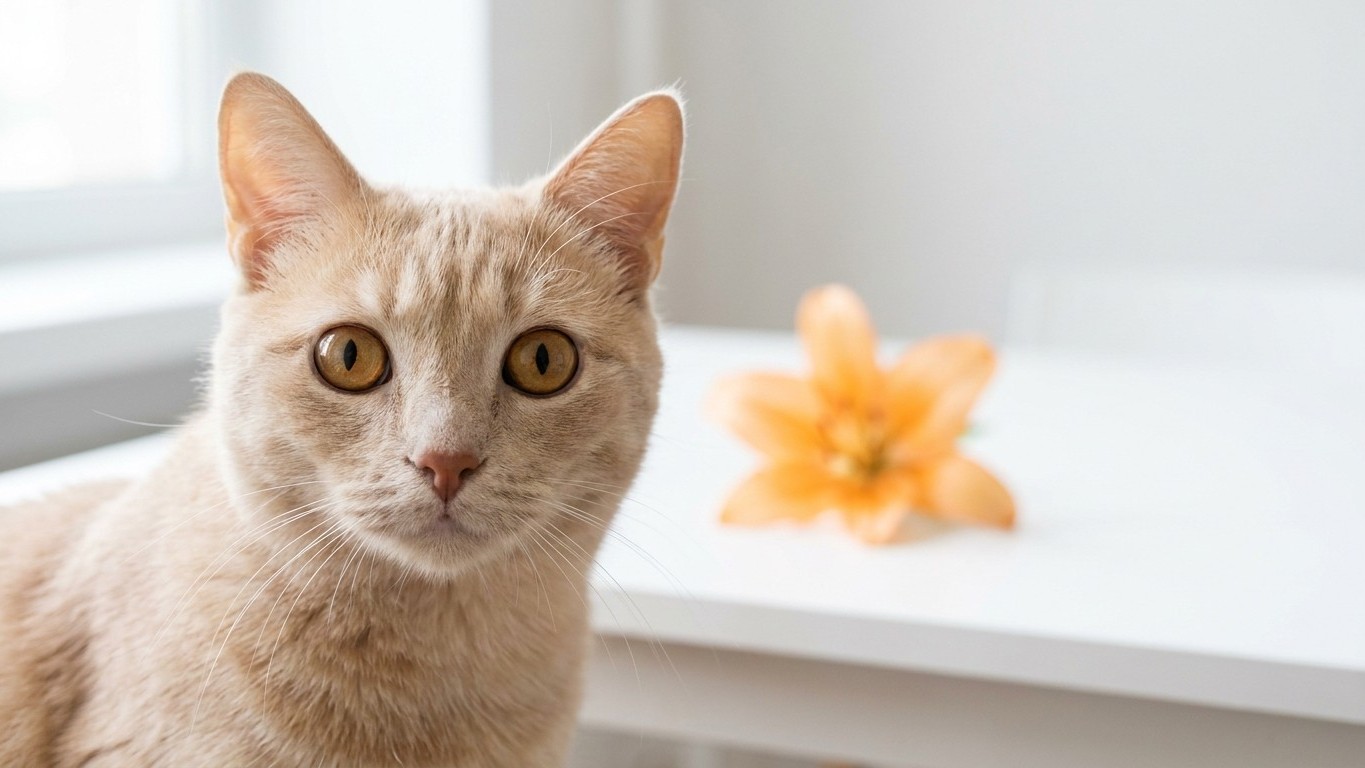
A cat can die from lilies simply by grooming pollen off its own fur, no nibbling required. That single fact catches out thousands of British cat owners every spring, when bouquets stuffed with Stargazer or Oriental lilies land on kitchen tables as gifts for Mother’s Day, Easter or just because they smell wonderful. Vets see the same heartbreaking story on repeat: a much-loved cat, a “pretty” bunch of flowers, and a kidney crisis nobody saw coming.
According to Cats Protection’s most recent CATS Report, over half of all cat owners are not aware that lilies are a danger to their cat. That’s a startling gap in knowledge for a plant that sits in nearly every UK supermarket flower aisle and florist’s window. American research tells a similarly grim story: according to one study, 73% of owners whose cats were exposed to a lily didn’t even realise the plant was toxic to their pets. The flower’s reputation as an elegant, fragrant classic simply hasn’t caught up with the danger it poses to feline kidneys.
Key takeaways
- A cat can die from lilies by simply grooming pollen off its fur—no chewing required
- Early symptoms fade within hours, but kidney damage progresses silently over 24-48 hours
- Treatment must happen within 18 hours or the outcome becomes tragic
Why lilies and cats are such a lethal combination
The specific poison inside true lilies (Lilium species) and day lilies (Hemerocallis species) still hasn’t been pinned down by science, oddly enough. The lily toxin, which only affects cats, has not been identified, though all members of the plant genus Lilium produce a chemical present in all parts of the plant that can damage cat kidneys. Dogs get off comparatively lightly. If dogs ingest lilies, they do not develop kidney failure, although they may have an upset stomach. Cats, uniquely among domestic animals, suffer catastrophic renal tubular damage from exposure that would barely trouble another species.
What makes this genuinely frightening is the sheer minimalism of the exposure required. The entire lily plant is toxic: the stem, leaves, flowers, pollen, and even the water in a vase, and eating just a small amount of a leaf or flower petal, licking a few pollen grains off its fur while grooming, or drinking the water from the vase can be enough to trigger Fatal Kidney Failure. There’s no need for your cat to actually chew the flower. A cat that simply brushes past a vase, picks up a dusting of orange pollen on its whiskers, then washes its face later that evening, has potentially sealed its own fate.
Not every “lily” carries this specific risk, which adds to the public confusion. Calla lilies, peace lilies and lily-of-the-valley are less toxic, as they are from a slightly different plant family. Peace lilies and calla lilies cause mouth irritation from calcium oxalate crystals rather than kidney failure, unpleasant but rarely deadly. Lily-of-the-valley is a different beast entirely: it contains cardiac glycosides that can throw a cat’s heart rhythm into chaos. The true villains, the ones florists should be shouting about, are Easter lilies, Stargazer lilies, Tiger lilies, Asiatic and Oriental hybrids, and ordinary garden day lilies.
Recognising the warning signs before it’s too late
The clinical picture unfolds in a cruelly deceptive rhythm. Early signs appear fast, then seem to fade, lulling owners into false reassurance. The effects of lily toxicity are rapid: within 1-3 hours of ingestion, cats become nauseous leading to a decreased appetite, drooling and vomiting as well as display signs of depression and lethargy, though vomiting is typically self-limiting and resolves within 2-6 hours. Don’t be fooled by that apparent recovery. Within 12-30 hours your cat will develop excessive thirst and urinations as the kidney damage progresses, placing them at risk for severe dehydration, and within 24-48 hours the kidneys may completely shut down.
Timing is everything here, and it’s brutally unforgiving. It is often fatal if treatment is delayed longer than 18 hours after ingestion. That’s not a typo, eighteen hours, roughly the length of one uneasy night’s sleep, can be the difference between a cat that walks out of the vet’s a few days later and one that doesn’t survive at all. If your cat stops producing urine altogether, the prognosis becomes very poor since this signals the kidneys have essentially given up.
This isn’t a hypothetical scare story either. Blue Cross treated a young cat called Simba after she was spotted nibbling the flowers at home before becoming unwell, and a kidney issue was discovered; she was put on a drip and kept on fluids overnight, and happily was well enough to return home the following day. She was lucky. Back in 2017, the RSPCA was called to a Wirral home where two of their cats became ill after ingesting lily pollen; both cats were taken to a vet, however sadly they both died. Same plant, same toxin, wildly different outcomes, purely down to timing and dose.
What to actually do if you have cats and love flowers
There’s no clever workaround here, no “safe amount” of lily to allow indoors. The clearest, simplest advice from British charities is refreshingly blunt. Lilies (Lilium species) and day lilies (Hemerocallis species) are one of the most toxic plants to cats, and all parts of the plant are highly poisonous and can lead to kidney failure. Pollen-free varieties marketed as supposedly cat-friendly don’t solve the problem either, since the stem, leaves and petals remain just as dangerous.
Cats Protection has gone as far as lobbying retailers directly over this, and there’s been some genuine progress worth acknowledging. So far, Morrisons and Marks and Spencer lead the way with clear warnings on their lily labels. If you’re buying flowers for a cat-owning friend or relative this Mother’s Day, check the label, or better still, ask the florist to swap lilies for roses, sunflowers, or gerberas instead.
If exposure has already happened, or you even suspect it might have, don’t wait for symptoms and don’t try home remedies. If you can see the poisonous substance, take your cat away from it and call your vet for advice; they may want to see your cat immediately, and making your cat sick may not be helpful. Bring a photo of the flower or a cutting with you; it genuinely helps vets identify whether you’re dealing with a true lily or a harmless lookalike, and that identification shapes every decision that follows. One final, oddly reassuring detail from recent research: newer studies suggest that for some milder exposures, outpatient fluid therapy at home may work almost as well as overnight hospitalisation, giving owners with tighter budgets or no access to 24-hour vet care a genuine fighting chance to save their cat.
Sources : vethelpdirect.com | topazvet.com