
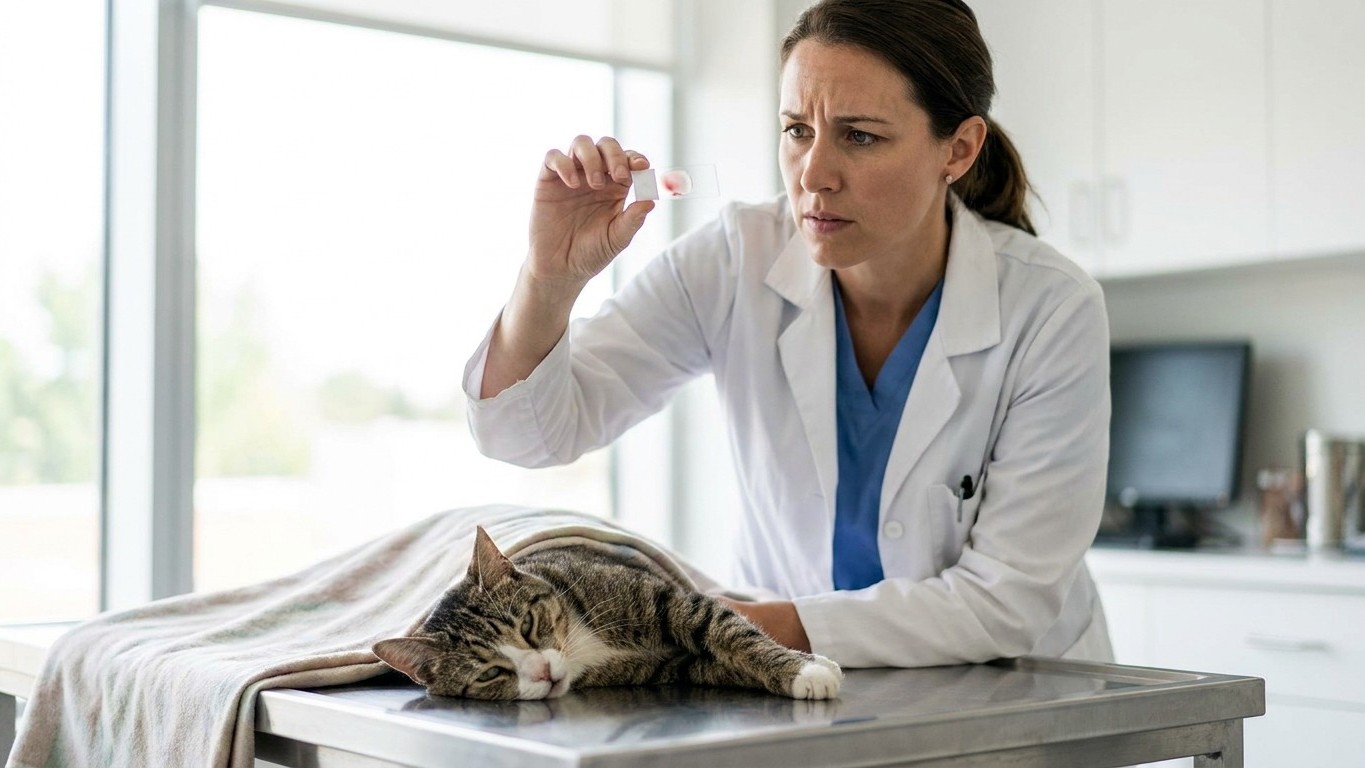
Onion doesn’t just upset a cat’s stomach. It attacks the red blood cells themselves, turning them into fragile, oxidised husks that the spleen then destroys wholesale. That’s precisely what happened to a Yorkshire tabby whose owner shared a few forkfuls of leftover barbecue skewers, marinade and all, only to watch his cat’s health unravel over the following three days. By the time the vet ran a blood smear, the damage was already written across the slide in small, telltale inclusions called Heinz bodies.
Key takeaways
- Onions contain thiosulfates that cause red blood cells to rupture and collapse—and cooking doesn’t eliminate the toxin
- Symptoms don’t appear for 12 hours to 5 days, but irreversible blood damage begins immediately
- A single teaspoon of finely chopped onion is enough to poison an average cat; garlic is 3–5 times worse
What Onion Actually Does to a Cat’s Blood
Onions, along with garlic, leeks, chives and shallots, belong to the Allium family, and every one of them carries organosulfur compounds that cats simply cannot process safely. Onions contain compounds called thiosulfates that are highly toxic to cats because they cause oxidative damage to red blood cells, leading to a condition known as hemolytic anemia. The mechanism is almost mechanical in its cruelty: the compounds in onion can cause the red blood cells circulating through your pet’s body to become very fragile and burst.
Under the microscope, this oxidative stress shows up as Heinz bodies, small clumps of denatured haemoglobin sitting on the edge of the red blood cell membrane. The presence of Heinz bodies marks the cells as abnormal, triggering their removal from circulation by the spleen, leading to accelerated red blood cell destruction and hemolytic anemia. Essentially, the cat’s own immune system starts clearing out its blood supply, mistaking damaged cells for waste. And here’s a detail that surprises most pet owners: cooking, marinating or drying the onion changes nothing. Cooking, drying and processing do not eliminate the toxic effect of Allium species. A barbecue marinade soaked into meat is every bit as dangerous as a raw slice of onion in a salad.
Why the Symptoms Took Three Days to Show
This delay is the cruel twist of onion poisoning, and it’s exactly why so many cases catch owners off guard. Several days after ingestion, clinical signs of acute hemolytic anemia develop, including weakness, pallor, icterus, and collapse. Veterinary toxicologists have pinned down the timeline fairly precisely: the onset time for developing anemia can be as soon as 12 hours after ingestion, but it is typically delayed up to two to five days after the exposure. Even the visible oxidative markers lag behind the real crisis point. Although marked Heinz body formation may be present within a day after onions are ingested, the anemic nadir typically develops several days later.
Early on, the signs are frustratingly vague and easy to dismiss as a dodgy stomach from too-rich barbecue scraps. Initial gastrointestinal symptoms including nausea, drooling, vomiting, and diarrhea may occur soon after ingestion. It’s only once the red blood cell count really starts to crash that the true picture emerges, with breathlessness, lethargy, pale, yellow, or “muddy” colored gums, rapid breathing, and an elevated heart rate signalling that the cat’s tissues are running desperately short of oxygen. Some cats also pass discoloured, tea-coloured urine as haemoglobin from burst cells spills into the bladder, a sign that shouldn’t ever be brushed off as “probably nothing.”
What Happens at the Vets: Diagnosis and Treatment
There’s no clever antidote to reverse onion toxicity, unfortunately. Treatment is entirely about supporting the cat’s body while the crisis runs its course. No specific antidote is available for onion toxicity and the condition is mainly treated with supportive care, so the feline may be hospitalised and administered intravenous fluid therapy, used to flush the body of the toxin and give the body time to stop hemolyzing its red blood cells. In cats presenting with the more severe respiratory distress, oxygen support often features too, alongside close daily monitoring. Daily PCV measurement and blood smear analysis are recommended for five days since the onset of clinical signs can be delayed.
Confirming the diagnosis rests heavily on that blood smear, along with a proper conversation with the owner about what the cat has actually eaten. The presence of Heinz bodies on the edge of a red blood cell, seen microscopically, will indicate oxidative injury, using a diagnostic tool called a blood smear that requires only a small sample of blood. Because several other feline illnesses can also trigger hemolytic anemia, vets don’t rely on the smear alone. Hemolytic anemia is also a clinical sign of several other common feline diseases, so your veterinarian will likely request a biochemistry profile or imaging to complete the differential diagnosis. In genuinely severe cases, where the red cell count has dropped too far, the only option left is a blood transfusion, and sadly some cases still don’t survive despite intensive care.
Barbecue Season Brings More Risks Than Just the Onion
What makes this particular story so instructive is the quantity involved. Onion poisoning doesn’t require a whole bulb; the threshold is remarkably low. The ingestion of 5 g/kg of onions by cats and 15–30 g/kg by dogs is enough to cause clinically important hematologic changes. For an average cat, that works out to roughly one teaspoon of finely chopped onion, well within what a well-marinated skewer might contain. Worse still, cats seem particularly ill-equipped to cope with it. It is believed that cats are more sensitive to the toxins of onions than other animals such as dogs or horses. Garlic, often lurking in the same marinade, compounds the risk considerably: garlic is 3–5 times more toxic than onion.
The other barbecue hazards rarely get mentioned in the same breath as onion toxicity, but they matter just as much. A skewer stick left on a plate is a genuine choking and intestinal perforation risk if a curious cat mouths it while chasing the last bit of meat juice. Fatty, charred meat trimmings can trigger pancreatitis in cats prone to digestive sensitivity, and that heavy dose of salt in many marinades isn’t doing feline kidneys any favours either. My own rule after researching this piece: nothing from the grill goes anywhere near the cat bowl, however much those pleading eyes suggest otherwise. If your cat has got hold of anything containing onion or garlic, even a small amount, ring your vet straight away rather than waiting to see if symptoms appear, because by the time they do, the real damage may already be well underway in the bloodstream.
Sources : link.springer.com | furrycritter.com