
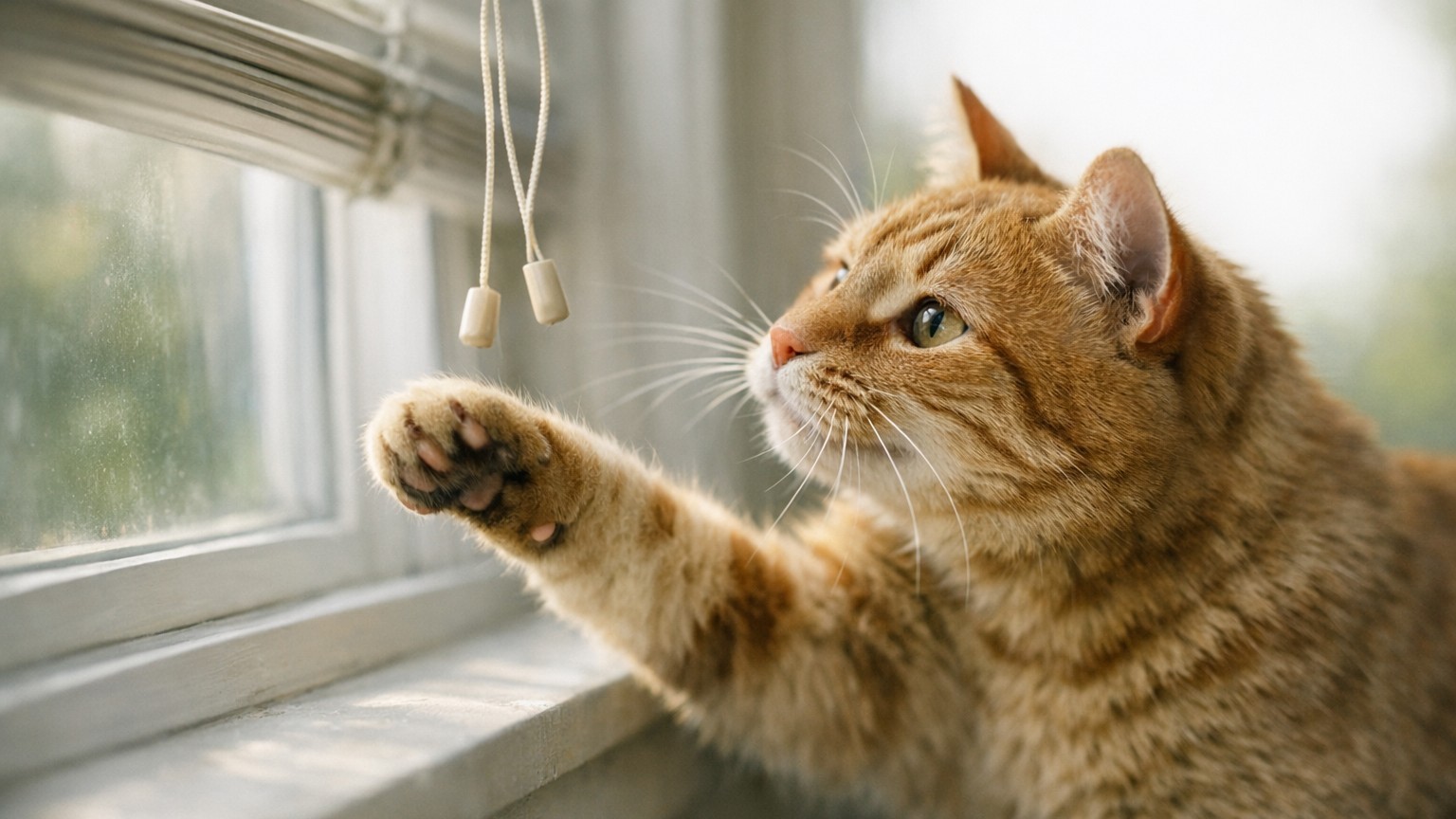
A venetian blind cord hanging loose in June is practically an invitation. Summer heat means windows stay partially open, blinds are half-raised, and the cord dangles and sways in the breeze, a perfect moving target for any cat in the house. What follows, if no one is home or if the room goes unmonitored for just a few minutes, can be catastrophic.
Key takeaways
- A cat can lose consciousness from cord strangulation in as little as two minutes—the time it takes to make tea
- Millions of UK homes still have pre-2014 blinds with dangerous cords that aren’t legally required to have safety devices
- Simple, affordable solutions exist: from cordless blinds to cord tidies and tensioners that could save your pet’s life
A danger hiding in plain sight
Curious dogs and cats may inadvertently have a window-blind cord wrap around their necks and suffer serious and fatal consequences. The horror is not in the cord itself but in the physics of what happens next. At some point, without the immediate help of a third party to untangle a mixed-media puzzle of cat and window blind, a cat can become frantic. The more the cat struggles, the tighter the cords can become. A cord wrapped too tightly around a limb, tail, paw, or toe can cut off circulation, and a cord around a neck can choke a cat.
The timeline is terrifyingly short. A choking cat may have reduced oxygen delivery resulting in cyanosis, a bluish colour of the tongue and gums, and may lose consciousness within two minutes if the airway is completely obstructed. Two minutes. That’s the length of time most of us spend making a cup of tea. Irreversible brain damage may develop after several minutes without oxygen. These are not remote possibilities; they are documented outcomes.
Cats are playful by nature and are attracted to objects that they can bat at, pounce on, or manipulate. Window blinds, especially those with dangling cords or strings, can resemble toys to a cat, encouraging them to interact with them in a playful manner. June specifically raises the risk: blinds are used more actively when people try to block the sun, cords are pulled down further, and cats spend more time at windowsills watching birds and insects outside. The cord that swings gently in a cross-breeze is, from your cat’s point of view, indistinguishable from a toy on a string.
What UK law actually says, and what it doesn’t protect
Previously, blinds companies had only been subject to very limited requirements. However, in February 2014, new UK regulations were introduced following a number of blinds-related fatalities, establishing a new British safety standard for internal blinds: BS EN 13120. Every set of blinds must now comply with these rules, regardless of whether they are in a household with children present.
According to the BS EN 13120 regulations, blinds must have no accessible cords. If they do, they must be fitted with the appropriate child safety devices. For all blinds with pull cords, there must be 150cm between the bottom of the cord and the floor; this is reduced to 60cm if a breakaway device is fitted. Since 2014, all blinds sold in the UK must comply with EU child safety requirements, which remain in place post-Brexit. All new blinds must either be cordless or have built-in safety mechanisms to limit risk.
The catch? Millions of homes still have older blinds bought before 2014. And safety devices, the P-clips, cord cleats, and breakaway connectors that modern blinds carry as standard — mean nothing if they are not used correctly, or if cords are left untethered after adjusting the blind. One supplier of blinds warns that “there is a possibility that over time they [cords] will intertwine and twist therefore forming a loop,” through which “a child or pet may put their head and strangle.” This looping can happen gradually without anyone noticing.
There is also the question of what happens to pets specifically. Over 30 children are known to have died in the UK as a result of becoming entangled with a blind or curtain cord or chain in the last 15 years. Pet fatalities are far less formally recorded, but strangulation and near-strangulation incidents due to window-blind cords are a dangerous reality that is more common than one may realise.
If your cat gets tangled: act immediately
The first rule is staying calm, which is easier said than done when you find your cat writhing in a cord. Panic spreads directly to the animal. If you think your cat is suffocating and they are still conscious, briefly and calmly assess the situation. Your cat may be panicking, which will cause them to struggle more. As difficult as it is, you must try to remain calm to prevent exacerbating your cat’s anxiety.
Check whether there is something stuck around your cat’s head, in their mouth, or around their neck, and if so, try to gently remove the object. Cut the cord if necessary, do not waste time trying to untangle a knot. Once the cat is free, suffocation in cats is a Medical Emergency, and if your cat has lost consciousness or has any other signs of choking or suffocation, take them immediately to an emergency veterinarian. Even a cat that seems fine after a brief entanglement should be checked over. Strangulation can lead to fluid accumulation in the lungs, which is very serious and life-threatening. Internal injury can take hours to declare itself.
If your cat shows signs of pain, breathing difficulty, or is unable to walk normally, contact your vet straight away, as they may need urgent veterinary care. The same applies after any cord entanglement incident, even if your cat appears to have walked away unscathed, please call your vet and describe what happened.
Making your home genuinely safer
The most effective solution is the simplest: remove the cords entirely. The safest blind options for pets and children include cordless cellular shades, aluminium venetian blinds without chains, and motorised roller blinds, which eliminate cord strangulation risks while using non-toxic materials that resist common damage patterns. Motorised blinds, once a luxury, have become genuinely affordable and are now widely available across the UK market.
If replacing your blinds isn’t immediately feasible, the interim measures are not complicated. Tying up the cords on blinds using cord tidies, cleats, or special clips keeps them out of reach. Installing cord cleats to wrap excess cord out of reach, and using cord tensioners to keep looped cords taut and secure against the wall or window frame, are both inexpensive and quick to fit. The problem is not a lack of available solutions. The problem is that most of us simply never think of it until something goes wrong.
One thing worth knowing: a kitten can get their tail caught on a blind cord and end up hanging upside down by the tail. The cries and shrieks from a scared kitten in that situation can haunt you forever. Tails, paws, and limbs are just as vulnerable as necks, any part of a cat that can loop into a dangling cord can become trapped. The cord doesn’t need to be long to cause harm. Even cords that seem short can become hazardous if a cat climbs on furniture to reach them, creating enough slack to form a dangerous loop. A cat sitting on a windowsill with a blind cord at head height is already in the danger zone, whether or not you’re watching.
Sources : burghblindsnshutters.co.uk | gsvs.org