
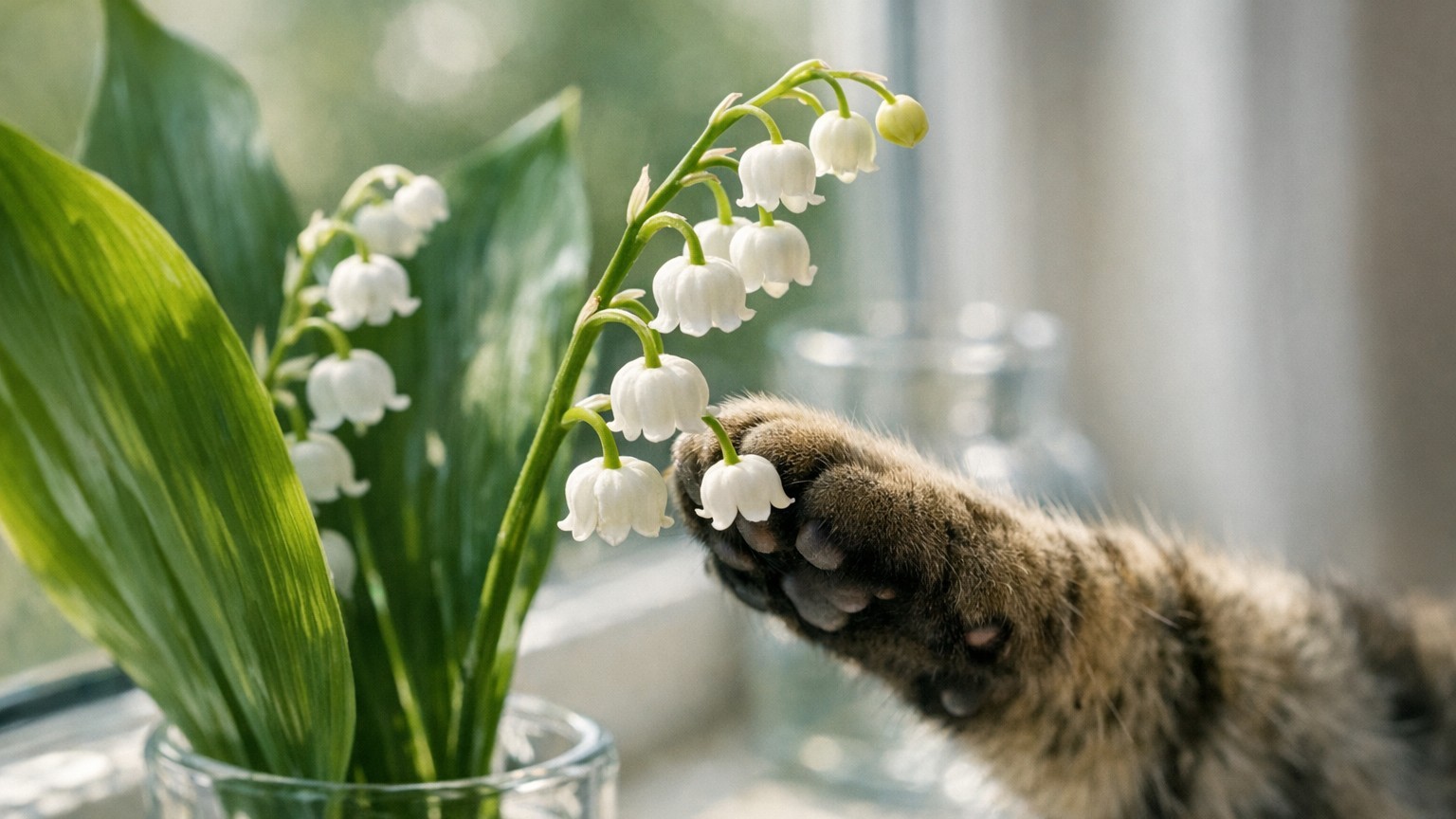
Every May, lily-of-the-valley fills florist buckets and kitchen windowsills across Britain. Those tiny white bells, nodding on their arching stems, carry a scent that somehow smells exactly like spring itself. For years, I brought a fresh bunch home without a second thought. The cat would sniff the vase, occasionally mouth at a stem, and I’d shoo her away absent-mindedly. What I did not know, and genuinely should have, is that this flower is one of the most cardiotoxic plants a cat can encounter, and that the clock starts ticking the moment they take a bite.
Key takeaways
- A common spring flower contains the same cardiac compounds used in human heart medications—but with no safety controls
- Symptoms can appear within 4-12 hours, but a cat may seem to recover before suddenly deteriorating into life-threatening arrhythmia
- Even the water in the vase is toxic; one stem chewed on a windowsill can set a countdown clock that measures time in hours, not days
A plant with a hidden pharmacy inside it
Lily-of-the-valley (Convallaria majalis) is a perennial plant with small bell-shaped white flowers that are beautiful and fragrant. The Latin name sounds gentle enough. The chemistry inside it is anything but. The plant contains 38 different cardenolides (cardiac glycosides) which irritate the gastrointestinal tract as well as disrupt the heart’s normal activity. One of these, convallotoxin, is considered the most potent. To put the danger in context: these compounds are also used in many human heart medications, though in tightly controlled doses. In a cat chewing a raw stem, there is no such control.
What catches many owners off guard is that lily-of-the-valley is not a true lily at all. It isn’t actually a lily, it belongs to the asparagaceae family, which also contains asparagus. The confusion matters because true lilies (such as Easter, Stargazer, or Tiger varieties) are notorious for causing kidney failure in cats, whereas lily-of-the-valley attacks a different organ entirely. Lilies of the genus Convallaria are toxic to the heart and intestines. The mechanism, the symptoms, and the urgency are all different from what most cat owners have been warned about.
All parts of the plant are toxic, including the bulb, roots, stems, leaves, flowers, and berries, with a higher concentration of cardiac glycosides residing in the bulb. And here’s the detail that really matters for anyone who keeps cut flowers indoors: it’s not just the flower that’s toxic, but also the water in which it rests, the leaves and the stem. A cat that doesn’t chew the plant directly but simply drinks from the vase is still at risk.
What happens after ingestion, and how fast
The timeline is what makes this poisoning so frightening. Signs occur within 4 to 12 hours of ingestion and can last for 2 to 5 days. When ingested by pets, Convallaria majalis can cause vomiting, diarrhoea, a drop in heart rate, severe cardiac arrhythmias, and possibly seizures. The problem is that some of those early signs, a cat being quieter than usual, bringing up a small amount of food, can look like an ordinary off day. A cat that seems to recover briefly after initial vomiting may still be in serious danger.
Lily-of-the-valley can cause heart problems when ingested, including irregular heartbeat and low blood pressure, which can lead to seizures or coma. In severe cases, there may be vomiting, arrhythmias, decreased cardiac output, a weak pulse, high potassium levels, and possibly death. This is not a plant that causes a bit of tummy upset. The cardiac involvement puts it in a different category of emergency altogether.
Lily-of-the-valley causes symptoms like those of foxglove (digitalis) poisoning: a drop in heart rate, cardiac arrhythmias, vomiting, diarrhoea, and seizures leading to death. Anyone who knows what digitalis toxicity looks like in humans will understand exactly why vets treat this as an emergency from the moment they hear what the cat has chewed.
What to do if your cat has been near the plant
Speed is everything. It can be fatal within hours if not treated immediately. Do not wait to see if symptoms develop. If you suspect that your cat has eaten any part of a lily or drunk water from a vase containing them, immediately call your veterinarian or a pet poison control centre, as it may be a medical emergency and prompt treatment is critical. Take the plant with you, or at the very least photograph it clearly so the vet can confirm the species. This is not a situation for a “watch and wait” approach over the weekend.
At the clinic, treatment involves decontamination, activated charcoal, and supportive care such as IV fluids and heart monitoring. If signs are severe, Digibind (Digoxin Immune Fab) can be considered for treatment, an antidote that binds the glycosides directly, though it is costly and not always available at every practice. Treatment may include blood pressure monitoring, heart monitoring, and, in severe cases, this expensive antidote. The sooner intervention begins, the better the chances of a good outcome.
Although cats like to eat grass, most are very wary of eating anything unusual, which means plant poisoning cases taken to the vet are rare. That relative rarity is part of why the risk gets underestimated. Cats are cautious, until they aren’t. A young cat, a bored indoor cat, or simply one in the wrong place at the wrong moment will investigate a vase on a windowsill. One bite can be enough.
The safest approach for cat owners this May
Many common plants and flowers found in UK homes and gardens are toxic to cats, including lilies, daffodils, tulips, and crocuses, making spring the most hazardous season of the year for curious cats. Lily-of-the-valley sits at the more dangerous end of that list, specifically because of its cardiac effects. The best way to prevent your cat from being poisoned is simply to not have lilies in your home or garden. That is blunt advice, but it is the right advice.
If you want a May bouquet that won’t put your cat at risk, roses are a good option (avoid pesticide-treated stems), and there are many safer alternatives for your bouquets : Peruvian lilies (genus Alstroemeria) are much safer than true lilies and carry none of the cardiac glycoside risk. Snapdragons and sunflowers are also considered safe for cats. If you are ever unsure about a specific flower variety, your vet or a resource like the Cats Protection plant guide can confirm toxicity before the bunch even comes through the door.
One detail worth knowing, especially if you are worried about a past near-miss: even drying the plant does not render its toxic compounds harmless, when dried, the concentration of cardiac glycosides in lily-of-the-valley is around 0.2 to 0.5%. Old dried arrangements carry the same risk as fresh ones. The fragrance fades; the toxicity does not.
Sources : wagwalking.com | ncbi.nlm.nih.gov