
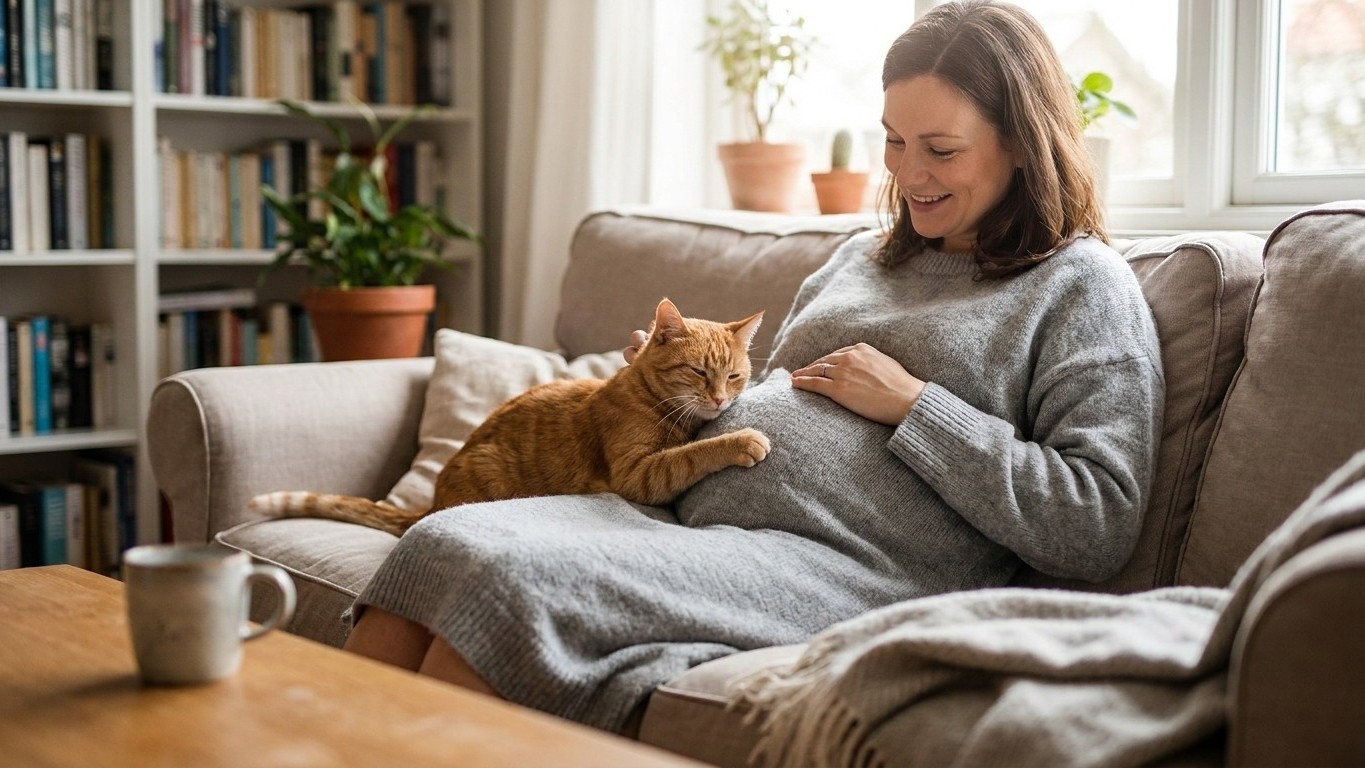
Every pregnant cat owner has a moment of panic when their beloved pet hops onto their bump with those rhythmic, probing paws. The instinct is to push him off. But here is the thing most people get spectacularly wrong: the kneading itself is not the danger. The real risk was lurking somewhere far less obvious, in the litter tray.
Key takeaways
- Your cat’s kneading is a sign of trust and affection, not a threat to your pregnancy
- Toxoplasmosis comes from the litter box, not from your cat’s cuddles or paws on your bump
- Simple precautions like wearing gloves during litter changes eliminate almost all infection risk
Why cats knead in the first place
Kneading begins in kittens as an instinctual behaviour associated with feeding. Kittens knead their mother’s mammary glands to actually draw the milk out. That early experience links kneading with warmth, nourishment, and safety, and even as adults, cats still carry that connection. So when your cat pushes his paws into your soft, warm, pregnant belly, he is not being odd or threatening. He is, in feline terms, paying you the highest possible compliment.
The motion triggers the release of feel-good hormones, mainly dopamine and oxytocin, which explains why kneading cats often look so blissfully peaceful. Cats mainly make biscuits when they feel secure in their environment and relaxed enough to let their guard down, you will often notice kneading paired with purring, slow blinking, a relaxed posture, and half-closed eyes. A cat who kneads you is a cat who trusts you completely. Pushing him away is, from his perspective, a baffling rejection.
Cats also have scent glands in their paws, and when they knead on you or a favourite blanket, they deposit their unique scent. It is a possessive behaviour, but also a deeply affectionate one: your cat is marking you as part of his family. Pregnancy, with all its physical changes, probably just makes you smell like someone very worth claiming.
Can cats actually tell you’re pregnant?
Cats have about 200 million odour-sensitive cells in their noses, compared to our mere 5 million, and there is no scientific evidence yet that they can specifically smell pregnancy. But that does not mean they are oblivious to what is happening. Hormonal changes during pregnancy can alter a woman’s natural scent, sometimes even before she knows she is pregnant. Combined with shifts in body heat and routine, this might help explain why cats become especially attentive.
Your blood volume and circulation increase during pregnancy, which can make your body temperature rise slightly, and cats may notice you are running hotter than usual, which they may actually like, since cats naturally seek out warm, cosy spots. Cats also react to pregnancy because they are creatures of habit; they notice rearranged furniture, new household items, changes in daily routines, unfamiliar smells, and even shifts in their humans’ behaviour. The belly growing, the slower movements, the nesting energy filling the flat — all of it reads as significant change to a species that tracks every tiny fluctuation in its territory.
There is no scientific evidence to support that cats can sense early pregnancy in humans, but the behavioural changes people observe in their cats are likely influenced by changes in body odour, routines, or the behaviour of the pregnant person, rather than detection of pregnancy itself. Whether your cat is responding to your hormones, your warmth, or simply the fact that you have stopped cleaning his litter tray, the result looks remarkably the same: a very attentive cat who wants to be close.
The actual risk, and it is not the kneading
You cannot catch toxoplasmosis just from stroking your cat, and kneading on your belly, for all its vigorous pawing, poses no direct infection risk. The risk of getting toxoplasmosis is extremely low, and with some sensible precautions, you can protect yourself further. The genuinely dangerous part of sharing your home with a cat during pregnancy involves his toilet habits, not his affectionate behaviour.
Toxoplasmosis is an infection caused by the parasite Toxoplasma gondii, which lives mainly in cats but can infect other animals and people. Cats can carry the parasite if they eat infected wildlife; however, it can only be passed on via the cat’s faeces for two weeks after the first infection, and you must swallow the parasite to become infected. That last point bears repeating: swallow. Not cuddle. Not absorb through your bump while your cat does his biscuit-making routine.
Cats do not even present the greatest risk of contracting toxoplasmosis, undercooked meat and unwashed vegetables are a bigger risk. If you get toxoplasmosis while pregnant it can increase the risk of miscarriage and stillbirth, or cause serious health problems for your baby — but the chances of getting it for the first time during pregnancy are small, with around 350 people in England and Wales diagnosed each year. Still, when the stakes involve your baby, small is not nothing.
The precautions are not complicated. Have someone else change the litter tray if possible. If you have to clean it, wear disposable gloves and wash your hands thoroughly with soap and warm water afterwards. Change the litter daily, the parasite does not become infectious until one to five days after it is shed in the faeces. Keeping your cat indoors also significantly reduces his exposure to the parasite in the first place.
There is also a food angle worth knowing: Toxoplasma gondii can be found in raw or undercooked meat, raw eggs, and unpasteurised milk. A pregnant woman who handles raw lamb for Sunday dinner and forgets to wash her hands thoroughly is at greater risk than one whose indoor cat rubs his face on her bump every evening.
Redirecting worry where it belongs
Some cats like to knead or “make biscuits” right on their owner’s bump, and Affectionate biscuit-making is not likely to cause the baby harm. Shooing your cat away every time he tries to knead you achieves little beyond confusing him and rejecting a gesture of genuine feline tenderness. Sensible precautions will protect you from toxoplasmosis during your pregnancy, and getting rid of your cat would be an unnecessary cruelty to both of you.
The image of a cat serenely making biscuits on a pregnant belly has gone viral more than once for good reason, cats kneading their paws on their owner’s bump while the baby kicks back from inside is a scene that resonates with anyone who has been through it. That instinctive, ancient behaviour connecting nursing kittens to their mothers, now redirected at a warm, hormone-rich, growing human belly, is about as tender as cats get. If you are ever unsure about specific health concerns during pregnancy with pets, always check with your midwife or GP — but do not let unfounded anxiety rob you of your cat’s version of a hug.
One final detail that tends to surprise people: once a cat has been infected with toxoplasmosis, they typically acquire immunity and can only rarely get re-infected. It is normally only during a cat’s first exposure to T. gondii that they excrete potentially infectious oocysts. If your cat has been an indoor pet his whole life and has never eaten raw meat or wildlife, the probability of him actively shedding the parasite right now is genuinely very low. The fear was real, but aimed at the wrong end of the cat.
Sources : quora.com | scientificamerican.com